
What Is Robotic Sleeve Gastrectomy?
Sleeve gastrectomy is the most frequently performed weight loss operation in the world, and most of the millions of sleeves done over the past two decades were performed laparoscopically. As robotic surgical systems have entered operating theatres, many patients in Jordan and the wider region ask the same questions: what is the difference between a robotic and a laparoscopic sleeve, is the robot better or safer, and when is it actually needed?
The honest answer is that a robotic sleeve is the same operation, on the same principle, with the same anatomical result. In a sleeve gastrectomy, about 80 to 85 percent of the stomach is removed along its greater curve, leaving a narrow, banana-shaped tube. The smaller stomach fills with less food, and levels of the hunger hormone ghrelin fall, because most of it is produced in the part that is removed.
What changes is the tool. Instead of holding laparoscopic instruments directly, the surgeon sits at a console inside the operating theatre, a few metres from the patient, and moves precise robotic arms that enter the abdomen through small incisions of roughly 8 to 12 mm. The surgeon sees a magnified, high-definition 3D image, and the instruments move on joints that mimic the human wrist, with automatic filtering of hand tremor.
The robot does not work on its own and does not "decide" anything: every movement is the surgeon's hand movement, transmitted precisely. The surgeon's experience in bariatric surgery therefore remains the most important factor in a good outcome, and the robot is a tool that helps the surgeon work with more precision and comfort.
Why robotics matters in bariatric surgery
- Stable 3D vision: the surgeon controls the camera, so the image does not shake or depend on an assistant holding it. Depth perception is better, especially in the upper abdomen near the oesophagus and spleen.
- More flexible instrument movement: wristed robotic instruments rotate at angles that straight laparoscopic instruments cannot reach, which helps in tight spaces.
- Surgeon comfort: a thick abdominal wall makes laparoscopic instruments tiring to move in patients with severe obesity; the robot takes that strain instead of the surgeon's hands and shoulders.
- An advantage in complex cases: a very high BMI, previous abdominal surgery, repair of a hiatal hernia in the same session, or revision after earlier bariatric surgery.
Patients should also see the full picture. Large studies, most notably analyses of the US Metabolic and Bariatric Surgery Accreditation and Quality Improvement Program (MBSAQIP) registry with hundreds of thousands of cases, found that robotic and laparoscopic sleeve results are comparable for weight loss and complications in experienced hands, not consistently better, while the robotic operation usually takes longer and costs more. The robot is an excellent, precise option, but it is not a "different operation" and not an automatic guarantee of a better result.
In Jordan, robotic surgical systems are now available in a number of hospitals and are used in bariatric surgery alongside conventional laparoscopy. Dr. Mohammad Al-Zaitawi was the first surgeon to perform robotic sleeve gastrectomy in Jordan — Robotic Sleeve Gastrectomy (Lap. Assisted). At his center, every case is assessed in full, and each patient is told clearly when the robot adds real value and when laparoscopy gives the same result at a lower cost.
Robotic Surgical Systems: MedBot and da Vinci
A robotic surgical system has three main parts:
- The surgeon console: the surgeon sits at it inside the operating theatre, looks through a viewer that gives a 3D image magnified roughly ten times, and moves the instruments with the fingers through precise hand controls.
- The patient cart: it carries the robotic arms, usually three or four, one holding the camera and the others the instruments.
- The vision tower: it shows the image to the whole team, so the assistant surgeon, anaesthesia team and nurses follow every moment.
An assistant surgeon stays beside the patient throughout the operation, exchanging instruments, helping to introduce the surgical stapler and stepping in immediately when needed. At any moment the operation can be converted to conventional laparoscopy or open surgery if patient safety requires it, although this is rare in experienced centers.
A robotic sleeve usually uses 4 to 5 small incisions. That can be one more than some laparoscopic techniques, because the arms need a certain distance between them so they do not collide. The removed part of the stomach is usually taken out through one of the incisions after slightly enlarging it.
MedBot and da Vinci
The best-known system worldwide is the American da Vinci system, used in millions of operations in general surgery, urology, gynaecology and bariatric surgery. In recent years newer systems from other companies have entered the market, including the MedBot surgical system (such as the Toumai platform), which works on the same principle: an open or closed console with 3D vision, precise wristed arms and tremor-filtering instruments.
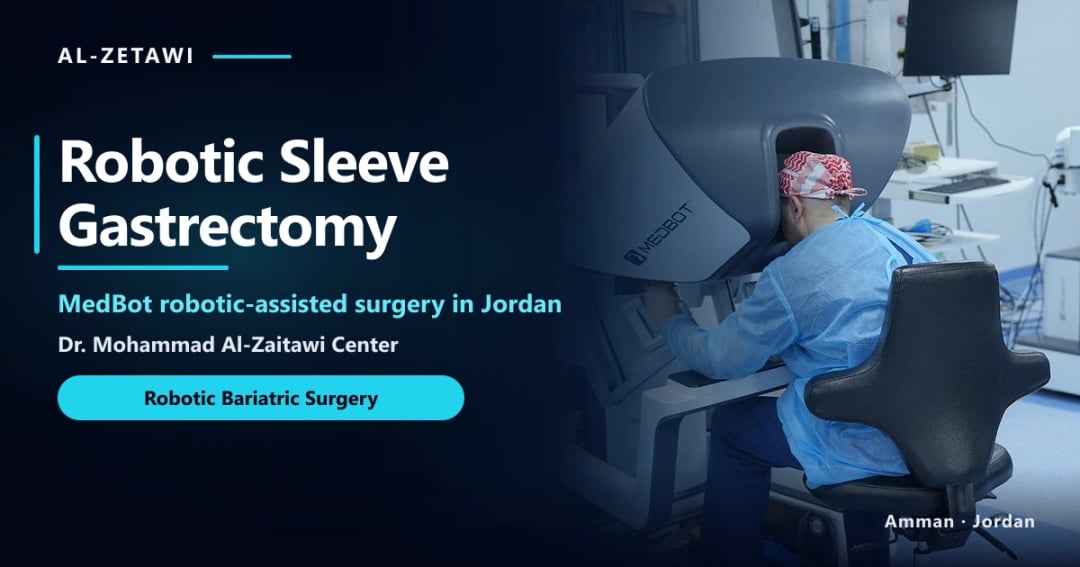
The main image of this page shows Dr. Mohammad Al-Zaitawi at the 3D console of the MedBot system, where the surgeon looks through two eyepieces at a magnified stereoscopic image of the inside of the abdomen and moves the instruments with high precision. For the patient, the name of the system matters far less than whether the surgeon is properly trained on it and the whole team is used to working with it.
Surgeons usually complete structured training before operating robotically on patients, including simulator training, hands-on courses in specialised training centers, and then operations under expert supervision.
A short history of robotic bariatric surgery
The first robot-assisted bariatric operations were performed in the late 1990s and early 2000s, initially in a few academic centers. As systems improved and training spread, the share of robotic bariatric operations in the United States rose sharply over the last decade, until a noticeable proportion of sleeves and gastric bypasses in US quality registries are now performed robotically.
In the Arab region, robotic surgery spread first in major hospitals, including hospitals in Jordan, starting with urology and gynaecology and then general and bariatric surgery. With new systems entering the market, costs are expected to fall gradually and access to grow.
What Happens to the Stomach, and What Robotic Precision Means
A common misconception is that a sleeve relies on "stitching" the stomach or on a connection between the stomach and the intestine. In fact, a sleeve involves no connection between organs at all, which is one reason it is relatively simpler than a gastric bypass. What actually happens is:
- The small blood vessels and ligaments along the greater curve of the stomach are divided.
- A calibration tube (bougie) is passed through the mouth into the stomach to set the diameter of the remaining tube, so it is neither too narrow nor uselessly wide.
- The stomach is cut and sealed in the same step with a surgical stapler, which places rows of fine staples and cuts between them.
- The staple line is sometimes reinforced with extra sutures or buttressing material, depending on the surgeon's technique.
The most sensitive area is the top of the staple line, near the junction of the stomach and oesophagus, where most of the rare leaks occur. Here, 3D vision and fine control help to keep a safe distance from the oesophagus and to make sure the remaining tube is straight, without twisting or narrowing.
What precision means in practice
- Bleeding control: careful division of the short vessels between the stomach and spleen reduces bleeding during and after surgery.
- Avoiding narrowing and twisting: a straight sleeve of even diameter reduces swallowing problems, vomiting and reflux later.
- Protecting the top of the staple line: keeping a safe distance from the oesophagus reduces the risk of a leak.
- Hiatal hernia repair: if a hiatal hernia is found, it is closed in the same operation. This step needs precise suturing in a tight space, and this is where the robot shows a clear benefit. Closing the hernia matters because it reduces reflux after a sleeve.
Robotic vs Laparoscopic Sleeve: What the Evidence Shows
Many studies have compared robotic and laparoscopic sleeve gastrectomy. The largest are analyses of the US MBSAQIP registry, which collects data on hundreds of thousands of operations from accredited centers. Most of these analyses agree on the following:
- Weight loss is similar with both approaches in the short and medium term.
- Rates of major complications, such as leaks and bleeding, are similar among experienced surgeons, with small differences between studies.
- Operating time is longer with the robot, especially early in the learning curve.
- Cost is higher with the robot because of the equipment, the instruments and theatre time.
- The differences shrink as the team gains robotic experience.
For this reason, international societies do not recommend the robot as a mandatory replacement for laparoscopy in routine sleeve surgery; they regard it as a useful additional tool chosen according to the case and the team's experience. The practical conclusion is that the robot does not replace experience. An experienced laparoscopic surgeon achieves excellent results, and an experienced robotic surgeon achieves the same results with extra advantages in certain cases. The more important question is not "robot or laparoscopy?" but "how many bariatric operations does this team perform each year, and what are its results?"
| Criterion | Robotic sleeve | Laparoscopic sleeve |
|---|---|---|
| Type of operation | Same operation, same anatomical result | Same operation, same anatomical result |
| Vision | Stable 3D image controlled by the surgeon | Usually 2D, with an assistant holding the camera |
| Instrument movement | Wristed, with tremor filtering | Straight, relying directly on hand skill |
| Operating time | Usually longer because of robot set-up | Usually shorter |
| Weight loss | Similar | Similar |
| Complications in experienced hands | Similar in most large studies | Similar in most large studies |
| Cost | Higher | Lower |
| Where it stands out | Very high BMI, previous surgery, hiatal hernia, revision surgery | Most routine first-time cases |
When Does the Robot Add Real Value?
The real difference the robot makes shows in technically difficult cases, not in every case:
- A very high BMI: for example 50 or more, where the abdominal wall is very thick and the liver large, so laparoscopic instruments become tiring to move and less precise.
- Previous abdominal surgery: with adhesions that need careful release.
- A hiatal hernia: which needs precise suturing in a tight space in the upper abdomen.
- Revision surgery: for example converting a sleeve to a bypass because of reflux or weight regain; see revision bariatric surgery.
- Cases that need a lot of hand suturing: such as reinforcing the staple line with sutures.
In a routine first-time case, in a patient with a moderate BMI and no previous surgery, conventional laparoscopy in the hands of an experienced surgeon usually gives the same result at a lower cost.
A message from Dr. Mohammad Al-Zaitawi
Many patients ask me: is the robot better? My answer is always honest. The robot is an excellent tool that gives the surgeon a clearer view and more precise movement, and I use it especially in complex cases, hiatal hernias and revision surgery. But it does not create the result on its own. The result comes from choosing the right operation, the experience of the team and the patient's commitment after surgery. That is why I explain to every patient when the robot adds real value to their case, and when laparoscopy gives the same result at a lower cost.
Who Is a Candidate for Robotic Sleeve Gastrectomy?
The criteria for a robotic sleeve are the same as for a laparoscopic sleeve, because it is the same operation. In 2022 the American Society for Metabolic and Bariatric Surgery (ASMBS) and the International Federation for the Surgery of Obesity and Metabolic Disorders (IFSO) published updated guidance that replaced the criteria used since 1991:
- BMI of 35 or more: bariatric surgery is recommended whether or not obesity-related conditions are present.
- BMI of 30 to 34.9 with metabolic disease: such as type 2 diabetes, surgery is an appropriate option, especially when non-surgical treatment has not worked.
- People of Asian descent: lower thresholds apply, and surgery may be discussed from a BMI of 27.5, because obesity-related disease appears at lower weights.
- Age: there is no fixed upper limit; healthy older adults may benefit, and adolescents can be considered with specialist assessment.
BMI is weight in kilograms divided by height in metres squared. For example, a person weighing 110 kg who is 1.70 m tall has a BMI of 110 ÷ (1.70 × 1.70), about 38. You can use the BMI calculator directly.
The right candidate
- Someone who has tried to lose weight with diet, exercise and medical follow-up without a lasting result.
- Someone without a medical condition that rules out general anaesthesia or makes the risk of surgery greater than its benefit.
- Someone who understands that the operation is a powerful tool that needs lifelong dietary and behavioural commitment.
- Someone able to keep up with follow-up, blood tests and supplements after surgery.
When a sleeve may not be the best choice
Another operation, such as a gastric bypass, may be preferred, or surgery may be postponed, in the following situations:
- Severe reflux: a sleeve can worsen reflux in some patients, whereas a gastric bypass usually improves it.
- Barrett's oesophagus: a change in the lining of the oesophagus caused by chronic reflux, usually a reason to prefer a bypass.
- Advanced diabetes treated with insulin for many years: a bypass may improve blood sugar more in some patients.
- Untreated eating disorders: such as severe binge eating, which need psychological treatment before or alongside surgery.
- Untreated alcohol or substance dependence.
- Current pregnancy or pregnancy planned in the near future.
- Unstable heart or lung disease that needs control before any anaesthetic.
Evaluation and Preparation Before Surgery
A thorough assessment decides whether surgery is safe for you, which operation suits you and how to prepare:
- A detailed medical history: previous weight loss attempts, chronic conditions, medications, previous operations and smoking.
- Blood tests: full blood count, liver and kidney function, HbA1c, lipids, thyroid, iron, vitamin D and B12, and clotting.
- An ECG: with a wider cardiac assessment when risk factors are present.
- A chest X-ray: and lung function assessment when needed.
- An abdominal ultrasound: to assess fatty liver and gallstones.
- Upper endoscopy: recommended by many centers before a sleeve to detect reflux, a hiatal hernia, H. pylori or Barrett's oesophagus, because these findings can change the choice of operation.
- Sleep apnoea assessment: very common in obesity, and it may need a breathing device before and after surgery.
- A nutrition consultation: to understand the eating stages after surgery and start changing habits.
- A psychological assessment when needed: to confirm readiness and treat any eating disorder or depression.
Practical preparation in the weeks before surgery
- A pre-operative diet: usually a low-calorie, low-carbohydrate plan for one to two weeks to shrink a fatty liver, so the stomach is easier and safer to reach, robotically or laparoscopically.
- Stopping smoking: at least four weeks before surgery, because smoking raises the risk of leaks, ulcers, clots and breathing complications.
- Adjusting medications: especially diabetes medicines and blood thinners, as instructed by your doctor. Do not stop any medicine on your own.
- Controlling blood sugar: as far as possible before surgery to support healing.
- Daily walking: improves fitness and breathing and eases recovery.
- Arranging time off and a companion: and preparing suitable fluids and protein for the first stage after surgery.
How Robotic Sleeve Gastrectomy Is Performed
The day of surgery and general anaesthesia
Patients are usually admitted on the morning of surgery after fasting for the time set by the anaesthesia team. The anaesthetist reviews the history and test results and explains what will happen, and the operation is performed under full general anaesthesia, so the patient feels nothing. Preventive measures come first: compression stockings or pneumatic leg compression, sometimes with a preventive blood-thinning injection, to prevent clots; a preventive antibiotic before the incision; and safe positioning on the operating table that suits the patient's weight and protects nerves and pressure points.
Step 1: The incisions and docking the robotic arms
The abdomen is inflated with carbon dioxide to create working space, and 4 to 5 small incisions are made in the upper abdomen. The camera goes in first to inspect the abdomen, then the robotic arms are attached to the ports, a step called docking. The liver is gently lifted with a special retractor to expose the stomach. The surgeon then moves to the console inside the room, while the assistant surgeon stays beside the patient to exchange instruments, introduce the stapler and act immediately if needed.
Step 2: Freeing the stomach and checking for a hiatal hernia
The surgeon divides the small blood vessels and ligaments along the greater curve of the stomach, from near the pylorus at the bottom up to the top of the stomach near the spleen and oesophagus. Energy devices seal and divide the vessels at the same time, keeping bleeding to a minimum. The diaphragm around the oesophagus is then checked. If a hernia is found, the part of the stomach that has slid upwards is returned to the abdomen and the opening is closed with fine sutures, an important step to reduce reflux after surgery.
Step 3: Dividing the stomach with the stapler
The anaesthetist passes the calibration tube through the mouth into the stomach, where it lies along the lesser curve. The surgeon starts stapling from below, a few centimetres from the pylorus, and works upwards along the tube to the top of the stomach, leaving a safe distance from the junction with the oesophagus. Here the 3D view helps confirm that the staple line is straight and does not spiral, that the remaining tube has an even diameter without a narrowing in the middle, and that the upper part of the stomach (the fundus) has been almost completely removed, because it stretches the most and produces most of the hunger hormone.
Step 4: Checking the staple line and finishing
The whole staple line is checked for bleeding. Many surgeons perform a leak test, either by injecting coloured fluid or air through a tube in the stomach and watching for any escape, or with an endoscopy during surgery. The staple line may be reinforced with extra sutures according to the surgeon's technique. The removed part of the stomach is taken out through one of the incisions, the robot is undocked, the gas is released and the incisions are closed with small cosmetic sutures. The operation usually takes between one and two hours, and it can take a little longer robotically because of set-up time, or when a hernia or adhesions are present.
Recovery, Warning Signs and Returning to Work
Patients go to the recovery room and then to their ward room; intensive care is rarely needed unless there is heart or lung disease or severe sleep apnoea. Following internationally adopted Enhanced Recovery After Surgery (ERAS) protocols:
- Walking starts on the day of surgery: a few hours afterwards, with help from the nurses, because it is the most important way to prevent clots and improve breathing and bowel movement.
- Small sips of water: usually start the same day or the next morning, depending on the surgeon's protocol.
- Deep breathing exercises: to avoid chest infection.
- Multimodal pain relief: reducing the need for strong painkillers, with anti-sickness medicine.
- Stomach protection: with an acid-reducing medicine, usually continued for several weeks or months.
Warning signs: when to contact the center immediately
Contact the center or go to the emergency department straight away, especially in the first weeks, if you have:
- A high temperature or shivering.
- A persistently fast pulse (more than about 110 beats a minute), an important early sign that can come before other symptoms of a leak.
- Abdominal or left shoulder pain that gets worse instead of better.
- Shortness of breath or chest pain.
- Swelling and pain in one leg.
- Persistent vomiting or being unable to drink fluids.
- Vomiting blood or black stools.
- Marked redness or pus from the incisions.
Practical tip: the three most important things in the first weeks are to sip fluids frequently even if you are not thirsty, to put protein before anything else, and to watch your pulse and temperature. A persistently fast pulse, fever or increasing pain are signs to call the center right away, not to wait for the next appointment.
Leaving hospital and returning to work
Most patients leave hospital within one to two days, once they tolerate fluids well, their pain is controlled with tablets, they walk easily and their vital signs are stable. They receive written instructions on fluids, medicines, supplements, warning signs and the first follow-up appointment.
- Office work: usually after one to two weeks.
- Physically demanding work: after 4 to 6 weeks.
- Driving: once you can turn and brake without pain and are not on strong painkillers.
- Heavy lifting: postponed for about 4 to 6 weeks to protect the incisions from hernias.
Risks, Complications and Reflux
The sleeve is one of the safest bariatric operations, and the risk of death in experienced centers is very low, under 0.1 percent in large datasets. Every patient still has the right to know the possible complications, whether the operation is robotic or laparoscopic:
- A leak from the staple line: the most serious early complication, occurring in about 1 percent of cases or fewer in experienced centers. It is usually treated endoscopically, with stents or drainage, and rarely with further surgery.
- Bleeding: from the staple line or splenic vessels, in a small proportion of patients, and most stops with observation.
- Narrowing or twisting: causing difficulty swallowing and vomiting, usually treated with endoscopic dilation.
- Venous blood clots: reduced by early walking and preventive medication.
- Reflux: one of the main long-term issues after a sleeve, explained below.
- Vitamin and mineral deficiencies: if supplements and blood tests are not kept up.
- Gallstones: more common with rapid weight loss; a preventive medicine may be prescribed for several months.
- Regaining some weight: happens in a proportion of patients after some years, especially with a return to old habits.
- Temporary hair loss: common between the third and sixth month, and it improves with enough protein and time.
Reflux after a sleeve and how to reduce it
The new stomach is a narrow tube under higher pressure, and the valve between the oesophagus and stomach can be affected. Some patients develop new reflux after surgery, and some who already had it may get worse. In the Finnish SLEEVEPASS trial, oesophagitis at ten years was more common after a sleeve than after a gastric bypass. To reduce the problem:
- Reflux is assessed before surgery with symptoms and endoscopy, and a bypass may be preferred for patients with severe reflux.
- Any hiatal hernia is repaired during the operation.
- The sleeve is made straight, without narrowing or twisting.
- Acid-reducing medicine is continued for as long as the doctor advises.
- Helpful habits are followed: small meals, not lying down straight after eating, and not eating two to three hours before bed.
A follow-up endoscopy a few years after surgery is also advised even without symptoms, because some studies found changes in the lining of the oesophagus in a proportion of patients without clear symptoms. If reflux is severe and does not respond to treatment, the sleeve can be converted to a gastric bypass, a revision operation in which the robot is particularly useful.
Diet Stages, Golden Rules and Supplements
The staged diet protects the staple line while it heals, gets the small stomach used to food, and secures enough protein and fluid. The stages below are approximate, and the team sets the details for each patient:
| Stage | Approximate timing | What it includes |
|---|---|---|
| Clear liquids | The first days | Water, clear broth, light unsweetened herbal drinks, in small frequent sips |
| Full liquids | Until about the end of week two | Low-fat milk, drinking yoghurt, strained soups, protein drinks |
| Puréed food | About weeks three and four | Mashed eggs, cottage cheese, finely minced fish or chicken, puréed vegetables |
| Soft food | About weeks five and six | Tender meat cut small, cooked vegetables, soft fruit |
| Healthy regular food | After about 6 to 8 weeks | A balanced diet in small portions, with protein first at every meal |
Golden rules after a sleeve
- Protein first: usually 60 to 80 grams a day, to protect muscle, reduce hair loss and support healing.
- Fluids between meals, not with them: stop drinking about half an hour before eating, and wait half an hour afterwards.
- Drink 1.5 to 2 litres a day: in frequent sips to avoid dehydration, a common reason for readmission to hospital.
- Eat slowly and chew well: a meal takes 20 to 30 minutes, and you stop at the first feeling of fullness.
- Avoid fizzy drinks, concentrated sugars and fried food: especially in the first months.
- Avoid grazing throughout the day: one of the main causes of weight regain.
Supplements and regular blood tests
Even with healthy eating, portions after a sleeve are small and absorption of some nutrients can be affected, so international guidelines recommend permanent supplements, with doses set by your doctor:
- A daily multivitamin designed for bariatric patients.
- Vitamin B12, under the tongue or by injection according to blood tests.
- Calcium with vitamin D.
- Iron, especially for women of childbearing age.
- A preventive medicine for gallstones for several months in some patients.
Blood tests are usually done at 3, 6 and 12 months and then once a year for life, including blood count, iron, B12, vitamin D, calcium, and liver and kidney function.
Expected Weight Loss and Health Improvements
Results after a robotic or laparoscopic sleeve are similar in large studies:
- Weight loss: about 60 to 70 percent of excess weight, or about 25 to 30 percent of total body weight, over the first one to two years, with the fastest loss in the first six months.
- Type 2 diabetes: improves in most patients, and many achieve full remission, especially when diabetes is of short duration and the patient has not depended on insulin for a long time.
- Blood pressure and blood lipids: improve in most patients, and many reduce or stop their medicines under medical supervision.
- Sleep apnoea: improves clearly with weight loss.
- Fatty liver, joint pain and fertility: often improve.
These results are not the same for everyone; they depend on starting weight, age, dietary commitment, physical activity and follow-up.
Exercise, Lifestyle and Pregnancy After a Sleeve
Regular physical activity protects muscle and helps keep the new weight stable:
- The first two weeks: daily walking that increases gradually.
- After 4 to 6 weeks: lighter and then harder exercise can start, with abdominal and weight training after the surgeon agrees.
- Long term: the aim is at least 150 minutes a week of moderate activity, with resistance training two or three times a week to maintain muscle.
- Psychological support: rapid body change and a changing relationship with food may need support, and support groups and psychological follow-up improve commitment.
At Dr. Mohammad Al-Zaitawi's center, the follow-up plan is built on this basis: surgical follow-up, a staged nutrition plan, a schedule of supplements and blood tests, and continuing lifestyle guidance, so that the operation is the start of lasting change rather than a temporary fix.
Pregnancy after a sleeve
Fertility often improves after a sleeve: as weight falls, periods and ovulation become regular in many women, and pregnancy can happen sooner than expected. Effective contraception is therefore advised, and pregnancy should be postponed for 12 to 18 months after surgery until weight is stable and nutrition is complete. When planning a pregnancy, vitamins and blood tests are reviewed with the doctor, especially folic acid, iron, vitamin D and B12, and the pregnancy is followed by a doctor who knows about the bariatric operation.
Cost and Medical Travel to Jordan
A robotic sleeve costs more than a laparoscopic sleeve for clear reasons: the price and maintenance of robotic systems, special limited-use instruments, extra operating theatre time and special team training. The final price depends on the hospital, the type of room, any associated conditions and what the package includes in tests, follow-up and supplements.
Before booking, ask clearly: what is the price difference between robotic and laparoscopic surgery in my case, and what extra benefit will I get for that difference? For package details, see cost and packages.
Jordan as a medical travel destination for bariatric surgery
- Surgeons with international training and fellowships, many of whom follow the guidelines of international bariatric surgery societies.
- Private and university hospitals equipped with modern laparoscopic systems, some with robotic surgical systems.
- Lower costs than many European and Gulf countries, with a high quality of care.
- Easy communication in Arabic and English, and geographic and cultural closeness for patients from the region.
Patients travelling from outside Jordan are usually advised to stay about 5 to 7 days after surgery before flying, to confirm that they tolerate fluids and have no early signs of complications. Follow-up continues remotely after returning home by phone and WhatsApp, with regular blood tests that can be done in the patient's own country. See international patients for travel planning.
How to Choose the Right Center in Jordan
Before booking with any center, ask these questions clearly and expect answers with numbers and details:
- How many bariatric operations does the team perform each year? Accumulated experience is the biggest factor in reducing complications.
- Is the robot really available for your case? In which hospital, and what is the surgeon's robotic experience specifically?
- Why is the robot being suggested to you? Does your case have a particular advantage, or is it an optional extra?
- Is there a multidisciplinary team? A dietitian, an internal medicine or endocrine physician, and psychological support when needed.
- What is the plan for complications? Is the hospital equipped with intensive care, endoscopy and interventional radiology?
- What does follow-up include after surgery? How long does it last, and does it include blood tests and supplements?
- What does the price include? Tests, stay, anaesthesia and follow-up, or the operation only?
A good center answers these questions with clear numbers and details rather than general marketing phrases.
Myths and the Future of Robotic Surgery
Common myths about robotic surgery
- "The robot performs the operation by itself": not true. The surgeon controls every movement, and the robot does not move without the surgeon's hand.
- "A robotic sleeve is a different operation": not true. It is the same operation with the same anatomical result.
- "Robot means no complications": not true. Complications are possible with any approach, and their rate depends more on experience than on the tool.
- "Robot means more weight loss": not true. Weight loss depends on the operation and on commitment, not on the tool.
- "After a robotic operation I do not need follow-up": not true. Lifelong nutrition follow-up and vitamins are essential, exactly as after laparoscopy.
The future of robotic bariatric surgery
Newer systems are moving towards smaller arms, more comfortable open consoles, advanced imaging such as fluorescent dye that shows tissue blood supply, and smart instruments that measure grip force. Remote surgery and artificial intelligence tools to assist surgeons and train doctors are also developing. As new companies enter the market, costs are expected to fall gradually, making the robot available to more patients. The principle will stay the same: the tool serves the surgeon, and experience, correct assessment and follow-up are the foundation of success.
Robotic Sleeve at Dr. Mohammad Al-Zaitawi's Center
Dr. Mohammad Al-Zaitawi was the first surgeon to perform robotic sleeve gastrectomy in Jordan — Robotic Sleeve Gastrectomy (Lap. Assisted) — and his center specialises in bariatric, laparoscopic and robotic surgery in Jordan. It offers laparoscopic and robotic sleeve gastrectomy, alongside other bariatric operations such as gastric bypass and revision surgery, within a complete care pathway that starts well before the operation and continues for years afterwards.
What sets the center's way of working apart is not the technology alone, but the whole pathway around it:
- Individual assessment before choosing the technique: deciding whether the patient really needs the robot or whether laparoscopy gives the same result, and whether a sleeve is the right operation at all, or a gastric bypass or mini gastric bypass is better because of severe reflux or advanced diabetes, for example.
- A clear explanation of expectations: how much weight the patient can expect to lose, the real risks, and how their relationship with food will change.
- Organised medical preparation: heart, lung, endocrine and blood sugar checks, medication adjustment, and sleep apnoea assessment when needed.
- Nutrition follow-up after surgery: a staged eating plan, a schedule of supplements and vitamins, and regular blood tests.
- Continuing support: follow-up through the first year and beyond, because the long-term success of a sleeve depends on habits as much as on the operation.
Start with a free consultation
If you are considering a robotic or laparoscopic sleeve, you can start with a free consultation with Dr. Mohammad Al-Zaitawi's center on WhatsApp at +962 79 570 2800, or through the free case review. Your case, BMI and any associated conditions will be discussed, and you will learn the most suitable option and the next steps of assessment before making any decision.
FAQ
What is robotic sleeve gastrectomy?
Who performed the first robotic sleeve gastrectomy in Jordan?
Is the robot better than laparoscopy for a sleeve?
Does the robot perform the operation by itself?
How long does a robotic sleeve take?
How many incisions does a robotic sleeve need?
How many days will I stay in hospital?
Is recovery faster after a robotic sleeve than after laparoscopy?
When can I return to work?
Is there less pain after a robotic sleeve?
How much weight will I lose after a robotic sleeve?
Who is a candidate for a robotic sleeve?
Who benefits most from the robot?
What are the risks of a robotic sleeve?
Can a sleeve cause reflux?
Why does a robotic sleeve cost more?
Is robotic surgery available in Jordan?
What is the MedBot system?
What will I eat after a robotic sleeve?
Will I need vitamins after surgery?
When can I get pregnant after a sleeve?
What are the warning signs after surgery?
Can weight come back after a sleeve?
How long should I stay in Jordan if I travel from abroad?
How do I choose the right center?
How do I book a consultation with Dr. Mohammad Al-Zaitawi's center?
Conclusion
A robotic sleeve gastrectomy is the same proven sleeve, performed with a more precise tool: stable 3D vision, wristed instruments and tremor filtering under the surgeon's full control. In experienced hands its results match laparoscopy, it stands out in complex cases such as a very high BMI, a hiatal hernia or revision surgery, and it takes longer and costs more. What matters most is the experience of the surgeon and team, choosing the right operation for you, and lifelong follow-up.
Your next steps
- Calculate your BMI and gather your medical history and current medications.
- Request a free consultation for a review of your case.
- Ask whether the robot adds real value in your case, and what the price difference is.
- Plan your stay in Jordan and your follow-up after you return home.
This guide is for general health education and does not replace individual medical advice. The final treatment decision is based on your history, examination and tests. If you have severe or sudden symptoms, go to the emergency department immediately.
Medical note from Dr. Mohammad Al-Zaitawi
Since I performed Jordan's first robotic sleeve gastrectomy, patients often ask me whether the robot is better. The robot is an excellent tool that gives a clearer view and more precise movement, and I use it especially in complex cases, hiatal hernias and revision surgery. But the result comes from choosing the right operation, the experience of the team and the patient's commitment after surgery, so I explain to every patient when the robot adds real value and when laparoscopy gives the same result at a lower cost.
Related articles and success stories
Helpful links for patients comparing treatment options and planning their journey.
Scientific references and guidance
These sources support the medical information on this page. If you want this guidance applied to your own case, send us your details for an initial review.
Reviewed by Dr. Mohammad Al-Zaitawi
Prefer a quicker route? Try the free case review or see bariatric surgery costs in Jordan.