
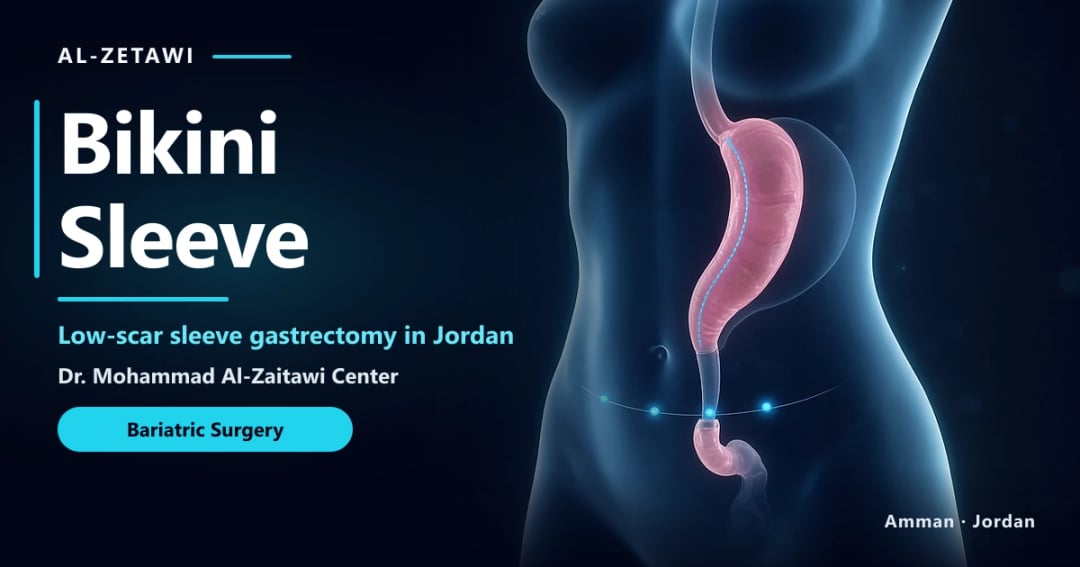
What Is Bikini Sleeve?
Bikini Sleeve is a laparoscopic sleeve gastrectomy in which the small keyhole incisions are planned low on the abdomen, along or below the line usually covered by underwear or swimwear. Inside the body, the operation is the same proven sleeve: about 80 to 85 percent of the stomach is removed, leaving a narrow, banana-shaped tube that limits how much you can eat and reduces hunger hormones. The pylorus, the valve at the outlet of the stomach, is preserved, so food continues to pass through the normal digestive route.
What changes is where the instruments enter. In a standard sleeve, the ports sit across the upper and middle abdomen, where small scars can remain visible in a bikini, a crop top or a low-cut dress. In a Bikini Sleeve, the surgeon positions the ports lower so that, once healed, the marks are easier to hide. This is why the procedure is most often requested by women, and why it is one of the most searched weight loss operations among patients in the United Kingdom and Europe.
Honest expectations: low-scar, not scarless
No keyhole operation is truly scarless. Every incision heals with a mark, and how visible it becomes depends on your skin type, healing, age and weight changes. The goal of Bikini Sleeve is to place those small marks where clothing normally covers them, not to remove them entirely. Any clinic that promises zero scars is overselling the procedure.
Equally important, Bikini Sleeve is not a cosmetic operation. It is a metabolic and bariatric procedure that must first be the right medical choice for you. Incision placement is a secondary refinement, decided only after safety and weight loss goals are addressed.
Watch: Bikini Sleeve explained
From Dr. Mohammad Al-Zaitawi's center: Bikini Sleeve in Jordan, explained on video.
Bikini Sleeve in Jordan: Sleeve Gastrectomy with Bikini-Line Incisions – Dr. Mohammad Al-Zaitawi
A short video from Dr. Mohammad Al-Zaitawi's center in Jordan explaining Bikini Sleeve: a laparoscopic sleeve gastrectomy with the incisions placed in the lower abdominal bikini-line area, aiming to make scars less noticeable beneath underwear or swimwear. The technique is not suitable for every patient, it does not guarantee a scar-free result, and outcomes vary from person to person.
Bikini Sleeve vs Standard Sleeve
Both operations remove the same part of the stomach and produce comparable weight loss. The differences are in the access route and in who is a suitable candidate for low port placement:
| Feature | Standard sleeve gastrectomy | Bikini Sleeve |
|---|---|---|
| Stomach surgery | About 80–85% of the stomach removed, pylorus preserved | Identical |
| Incision position | Upper and mid abdomen | Low abdomen, along or below the bikini line |
| Scar visibility | May show in swimwear or crop tops | Usually covered by underwear or swimwear |
| Expected weight loss | Typically 55–65% of excess weight long term | Comparable when the same sleeve is created |
| Operating time | Around 60 minutes | Around 60 minutes, sometimes slightly longer |
| Hospital stay | 1 to 2 nights | 1 to 2 nights |
| Suitability | Most sleeve candidates | Selected patients, depending on anatomy and body shape |
If you are still deciding between procedures, it can help to compare the sleeve with gastric bypass and mini gastric bypass, which may be better options for severe reflux or advanced type 2 diabetes.
Who Is a Candidate?
Medical criteria
Candidacy for any sleeve, including Bikini Sleeve, is based first on international bariatric guidelines. The 2022 joint guidelines from the American Society for Metabolic and Bariatric Surgery (ASMBS) and the International Federation for the Surgery of Obesity and Metabolic Disorders (IFSO) recommend surgery for:
- Adults with a BMI of 35 kg/m² or higher, with or without obesity-related conditions
- Adults with a BMI of 30 to 34.9 kg/m² who have type 2 diabetes or other metabolic disease
- Adults with a BMI of 30 to 34.9 kg/m² who have not achieved lasting weight loss with non-surgical methods
How this compares with UK (NICE) criteria
If you live in the UK, you may have read the NICE guideline on overweight and obesity management (NG246, 2025). For NHS referral, NICE uses a BMI of 40 kg/m² or more, or 35 to 39.9 kg/m² with a significant health condition that could improve with weight loss, such as type 2 diabetes, high blood pressure or sleep apnoea. NICE advises lowering these thresholds by 2.5 kg/m² for people of South Asian, Chinese, other Asian, Middle Eastern, Black African or African-Caribbean background. These are NHS referral thresholds; private and international programmes generally follow the ASMBS and IFSO criteria above, always after an individual medical assessment.
Who is suitable for low incision placement
Beyond BMI, the surgeon assesses whether the instruments can reach the upper stomach safely from a lower position. Factors that are reviewed include:
- Torso length and the distance between the bikini line and the upper stomach
- Abdominal wall thickness and the distribution of fat
- Liver size, which can be reduced with a short preoperative diet
- Previous abdominal surgery, including caesarean sections, and any adhesions
- Hiatal hernia or significant reflux that may need repair or a different procedure
If a low approach is not safe for your anatomy, the surgeon will recommend a standard sleeve or place one port higher. Your safety always takes priority over scar position.
Medical optimisation before surgery
Conditions such as sleep apnoea, type 2 diabetes, high blood pressure and fatty liver disease are reviewed and controlled before surgery. The team also checks nutritional status, because adequate protein, iron and vitamin levels support wound healing. If deficiencies are found, supplements or diet changes are started before the operation.
Bikini Sleeve for UK Patients
Many women from England, Scotland, Wales and Northern Ireland contact us after long waits for NHS weight management services, or because they prefer to self-fund their treatment privately. Jordan is a short flight from London, and Amman has an established bariatric surgery community serving international patients.
The British Obesity and Metabolic Surgery Society (BOMSS) advises UK residents to be cautious about weight loss surgery abroad and lists specific concerns. We believe you should know them, and know how a responsible programme answers each one:
| BOMSS concern | How we address it |
|---|---|
| Inadequate assessment before surgery | Remote review of your medical history, BMI and investigations before you travel, followed by an in-person consultation and tests in Amman |
| Wrong choice of procedure | Sleeve, bypass and other options are discussed openly; Bikini Sleeve is offered only when it suits your anatomy and health |
| Unknown details of the operation | You receive a written operation note and discharge summary in English to share with your GP |
| Blood clots when flying home | Early walking, compression stockings and blood-thinning injections as prescribed, plus clear advice on when it is safe to fly |
| Lack of follow-up | Structured remote follow-up for at least two years, with dietitian support and blood test reviews |
| No expert access if a problem occurs | Direct contact with the surgical team after you return home, with guidance on when to seek urgent local care |
If you have private bariatric surgery, either abroad or in the UK, routine NHS bariatric follow-up is generally not provided for the first two years. Emergency care remains available through the NHS. Talk to your GP before you travel, and use the NHS treatment abroad checklist to plan your aftercare.
Our UK patient service coordinates your assessment, travel dates and follow-up, and you can read patient stories and patient reviews from international patients who made the same journey.
How the Procedure Is Performed
Bikini Sleeve is performed under general anaesthesia and usually takes about 60 minutes. Dr. Mohammad Al-Zaitawi performs bariatric surgery laparoscopically and robotically, and the approach is chosen for each patient after assessment. Dr. Al-Zaitawi was the first surgeon to perform robotic sleeve gastrectomy in Jordan — Robotic Sleeve Gastrectomy (Lap. Assisted). You can review his credentials and experience before your consultation.
- Small ports are placed low on the abdomen, along or below the bikini line, after careful marking with you standing.
- The abdomen is inflated with carbon dioxide and a camera guides the surgeon.
- The blood vessels along the outer curve of the stomach are sealed and divided.
- A calibration tube is passed into the stomach to set the width of the sleeve.
- The stomach is divided with surgical staplers along the tube, leaving a narrow sleeve and preserving the pylorus.
- The staple line is checked for bleeding and leaks.
- The removed part of the stomach is taken out through one of the low ports, and the incisions are closed with dissolvable stitches.
Because the stomach work is identical to a standard sleeve, the safety principles are the same: precise stapling, a properly calibrated sleeve and careful checking of the staple line. The low port position requires experience with the angles and instrument lengths involved, which is why Bikini Sleeve should be performed by a surgeon with a large sleeve gastrectomy practice.
Recovery, Diet and Scar Care
In hospital
Most patients stay in hospital for 1 to 2 nights. You are encouraged to walk within hours of surgery, which reduces the risk of blood clots and helps the bowel recover. Pain is usually controlled with simple medicines, and many patients find the low ports comfortable when wearing everyday clothing.
Diet stages
| Stage | Typical timing | What you eat |
|---|---|---|
| Clear liquids | First days after surgery | Water, clear broth, sugar-free drinks in small sips |
| Full liquids | About weeks 1 to 2 | Protein shakes, milk, yoghurt drinks, smooth soups |
| Puréed and soft foods | About weeks 3 to 4 | Blended protein, soft eggs, fish and well-cooked vegetables |
| Regular textures | From about week 5 | Small balanced meals, protein first, eaten slowly |
Lifelong vitamin and mineral supplements are needed after any sleeve. Your team will advise on a multivitamin, vitamin B12, vitamin D, calcium and iron as required, with blood tests to check your levels.
Returning to normal life
- Desk-based work: usually after 1 to 2 weeks
- Driving: once you can brake suddenly without pain, usually after about 1 to 2 weeks
- Heavy lifting and intense exercise: usually after 4 to 6 weeks
- Swimming: once the wounds have fully healed, usually after 2 to 3 weeks
Caring for your scars
Keep the incisions clean and dry until they heal. Once the skin has closed, many surgeons recommend silicone gel or sheets to help scars flatten and fade, and sun protection for at least the first year, especially if you plan to wear swimwear in the sun. Scars typically soften and lighten over 6 to 12 months.
Women's Health After Bikini Sleeve
Pregnancy
Pregnancy is generally best postponed for 12 to 18 months after bariatric surgery, until your weight has stabilised and any nutritional deficiencies have been corrected. When you plan a pregnancy, tell your bariatric team and your GP, because supplement doses and monitoring differ during pregnancy. Pregnancy after successful weight loss surgery is associated with lower rates of gestational diabetes and high blood pressure.
Fertility and contraception
Fertility often improves quickly as weight falls, particularly in women with polycystic ovary syndrome (PCOS). This means unplanned pregnancy is a real possibility. UK guidance from the Faculty of Sexual and Reproductive Healthcare advises that oral contraceptive pills may be less reliable after bariatric surgery and recommends non-oral methods such as an implant, injection, coil or hormonal IUS. Women taking the combined pill are usually advised to switch at least 4 weeks before major surgery. Discuss a plan with your GP or sexual health clinic before you travel.
Periods, iron and hair
Women with heavy periods are more prone to iron deficiency after a sleeve, so iron levels are monitored closely. Temporary hair thinning is common between 3 and 6 months after surgery as the body adapts to rapid weight loss; adequate protein, iron and zinc help, and the hair usually recovers.
Body contouring after weight loss
After significant weight loss, some women develop loose skin on the abdomen, arms, thighs or breasts. Body contouring, such as an abdominoplasty, body lift, arm or thigh lift or breast reshaping, is usually considered once your weight has been stable for several months, typically 12 to 18 months after surgery. A staged plan allows each area to be addressed safely. An advantage of Bikini Sleeve is that its low incisions often sit within the area removed or hidden by a later abdominoplasty.
Expected Weight Loss and Health Benefits
Weight loss follows a predictable curve. Most of it happens during the first 12 to 18 months, and many patients lose about 30 to 60 percent of their excess weight in the first year. Over the long term, a loss of around 55 to 65 percent of excess weight is commonly reported, depending on diet, activity and follow-up.
- Improvement or remission of type 2 diabetes and prediabetes
- Lower blood pressure and better cholesterol levels
- Improvement in sleep apnoea and fatty liver disease
- Less joint pain and better mobility
- More regular cycles and improved fertility in many women with PCOS
- Better confidence, energy and quality of life
The results of a Bikini Sleeve depend on the sleeve itself, not on the incision position. Long-term success relies on lasting habits: protein-first meals, eating slowly, regular activity, daily supplements and attending your follow-up reviews.
Safety and Risks
Sleeve gastrectomy is one of the most commonly performed and best-studied bariatric operations, but it is still major surgery. Understanding the risks helps you recognise problems early:
- Bleeding from the staple line or the incisions
- Leak from the staple line, which is uncommon but serious and is investigated with imaging if symptoms arise
- Infection of the wounds or inside the abdomen
- Blood clots in the legs or lungs, reduced with early walking, stockings and preventive injections
- New or worsening reflux (heartburn), which affects some patients after a sleeve
- Narrowing of the sleeve, which can usually be treated with endoscopic dilation
- Nutritional deficiencies if supplements are not taken
- Weight regain if lifestyle changes are not maintained
Contact your surgical team immediately if you develop a fever, a fast heart rate, increasing abdominal or shoulder-tip pain, shortness of breath, persistent vomiting or leg swelling. After returning to the UK, go to your nearest A&E department for any of these symptoms and bring your operation note with you.
If you already have significant reflux before surgery, a gastric bypass may be a better choice, and your surgeon will discuss this during your assessment.
Cost of Bikini Sleeve in Jordan
As a reference, the average cost of sleeve gastrectomy in Jordan is around USD 2,500 (roughly £1,900 at recent exchange rates). Bikini Sleeve is quoted individually after your medical assessment, because the final price depends on the hospital, the length of stay and any additional procedures, such as hiatal hernia repair. For comparison, self-funded sleeve surgery in the UK private sector usually costs several times more.
What a package usually includes
- Surgeon and anaesthesia fees
- Hospital and operating theatre fees
- Preoperative blood tests and investigations
- Hospital stay and standard postoperative care
- Initial diet plan and supplement guidance
- Follow-up reviews after surgery
Possible additional costs to clarify
- Flights, hotel and transfers outside the agreed package
- Additional imaging or specialist consultations
- Extended hospital stay for medical reasons
- Long-term supplements and blood tests at home
Ask for a written outline of what is included and what may be billed separately, so you can compare centres on the same basis rather than on headline price alone. Many UK insurance policies do not cover elective bariatric surgery abroad, so check your policy and consider travel insurance that covers planned medical treatment.
| Factor | Jordan (Amman) | UK private sector |
|---|---|---|
| Typical cost | Lower, around USD 2,500 for a standard sleeve | Usually several times higher |
| Waiting time | Surgery can usually be planned within weeks | Varies by provider |
| Aftercare | Remote follow-up from the surgical team | Local in-person follow-up |
| Travel | About a 5-hour direct flight from London | No international travel |
For a personalised quote, request a free consultation and share your height, weight and medical history.
Travelling from the UK to Amman
Before you travel
- Send your medical history, current medications and any recent blood tests for a remote review
- Discuss your plans with your GP and agree how blood tests will be arranged after you return
- Check Jordan's entry requirements; UK passport holders can usually obtain a visa on arrival or online, but confirm with official sources before booking
- Arrange travel insurance that covers planned medical treatment
- Agree a contraception plan if you take the combined pill
How long to stay
Most international patients plan to stay in Amman for about a week. This allows time for preoperative tests, surgery, a hospital stay of 1 to 2 nights and an in-person review before the flight home. The surgical team confirms when you are fit to fly.
Flying home safely
- Wear compression stockings during the flight
- Walk in the aisle and move your ankles regularly
- Sip water or approved fluids throughout the journey
- Continue any blood-thinning injections exactly as prescribed
- Carry your operation note, discharge summary and supplement plan in your hand luggage
Our international patient team helps with airport transfers, accommodation near the hospital and appointment planning, so your stay is as simple as possible. Dr. Mohammad Al-Zaitawi's center is located in Shmeisani, close to major hospitals in Amman.
Choosing a Bikini Sleeve Surgeon
Choosing the right surgeon matters more than choosing the lowest price. Before booking, check:
- Board certification and specialist training in bariatric surgery
- Membership of recognised bariatric societies such as IFSO
- A large sleeve gastrectomy practice, including experience with low port placement
- Surgery in an accredited hospital with intensive care and emergency endoscopy available
- A written, structured follow-up plan for at least two years
Questions to ask at your consultation
- Am I a good candidate for low incision placement, or is a standard sleeve safer for me?
- How many sleeve operations do you perform each year?
- Which hospital will I be treated in, and how are emergencies managed?
- How do you prevent blood clots, and when will I be safe to fly?
- Who will I contact after I return to the UK, and how quickly will they respond?
- Which supplements and blood tests will I need, and for how long?
- Will I receive an operation note and discharge summary in English?
A good surgeon will answer these questions clearly, explain the alternatives and tell you honestly if Bikini Sleeve is not the right option for you.
FAQ
Is Bikini Sleeve scarless?
Does Bikini Sleeve give the same weight loss as a standard sleeve?
Is Bikini Sleeve suitable for every patient?
Do I qualify if my BMI is below 40?
How much does Bikini Sleeve cost in Jordan?
Is it safe to have weight loss surgery abroad?
How long do I need to stay in Jordan?
What aftercare will I have when I return to the UK?
When can I get pregnant after Bikini Sleeve?
Can I take the contraceptive pill after surgery?
When can I swim or wear a bikini after surgery?
How long is recovery after Bikini Sleeve?
Is Bikini Sleeve reversible?
Conclusion
Bikini Sleeve combines the proven weight loss of a sleeve gastrectomy with incisions planned low enough to be covered by underwear or swimwear. It is not scarless and not suitable for everyone, but in carefully selected patients it offers the same metabolic benefits with a more discreet result. At Dr. Mohammad Al-Zaitawi's center, every plan starts with a thorough assessment, an honest discussion of alternatives and a follow-up programme that continues after you return home.
Your next steps
- Calculate your BMI and gather your medical history and current medications.
- Request a free consultation for a remote review of your suitability.
- Receive a written plan with your recommended procedure, package details and travel timeline.
- Talk to your GP and plan your aftercare before you travel.
This guide is for general information and does not replace individual medical advice. Suitability for Bikini Sleeve is confirmed only after a personal assessment by your surgeon.
Medical note from Dr. Mohammad Al-Zaitawi
The correct procedure should be selected by medical assessment, not by name alone. Safety, anatomy, medical history and long-term follow-up are essential.
What international patients say
Selected patient feedback connected to this procedure.
International Patient
The coordination before travel and the follow-up after surgery were clear and professional.
Related articles and success stories
Helpful links for patients comparing treatment options and planning their journey.
Scientific references and guidance
These sources support the medical information on this page. If you want this guidance applied to your own case, send us your details for an initial review.
Reviewed by Dr. Mohammad Al-Zaitawi
Prefer a quicker route? Try the free case review or see bariatric surgery costs in Jordan.