
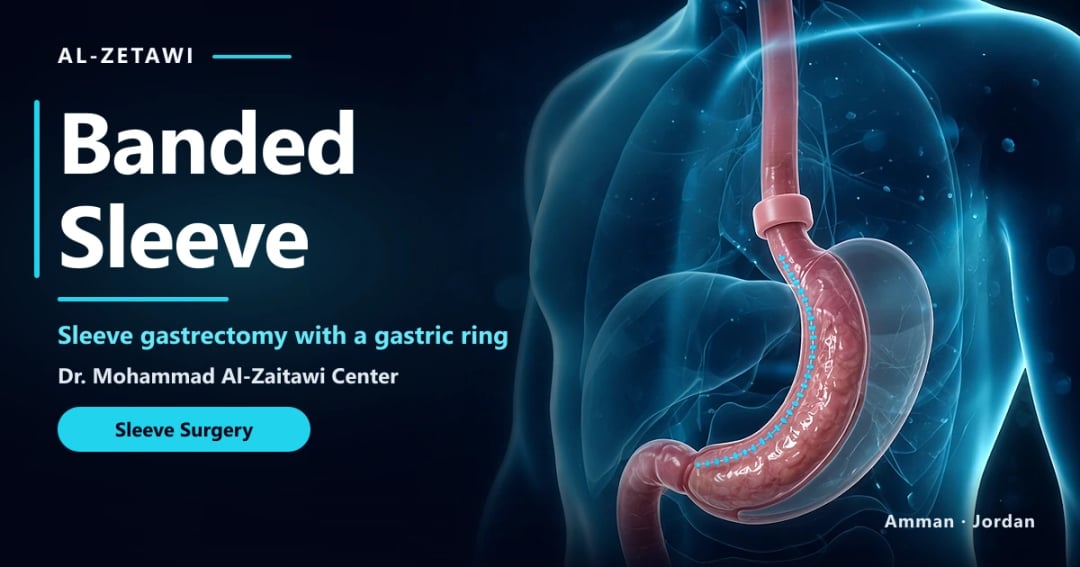
What a Banded Sleeve Is
A banded sleeve is a sleeve gastrectomy with a non-adjustable ring around the upper part of the new stomach. The ring is meant to support the sleeve and limit stretching. It is not a cover on the staple line, and it is not an inflatable band around a whole stomach. It is a selective option, not an automatic upgrade.
A sleeve gastrectomy removes most of the outer curve of the stomach, including the fundus, and leaves a narrower tube. The valve at the outlet, the pylorus, stays. Food still travels the normal intestine. Hunger often falls because the fundus, which produces much of the hormone ghrelin, has been removed, and because a smaller stomach fills sooner. That is the operation with the large evidence base. The band, or ring, is an addition. It circles the upper sleeve a short distance below the join with the oesophagus, and it is secured so that it supports the tube rather than strangling it. The intention is to slow a large swallow and to resist the gradual widening that some sleeves develop over years.
The intention is not a promise. Some people regain weight after a standard sleeve because the sleeve widens, and some regain because they sip calories all day, graze, or return to a pattern no ring can police. A ring can influence the first problem in selected patients. It does almost nothing for the second. Liquid chocolate, alcohol, and ice cream do not need a wide sleeve. Any explanation of a banded sleeve that skips that sentence is incomplete.
Why the name causes confusion
Patients hear reinforced, wrapped, covered, and banded as if they were one upgrade. They are not. Staple-line reinforcement, sometimes called coverage, is a strip of material, a suture oversew, or a sealant applied along the cut edge of the stomach. Its job is to support the staple line and reduce bleeding. It does not circle the sleeve. It does not add a second restriction. You can have a standard sleeve with staple-line coverage and have no ring at all. You can discuss a ring and still have the staple line handled in whatever way the surgeon uses for safety. Ask which words mean which object. If the answer treats them as synonyms, the consent is muddy.
The older adjustable gastric band is a different operation. That band wraps an otherwise intact stomach and is connected to a port under the skin so fluid can be added or removed in clinic. A modern ring used with a sleeve is generally fixed. There is no monthly fill. If the ring is too tight, the remedy is not a simple deflation in the office. It may be nutritional help, a look with a camera, or an operation to remove or reposition the ring. Dr. Mohammad Al-Zaitawi will name the device used in Amman if a banded sleeve is actually being offered. Device names change. The distinction from a staple-line cover and from an inflatable band does not.
Evidence for adding a ring is real and limited. Some series and comparisons suggest less widening and less regain. Others emphasise regurgitation, difficulty with solid food, and ring problems such as slip or erosion into the stomach. International sleeve guidance treats the sleeve itself as a standard metabolic operation. It does not treat a ring as mandatory. A banded sleeve is therefore a discussion for selected people, not a premium version that every sleeve candidate should buy.
Who May Be Considered for a Ring
First you have to be a candidate for a sleeve at all. Current joint guidance from surgical societies supports metabolic surgery for adults with a BMI of 35 or higher, and for adults with a BMI of 30 to 34.9 when type 2 diabetes or another metabolic disease is part of the picture, with individual judgement below older cut-offs when non-surgical care has not held. UK referral thresholds used by NICE are stricter for National Health Service pathways and are lowered for some ethnic groups. Private and international care still begins with health, not with a passport. A ring does not relax those foundations. It is only discussed once a sleeve is a reasonable operation.
Within sleeve candidates, a ring is sometimes discussed with people whose eating is genuinely about large solid portions, who understand they must chew and stop, and who have a particular concern about regain from stretching. It is sometimes discussed in revision settings where a sleeve has widened, which is a more complex operation than a first procedure and not a promise that the ring will restore the original result. It is not a good idea simply because a relative had one, or because a diagram looked tighter.
Who should usually be offered something else
Severe reflux, oesophagitis, a large hiatal hernia that is the main symptom, or Barrett's changes in the oesophagus often point toward a gastric bypass rather than any kind of sleeve. A ring does not treat acid reflux. It can increase regurgitation, which patients experience as food returning, foam, and night-time coughing. Adding a ring to a person who already cannot lie flat is usually the wrong direction. The hernia, if present, needs its own assessment. A small hernia found at surgery is a technical finding. A life organised around antacids is a clinical finding.
People who drink their calories, who graze for hours, or who cannot imagine eating slowly are poor ring candidates. The ring will announce their pattern as vomiting. Vomiting against a ring is not a learning style. It is how food impacts, how the ring slips, and how the stomach is injured. If slow eating feels impossible because of work, a swallowing problem, or a dental problem, fix that reality before you add a narrowing.
Previous ring erosion, active stomach ulcers, inflammatory disease, and an inability to attend follow-up are reasons to refuse. Pregnancy now is a reason to refuse. Planning a pregnancy next month is a reason to wait. The usual advice after bariatric surgery is to delay pregnancy for twelve to eighteen months, and a ring does not shorten that advice. You need nutrition stable, weight changing more slowly, and a maternity team who know the anatomy.
A person who wants the most reliable improvement in severe diabetes may be better served by a bypass. A person who wants the simplest sleeve with the broadest evidence may be better served by a standard sleeve without a ring. Declining the ring is not declining treatment. Dr. Mohammad Al-Zaitawi should be able to recommend a standard sleeve in the same conversation. If every consultation ends in a ring, the selection is not selection.
How the Decision Between Ring, Sleeve, and Bypass Is Made
The decision starts with reflux, hernia, diabetes, eating pattern, previous operations, and your ability to live with a permanent food rule. Endoscopy is often part of the work-up when reflux, pain, or anaemia is in the story, because a sleeve of any kind on an undiagnosed ulcer or Barrett's oesophagus is a bad surprise. A swallow study or other imaging is used when anatomy needs it, not as a ritual. Blood tests look for deficiencies before surgery so you do not start depleted. Sleep apnoea is treated before the anaesthetic if it is significant.
If the stomach is suitable and reflux is not the dominant illness, a standard sleeve is the default explanation. The ring is added to that explanation as an option with a trade. The trade is possible extra control of solid-food stretching versus possible extra regurgitation, food sticking, and a device that can slip or erode and then need removal. You should hear numbers as ranges from published experience, not as a personal guarantee. You should also hear that many excellent results after sleeve gastrectomy happen with no ring at all.
Revision is not the same conversation
Adding a ring during a re-sleeve, or placing a ring on a sleeve that has already stretched, is revision surgery. Scar, a thickened staple line, and a distorted tube raise the risk of leak and of injury. The reason for regain must be hunted first. If the reason is liquid calories and the sleeve is still narrow, a ring is a device aimed at the wrong target. If the sleeve has truly widened and the pattern is volume eating, a ring or a conversion to bypass may both be discussable. Conversion to bypass also addresses reflux, which a ring will not. The more dangerous sentence is we will just add a ring because you regained. Regain is a finding. It is not a diagnosis.
Staple-line coverage is decided as a safety technique for the cut edge. It is not bargained as the ring. You do not choose buttress material from a menu. The surgeon uses the method he trusts to keep the staple line haemostatic and secure. You choose, with advice, whether a ring is added. Keeping those choices apart protects you from paying for a cover and believing you received a band.
Informed consent for a banded sleeve includes the ordinary risks of a sleeve, which are leak, bleed, narrowing, reflux, clots, and nutritional deficiency, plus the ring-specific risks. It includes the eating rules, which are lifelong, not just for the healing month. It includes the possibility that the ring will need to come out and that weight may rise if it does. It includes cost as a quote after assessment, because the device, the hospital stay, and any treatment of a hernia are not one public number.
A decision to stage the idea, to do a standard sleeve and revisit only if widening is later proven, is legitimate. It accepts a possible second operation in exchange for not placing a device you may never need. Some people prefer one operation with a ring. Some prefer the standard operation. Both preferences can be rational. The irrational position is to believe the ring cancels the need for behaviour, follow-up, and supplements.
What the Operation Day Feels Like
You are asleep under a general anaesthetic. The anaesthetist has assessed your airway, your lungs, your sleep apnoea, and your medicines. You will not hear or feel the operation. Monitoring is continuous. The surgery is usually done through small incisions with a camera. An open cut is not the plan. It remains a rare conversion if vision or safety demands it. You should know that conversion exists and is a safety exit, not a failure of keyhole surgery.
Inside, most of the outer stomach is separated and removed so that the remaining stomach is a sleeve. The surgeon shapes that sleeve to a planned width. The exact calibration method is a theatre decision. It is not a measurement you need to shop for, and this page will not give device sizes. The ring is then placed around the upper sleeve and secured so that it cannot spin freely and so that it does not pinch the tube shut. A ring that is too tight causes obstruction. A ring that is unsecured can slip. Placement is a judgement. It is not a decoration.
Checks, waking, and the first walk
The staple line is inspected for bleeding. A leak test may be used according to the surgeon's practice. A drain is not routine in every sleeve and may be used if the surgeon wants one. The removed stomach is taken out through one of the small incisions. The wounds are closed. Local anaesthetic may be placed in the wounds so that waking is kinder. None of these steps is yours to direct. All of them are yours to have explained in outline before you sign.
You wake in recovery with a drip, a sore throat, shoulder-tip ache from the gas used to lift the abdominal wall, and abdominal soreness. Nausea is treated. You are not given a large drink to prove anything. Sips start when the team says they may. Pain that is escalating, a racing heart, a fever, or fainting are not ordinary soreness. They can be bleeding or a leak and they are reported immediately. Early recognition is the safety net of the first night.
Walking starts within hours unless the anaesthetic recovery forbids it. Walking protects the lungs and lowers the chance of clots. You will wear compression and you may receive a clot-prevention injection. The drug and dose are prescribed for you. They are not copied from this page. Breathing exercises are unglamorous and useful. A banded sleeve does not change that early discipline. The ring does not hurt in a separate, magical way on day one. The stomach operation dominates the first days. The ring's personality appears when you start eating solids later.
Most people stay one or two nights. A longer stay follows a fever, a difficult sugar control, persistent vomiting, or any worry about the staple line. Going home requires that you can sip, walk, pass urine, and name the warning signs. A long transfer to a hotel is fine. A long flight is not. International patients should expect to remain in Amman for a period of days after a sleeve of either kind, with the exact clearance given by the surgeon who saw the operation, not by the airline schedule.
Eating With a Ring During Recovery and After
The diet stages after a sleeve apply, and the ring makes the later stages stricter. You begin with clear fluids, then thicker fluids, then purees and soft foods, then small pieces of ordinary food. The timetable is written for you and is usually measured in weeks, not days. The point of the stages is to let the staple line heal and to teach you the volume of the new stomach before you challenge it with bread, meat, and vegetables that must be chewed. Rushing the stages is how people vomit in week three and blame the operation.
When solids begin, the ring shows its character. Bites must be small. Chewing must be patient. You stop at the first comfortable fullness, not at the last possible swallow. A mouthful that is too large reaches the ring and stops. The sensation is pressure, sometimes pain in the chest, and the urge to vomit. The correct response is to stop, to wait, and to sip only as you were taught. The wrong response is to force water to push the food through, or to vomit on purpose. Repeated forcing is how the ring is tested mechanically. It can slip. It can make the lining angry. It is not a party trick.
The foods that still defeat the operation
Minced meat that is dry, white bread, rice that clumps, fibrous pineapple, and poorly chewed steak are classic stickers for a narrowed upper stomach. You will learn your own list. Learning is allowed. Daily vomiting is not a learning method. If a food sticks every time, retire it or change the texture. If everything sticks, including fluids, you need a review. Everything sticking can mean oedema, a twist, a slip, or a ring that is too tight. That is a medical problem, not a motivational one.
Sweet drinks, alcohol, fruit juice, and melted desserts pass a ring that would stop a piece of chicken. They are the main way people regain with a perfect-looking sleeve. Protein comes first at meals because the volume is small and muscle is easy to lose. A dietitian's target, adjusted for your size, is part of the operation. This page will not invent a gram target as if it were universal. It will say that a sleeve plus a ring without a protein plan is a weight-loss accident waiting to become hair loss and fatigue.
Vomiting that is occasional and clearly after a rushed bite is a cue to slow down. Vomiting that is daily, vomiting of fluids, vomiting with pain, or vomiting of blood is a cue to call. Foam and night regurgitation are reflux until proved otherwise. Do not normalise them because a forum said banded sleeves do that. Some regurgitation is a known trade. A lot of regurgitation is a reason to look inside and to ask whether the ring, a hernia, or a twist is responsible.
Supplements are not optional trivia. A sleeve can leave you short of iron, vitamin B12, folate, vitamin D, and calcium over time, especially if intake is poor or if menstrual loss is heavy. Blood tests on a schedule catch this before you are exhausted. The preparation and the dose are prescribed. Do not borrow a friend's bariatric gummies. They may not contain what you are missing, and they may contain sugar you do not need. The ring does not change the need for this follow-up. If anything, a person who struggles to eat solid protein needs the blood tests more.
The rules do not expire when the wounds fade. The ring is still there in year five. A holiday is not a pause. You can eat in restaurants by choosing texture and pace. You cannot eat in restaurants by returning to pre-operative speed. People who accept that keep the benefit. People who fight the ring eventually meet the ring in an endoscopy report.
Recovery at Home and the First Months
The first week is fluids, walking, wounds, and rest. Shoulder-tip pain fades. The small dressings stay on as instructed. Showering starts when you are told. You do not soak in a bath until the skin has sealed. Wounds that become very red, open, or foul are photographed and shown to the team the same day. A little bruising is ordinary. A spreading redness with fever is not.
Energy is low because intake is low. This is expected and it is not treated by forcing solid food early. It is treated by the fluid plan, protein as texture allows, and patience. Dizziness on standing is a reason to check fluid and, if it persists, to be seen. Palpitations, severe weakness, or confusion are not a normal sleeve week. They can be dehydration or something more serious. Call.
Work, driving, and exercise
Desk work often resumes in two to three weeks if energy allows. Physical jobs take longer. Driving waits until you can brake hard and you are not using strong pain relief. Walking is the exercise of the first month. Abdominal strain, heavy lifting, and swimming wait for wound healing and clearance. Muscle matters later, because weight loss without resistance work sacrifices lean tissue. The ring does not forbid exercise. Pain in the chest on exercise that feels cardiac still needs a cardiac response. Weight-loss surgery does not make you immune to heart disease. It often means you had the risk factors.
Mood in month two can dip. Intake is restricted, compliments may start, and temper can be short. Gallstones can form during rapid weight loss and cause their own pain under the right ribs. That pain is not the ring. It is a reason to be examined so that a biliary attack is not blamed on a device. Hair shedding around month three to six is common after rapid loss and usually recovers. It is not a ring allergy.
Follow-up in the first year is frequent enough to catch a stuck diet, a reflux problem, a slipping ring, and a vitamin drift. The exact calendar is set by the clinic and should be written. Missing it because you feel well is how a slow iron deficiency or a slow slip presents late. If you live abroad, the calendar includes blood tests locally and reviews remotely, with a clear rule for when you must be examined in person.
Medicines change. Diabetes tablets and insulin often need rapid reduction as intake falls, under the prescriber, to avoid low sugar. Blood pressure tablets may become too strong. The ring is irrelevant to that arithmetic. The sleeve's effect on intake and, over time, on weight is what changes the doses. Do not adjust insulin from a blog. Do tell the prescriber you have had a sleeve before the first week is out.
By three to six months most people are in a rhythm: small meals, protein first, a vitamin routine, walking, and a weight that is moving. The ring is noticeable only when they rush. If it is noticeable at every meal, the rhythm is wrong or the ring is wrong. That is the moment for a clinical review, not for another month of heroism.
Risks and Warning Signs
Sleeve risks come first because they are the risks of the stomach operation. Bleeding can occur inside the abdomen or at the staple line. A leak from the staple line is uncommon and serious. It may appear as a rising heart rate, fever, shoulder pain, worsening abdominal pain, or a feeling of being suddenly very ill, often in the first days or weeks. Narrowing of the sleeve can cause vomiting of fluids. Reflux can appear or worsen. Clots in the leg or lung are a risk of any major operation and of long flights. Nutritional deficiencies are a late risk of not testing and not supplementing. Death after primary sleeve surgery is rare and is not zero. These risks exist whether or not a ring is added.
Ring risks are additional. The ring can be too tight from the start or become functionally tight when swelling develops, so that even fluids stop. It can slip out of position and kink the sleeve. It can, over time, erode through the stomach wall into the lumen. Erosion may announce itself as pain, bleeding, infection, a loss of the restrictive feeling, or an illness that looks like a late leak. A slipped or eroded ring may need endoscopic or surgical removal. Removal can relieve the problem and can also reduce the restriction you had counted on. Weight can rise afterwards. That possibility belongs in the original consent.
Warning signs you should be able to recite
In the early weeks, call urgently or go to hospital for fever, a heart rate that is racing, worsening pain, fainting, vomiting blood, a swollen calf, chest pain, or breathlessness. Do not manage a suspected leak with a hotel rest day. In the later months, call promptly for vomiting that includes fluids, food that sticks every day, black stool, persistent night-time regurgitation, or pain with meals that is new. A single rushed bite that passes is a lesson. A week of being unable to drink is an obstruction until someone proves otherwise.
Regurgitation that wakes you, cough at night, and new asthma-like symptoms can be reflux, a hernia, or a ring that is causing food to sit. Sleeping with the head up is a comfort and not a cure. An endoscopy decides whether the lining is injured and whether the ring has moved. Barrett's change, if it ever develops, is a surveillance problem. A ring is not a treatment for it.
Ulceration near a staple line or near a ring is more likely if you smoke or if you use anti-inflammatory painkillers regularly. Avoid both unless a prescriber who knows your anatomy has a compelling reason. Tell dentists and emergency doctors that you have a sleeve and a ring before they prescribe. A short course of the wrong painkiller is a common cause of a miserable month.
Pregnancy adds warning signs of its own. You should not conceive in the rapid-loss phase. When you do plan a pregnancy, the obstetric team needs the operation note, the supplement list, and the fact of the ring. Vomiting of pregnancy against a ring can dehydrate you quickly. That is a maternity emergency pathway, not a wait until the nausea of morning is supposed to pass. Contraception after a sleeve should not rely on a method your gynaecologist has not confirmed still suits you. Oral absorption questions are individual. Ask them before you need them.
Psychological risk includes the discovery that a ring is an intolerant teacher. Some people feel punished at every meal and develop fear of eating. That is a reason to review the ring, the diet texture, and your support. Leaving a person afraid of solid food for years is not a successful banded sleeve. Restriction that you can live with is the aim. Restriction that you can only survive by vomiting is a complication.
Alternatives to a Banded Sleeve
A standard sleeve without a ring is the main alternative and, for many people, the better one. You keep the metabolic operation, the fundus removal, and the pylorus. You do not take on slip, erosion, or ring intolerance. You accept that some sleeves widen and that regain is fought with follow-up, food pattern, and, if needed, a later operation based on what actually happened. Staple-line coverage can still be used. It remains a cover, not a quiet ring. If a clinic calls a covered sleeve a banded sleeve, ask to see the word ring in the consent.
Gastric bypass, including the classical and the single-anastomosis variants that a surgeon may discuss, is the alternative when reflux is severe, when diabetes is the dominant disease, or when a sleeve has already failed in a way a ring will not fix. Bypass changes the route of food and has its own deficiencies, dumping in some people, and its own surgical risks. It is not a punishment for wanting a ring. It is a different tool. Hearing about it does not oblige you to have it. Not hearing about it, when you have bad reflux, is the problem.
Medicines, balloons, and no operation yet
Anti-obesity medicines are an alternative to any operation when the indication for surgery is borderline or when you prefer to avoid anatomical change. They require a prescriber and follow-up. This page does not set doses. Medicines can also be discussed later if regain occurs, depending on your health and the evidence at the time. They are not a moral lesser choice. A ring is not a moral greater one.
An endoscopic balloon or a swallowable balloon capsule is a temporary alternative for some people who do not want, or do not yet need, a sleeve. Balloons do not remove the fundus and they come out or pass. They are the wrong comparison if you have severe metabolic disease and you are using a balloon to avoid a decision you have already been told is surgical. They are a fair comparison if your main aim is a reversible experiment in portion size.
Doing a standard sleeve and reserving any ring for a proven future widening is an alternative mindset, already mentioned, and it deserves equal billing. So does a structured non-surgical programme for a person whose BMI and illnesses do not justify the risks of a staple line today. Guidelines have widened surgical indications. They have not abolished judgement. A ring on a person who did not need a sleeve is not a smaller commitment. It is a sleeve plus a device.
Revision options in the future, if a banded sleeve is unsatisfactory, may include ring removal, conversion to bypass, or another procedure suited to the anatomy found. None of those is simple. The best time to hear them is before the first operation, when you can still choose a standard sleeve or a bypass instead. Surprise is a poor anaesthetic.
Life Years After a Banded Sleeve
Years later the scars are pale and the rules are the same. You eat slowly, you keep protein, you take the supplements that blood tests justify, and you treat vomiting as information. Weight settles to a range, not to a single heroic number. A rise of some weight from the lowest point is common after every bariatric operation and is not, by itself, a failed ring. A rise back toward the start, with a diet of liquids and grazing, is a behaviour problem a ring did not solve. A rise with documented widening or with a ring that has eroded is a surgical problem. The follow-up exists to tell those apart.
Reflux is the long symptom to respect. A sleeve can create or reveal it, and a ring can add regurgitation. If you need daily acid tablets, say so. If you wake choking, say so. Endoscopy and, when needed, a conversation about conversion are how severe reflux is treated. Living on high doses of acid medicine and three pillows, while telling yourself the ring is a success because the scale is kind, is a bad trade. The scale is one outcome. The oesophagus is another.
Deficiencies, bone, and pregnancy
Iron deficiency, low B12, and vitamin D deficiency are the quiet long-term harms. They cause fatigue, low mood, poor exercise, and, for vitamin D and calcium balance, bone loss. Women with periods are at higher risk of iron loss. The remedy is testing and replacement prescribed for the result, plus finding a source of bleeding if iron will not hold. A ring that makes red meat impossible means you need another iron strategy, not a lecture to chew harder. Tell the clinic which foods you have abandoned. The abandoned list is clinical data.
Bone health is walking, protein, vitamin D, and not smoking. It is not a special ring issue, and it is not optional after the forties. A DEXA scan is considered on clinical grounds, particularly after larger losses or in postmenopausal women. Ask. Do not assume a normal weight on the scale is a normal skeleton.
Pregnancy after the waiting period is usually successful when nutrition is supervised. The ring needs to be in the maternity notes. Hyperemesis against a ring dehydrates fast. The team may need to admit you for fluids early. The baby is not protected by your reluctance to make a fuss. Breastfeeding continues the need for your own supplements. A depleted mother is not a strategy.
If the ring has to come out years later, life afterwards is a standard sleeve again, plus the recovery of that removal. Some restriction remains because the sleeve remains. Some people feel suddenly able to eat faster and are caught out by regain. Plan the eating rules to continue even if the ring does not. The rules were never only the ring. The ring was a backstop for the rules.
Alcohol hits harder after a sleeve because the stomach that used to begin metabolism is smaller, and because drinks are liquid calories. A ring does not make alcohol safe. Dependency can appear in people who never had it, during the emotional rearrangement of major weight loss. If your drinking is climbing, ask for help early. This is a known post-bariatric risk and it is treatable. Shame is the delay.
Keep the operation note, the device name, and the blood-test schedule in a folder your future doctors can read. Emergency surgery years later, a gallstone, a hernia, or a pregnancy will go better if the anatomist in front of you knows there is a ring. You are the archivist. The clinic in Amman can resend papers. It cannot guess that you have forgotten the word ring when you are in another hospital.
Travelling to Amman for a Banded Sleeve
A banded sleeve is a planned operation with a recovery, not a fly-in procedure. Dr. Mohammad Al-Zaitawi's clinic can review your history, endoscopy, and weight-related illnesses before you travel, and then confirm in person that a sleeve is appropriate and that a ring adds more than it risks. If the in-person findings show severe reflux or a stomach that should not be sleeved, the plan changes. You should want that change. A deposit is not a medical indication.
International patients typically need a stay measured in days to about a week, sometimes longer if sugar, breathing, or nausea is complicated. The exact clearance to fly is given after surgery. Flying in the first days after a staple line, while dehydrated and immobile, raises clot risk and puts you out of reach if a leak declares itself. Walk the cabin when you do fly. Use the clot prevention you were prescribed. Sip on the schedule you were given. Do not order a large meal because the airline has offered one.
Records, cost, and care after you land
Bring medicine lists, sleep-apnoea details, HbA1c or diabetes records, blood pressure treatment, and any endoscopy. Bring a companion if you can. Hotels are for people who are already safe to leave hospital, not for the first night of a leak watch. You will leave with an English operation note that says sleeve gastrectomy and states whether a ring was placed and what kind. That sentence is more important than a brand slogan. Your doctor at home needs the anatomy.
Cost is quoted after assessment. A banded sleeve is not a standard sleeve plus a free idea. The ring is a device with a cost, and the hospital care is the care of a sleeve. A quote should say what is included if the plan changes to a standard sleeve, or to a bypass, because of findings. It should say what a longer stay adds. It is not a guarantee of a kilogram. Anyone selling a kilogram is not selling surgery.
After you go home, follow-up is shared. Blood tests can be done locally and read remotely. Vomiting of fluids, fever, chest pain, or a black stool cannot be cared for remotely. Use local emergency services and tell them you have a sleeve and a ring. Then tell the Amman team so the details are right. Do not board a plane back as your first response to a complication. Distance is not a protocol.
Supplements may be easier to buy at home. Match them to the plan rather than to the local fashion. If a product is unavailable, ask for a substitute before you simply stop. A month without B12 or iron replacement, when you were deficient, is a long month. The ring will not remind you. A calendar will.
Insurance, visas, and time off work are your arrangements. Many insurers treat surgery abroad as a choice and then argue about complications. Read the policy with that sequence in mind. The clinic's job is the operation, the truth about the ring, and a follow-up structure. It is not to make a banded sleeve sound simpler than a sleeve so that the trip feels easy. The trip is manageable. The eating rule is the part that lasts longer than the visa.
Questions to Ask Before You Choose a Ring
Ask whether you are being offered a ring, a staple-line cover, or both, and ask for each in a separate sentence. Ask where the ring will sit and whether it is adjustable. Ask what happens if it is too tight. Ask how slip and erosion present, and how they are treated in this hospital and in your home country. Ask what the eating rules will be in year three, not only in week three.
Ask why a ring is better for you than a standard sleeve. The answer should mention your eating pattern or your anatomy, not a general belief that tighter is modern. Ask why a bypass is not the better reflux operation if you have heartburn. Ask what published experience can and cannot promise about regain. If the answer is that regain will not happen, you are listening to marketing. Regain can happen. The ring is an attempt to reduce one mechanism of it.
Safety, follow-up, and money
Ask how a leak would be recognised and where it would be treated. Ask the fly date range for a person with your medical problems. Ask which vitamins you will need and which blood tests, and who reads them after you leave Jordan. Ask what to tell a maternity unit. Ask what to tell an emergency doctor. These questions are the real consent. The diagram of a ring is only a picture.
Ask what the quote includes if the ring is not placed because the stomach or the reflux finding changes the plan. Ask what removal of the ring later would involve. Ask whether staple-line coverage is already part of the surgeon's sleeve and is not being sold as the band. You are protecting yourself from a vocabulary trick. It is a fair thing to protect yourself from.
Ask about your own reflux, your sweet-drink habit, your ability to chew, and your previous operations until the answers use your chart. A generic banded-sleeve speech that could be given to anyone has not yet become your decision. Dr. Mohammad Al-Zaitawi can make it your decision in Amman by tying the ring, or the refusal of a ring, to your endoscopy, your meals, and your willingness to be followed.
Then ask yourself whether you will eat slowly when nobody is watching. The ring will be watching, in the mechanical sense that it will stop a large bite. It will not stop a litre of calories you can drink. If the second pattern is yours, choose a treatment that does not pretend otherwise. A standard sleeve, a bypass, a medicine, or more time are all more honest than a ring chosen as a talisman. A banded sleeve is for the person who has understood the talisman problem and still has a solid-food reason to add a device. That person is not everyone. The operation is allowed to be uncommon.
Staple-Line Coverage Is Not a Banded Sleeve
This distinction is important enough to stand alone, because it is the main misunderstanding in second opinions. When a stapler divides the stomach, it lays rows of tiny metal staples. Surgeons want that line to be dry and secure. They may reinforce it. Reinforcement can mean a synthetic or biologic strip that is stapled in with the cartridge, a suture run over the line, or a sealant. In conversation this is sometimes called covering the staple line or buttressing it. The material lies along the cut. It does not form a ring around the sleeve. It does not narrow the passage beyond the shape of the sleeve itself. It is not felt years later as a band that stops a large piece of meat. Its purpose is surgical safety at the cut edge, particularly bleeding. It is used, or not used, according to the surgeon's technique and the patient's tissues. It is not the operation you are choosing when you choose a banded sleeve.
A banded sleeve adds a separate circular device around the upper stomach tube after, or as part of, the sleeve construction. That device is the band. It is meant to stay. It can be seen on later endoscopy if it erodes, and it can be named in an operation note as a ring rather than as a staple reinforcement. If your operation note does not mention a ring or a band, you did not have a banded sleeve, even if you paid for a reinforced staple line. If your operation note mentions a ring, you have a device that future doctors must know about, even if the word reinforced was used in the advertisement.
How to read a quote and a consent form
Read the consent for the nouns. Sleeve gastrectomy should be there. If a ring is planned, a ring or band should be there as its own item. Staple-line reinforcement, if it is mentioned, should not be the only item and then described to you verbally as a band. Ask to correct the form before you sign if the words do not match the conversation. This is not pedantry. It is how the wrong follow-up is prevented. A person with a ring who is followed as a plain sleeve may have vomiting dismissed. A person without a ring who believes they have one will not understand why food never catches.
Manufacturers of reinforcement materials and manufacturers of rings are different commercial conversations. This page does not rank brands and does not describe their application technique. Brand choice, when a ring is appropriate, depends on availability in Jordan, the surgeon's experience with that device, and whether the device is fixed or has any adjustability. You should be told the name. You should not be asked to pick a brand from a brochure as if you were choosing a phone. The medical choice is ring or no ring. The technical choice of which approved ring, if yes, sits with the surgeon, explained in one clear sentence.
Friends will say their sleeve was covered and they never vomited, and will advise you that a band is nothing to fear. They may be describing buttress material. Their experience is not evidence about a ring. Other friends will say a band ruined their eating and will mean an old inflatable band with a port, which you are not being offered. Anecdotes from the wrong device are how this decision gets made badly. Use the nouns. Bring them to the consultation. Leave with the same nouns on paper.
In Amman, a banded sleeve with Dr. Mohammad Al-Zaitawi means a sleeve plus a ring, offered only after a standard sleeve and a bypass have been honestly compared, and written so that nobody can confuse it with a staple-line cover. If you do not need the ring, the correct banded sleeve is the one you do not have. The sleeve, if you need it, is still there. The cover, if the surgeon uses one for safety, is still a cover. Language is part of the operation. Get the language right and the surgery that follows is the surgery you think you chose.
Medical note from Dr. Mohammad Al-Zaitawi
I do not add a ring to a sleeve to make the operation sound more complete. A ring is for a selected patient who eats large solid meals and accepts lifelong pace, and it is the wrong tool for bad reflux or for liquid calories. If a cover on the staple line is all that is needed for safety, that cover is not a band, and I will say so in the consent.
Scientific references and guidance
These sources support the medical information on this page. If you want this guidance applied to your own case, send us your details for an initial review.
Reviewed by Dr. Mohammad Al-Zaitawi
Prefer a quicker route? Try the free case review or see bariatric surgery costs in Jordan.