
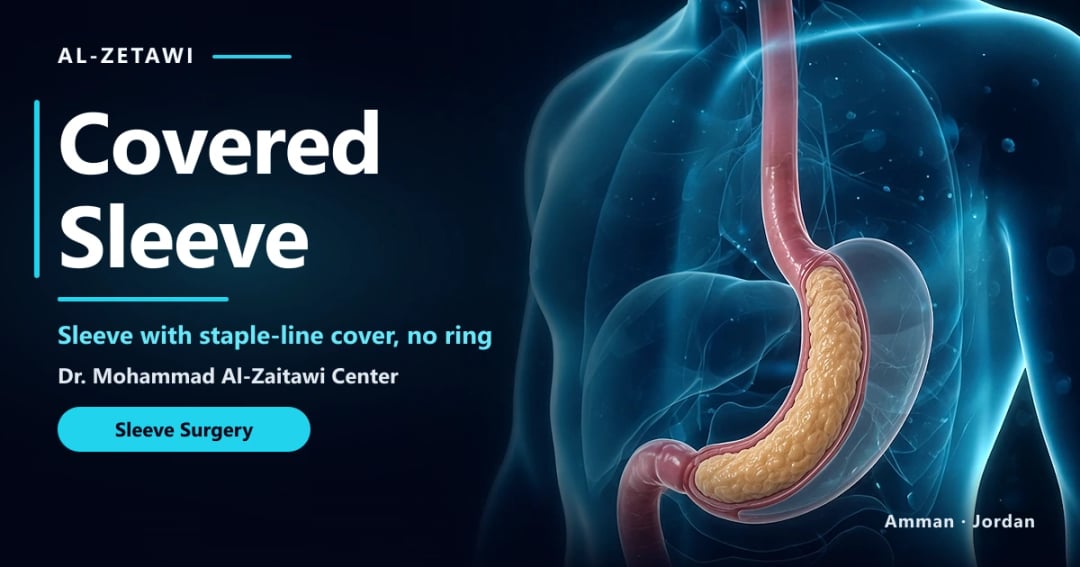
What Is a Covered Sleeve?
A covered sleeve is a sleeve gastrectomy in which the staple line is reinforced or covered, often with a fold of omentum. The stomach is still shaped into a narrow tube and the pylorus is kept. The cover is a safety step along the staple line. It is not a ring and not a different weight-loss operation.
During a sleeve, the surgeon separates the outer curve of the stomach, removes most of that outer portion, and leaves a tubular channel along the inner curve. The new edge is a staple line running from near the oesophagus down toward the pylorus, the muscular outlet that controls emptying into the duodenum. That line is the place where bleeding or a leak would matter most. Covering it means adding a layer after the sleeve exists. The layer may be the patient's own omentum, a running stitch along the join, a buttress carried on the stapler, or a combination chosen for that stomach. The meal-size effect and the change in hunger hormones come from how much stomach remains and from removing the fundus, not from the layer placed on top.
The omentum is tissue, not a device
The omentum is a fatty, vessel-rich apron that hangs from the stomach and transverse colon. In a sleeve it is partly separated so the outer stomach can be removed. An omental cover, sometimes called omentopexy, brings a tongue of that apron back up over the staple line and holds it there with stitches. It is living tissue. It is not a band, a mesh ring, or a balloon. You will not feel a separate object inside you, and there is no port to adjust. Patients sometimes expect a firm ridge or a device card. There is nothing of that sort to carry home, other than the usual operation note describing what was done.
Because the omentum is soft and mobile, the cover does not hold the sleeve at a fixed diameter for the next ten years. If the sleeve stretches, the reason is the sleeve and eating pattern over time, not a failed piece of plastic. That is the central distinction from a banded operation, and it is the reason a covered sleeve should be consented as a sleeve. Adding the word covered to a quotation does not create a new metabolic procedure.
What patients usually notice
Afterward, the sensations are those of a sleeve. Early fullness, a lower interest in large meals, and a need to eat slowly are common. Some people feel cold, tire easily, or have shoulder-tip discomfort from the gas used during keyhole surgery. None of those feelings proves that the omentum was used, and none of them is a reason to poke at wounds or to force food. The cover is invisible on the outside. Your scars are the small port sites of laparoscopic or robotic surgery, placed according to your body wall, previous incisions, and whether a low cosmetic pattern was specifically planned. A covered sleeve is not defined by scar position.
Dr. Mohammad Al-Zaitawi discusses this operation in Amman as one technical version of sleeve gastrectomy. The consultation starts with your weight history, reflux, diabetes, medicines, and what you have already tried. Only then does the staple line enter the conversation. If a cover is not feasible because the omentum is short, scarred, or unsafe to mobilise, a sleeve can still be completed another way, or a different operation can be chosen. The name on this page is a description, not a promise that every patient leaves theatre with omentum stitched in the same pattern.
Why the Staple Line Is Covered
The staple line has two jobs that have to succeed at once. It must be sealed enough that stomach fluid stays inside, and it must be haemostatic enough that the cut edge does not ooze into the abdomen or into the lumen. Staplers are designed for that double task, and in experienced hands the great majority of sleeves heal. Even so, the line is long, the stomach wall is not the same thickness from top to bottom, and the top of the sleeve near the oesophagus is a known weak point in leak reports. Surgeons have therefore tried extra manoeuvres: oversewing, buttress materials, sealants, and omental cover. The shared idea is support. The evidence behind each idea is not equally strong, and honest counselling says so.
Bleeding is the clearer target
Across comparative studies, reinforcing the staple line is more consistently associated with less staple-line bleeding than with a definite fall in leaks. Bleeding can be a slow drop in the blood count or a more obvious event with a fast pulse, dizziness, vomiting of blood, or black stool. A cover or a suture line can tamponade small vessels in the edge. That is a practical reason to do it. It is not exciting for marketing, but it matters at two in the morning on the ward. Reducing bleeding also reduces transfusions, returns to theatre, and the confusion of trying to decide whether a sick patient is bleeding, leaking, or both.
Leak prevention is less settled. Some series suggest fewer leaks when the line is reinforced. Others show no meaningful difference once surgical experience and staple height matched to tissue are taken into account. A leak can still open underneath an omental layer. In that situation the omentum may localise infection into a collection rather than a free spill, which can change how the problem looks, not erase it. Pain, a racing heart, fever, and a feeling of being suddenly unwell remain the signals that bring you back for assessment. A covered line is not a permission slip to ignore those signals because a webpage said the stomach was protected.
What a cover cannot do
A cover cannot compensate for a sleeve that is twisted, too narrow at the middle, or too tight at the outlet of the oesophagus. Those are shape problems. Stitching fat over a poorly shaped tube does not make the tube empty well. A cover also does not tighten the valve between stomach and oesophagus, so it is not a treatment for heartburn. People who already regurgitate food, wake with acid, or have a large hiatal hernia need that problem discussed on its own terms. Sometimes the same anaesthetic can include a hernia repair. Sometimes the better metabolic operation is a bypass, and the cover becomes irrelevant because a sleeve is not being built.
There is a cost in time and in tissue handling. Mobilising omentum and stitching it takes minutes and adds suture material. Rarely, a stitch can catch deeper tissue than intended or contribute to kinking if it is placed under tension. This is why the step belongs to a surgeon who does the operation often enough to know when to stop. In clinic, the useful question is not "Do you always cover?" It is "In a stomach like mine, what do you add, what do you avoid, and what problem are you trying to reduce?" The answer should mention bleeding and technical fit, not a guaranteed leak rate of zero.
Covered Sleeve, Standard Sleeve, and a Ring
Three names are often mixed together in advertisements: standard sleeve, covered sleeve, and banded sleeve. They do not describe the same object. A standard sleeve removes the outer stomach and leaves the staple line as the stapler finished it, sometimes with a suture if the surgeon's routine includes one. A covered sleeve is that same resection plus a deliberate reinforcement or omental layer. A banded sleeve adds a ring or a similar implant around the upper or mid sleeve so that, years later, the tube is less free to dilate. The ring is a foreign body with its own future: food sticking, slippage, erosion into the lumen, and a possible second operation to remove it. If you want a ring, say so. If you want a cover, say so. Agreeing to one while picturing the other is how expectations go wrong.
Weight loss follows the sleeve
Published sleeve series commonly describe loss of a large share of excess weight over the first year or two, with wide scatter and with some regain by five years. Those figures belong to the sleeve as a family of operations. They should not be re-quoted as a special property of omentum. A cover does not remove more fundus, does not bypass intestine, and does not add malabsorption. Someone choosing between a covered sleeve and a standard sleeve is choosing a staple-line detail. Someone choosing between a sleeve and a bypass is choosing a different intestinal route, a different effect on reflux, and a different pattern of vitamin risk. Those are the decisions that change life. The omental stitch is downstream of them.
A band is sometimes offered to people who fear regain. The theory is mechanical: a fixed outlet or a fixed waist in the tube may slow enlargement. Reports are mixed, follow-up is not uniform, and troublesome swallowing is not rare. Erosion can appear years later as pain, infection, or the device becoming visible at endoscopy. None of that is a reason to mock the operation. It is a reason not to let the word covered stand in for it. At consultation in Amman, Dr. Mohammad Al-Zaitawi separates these options in writing so the consent form and the operation note use the same language you heard in the room.
Other sleeve variants are also different
Incision placement, robotic instruments, and a repeat sleeve years after a stretched first sleeve are further variants. A low, clothing-covered port pattern changes scars, not the staple line. A robot changes how instruments are controlled, not the definition of an omental cover. A re-sleeve is a revision for a specific anatomical problem and carries scar tissue that a first operation does not. If you already had a sleeve elsewhere, bring the old note. A previous oversew or omentopexy changes where planes are found. It does not, by itself, prove that the first sleeve was done badly. Many careful surgeons reinforce routinely. The record matters more than the adjective.
Comparison with medicines and with gastric balloons belongs in the same conversation when your body mass index is in a borderline range. Modern hormone-based weight-loss medicines can be highly effective for some adults and do not involve a staple line at all. They also require ongoing use, have their own contraindications, and are not a moral test you must fail before surgery is allowed. Surgery remains a tool for selected people, especially when metabolic disease is established. The cover is not the feature that makes surgery legitimate. The indication is.
Who May Be Considered
Candidacy is for sleeve gastrectomy first. The cover is a technical option inside that decision. International surgical guidance from ASMBS and IFSO, updated in 2022, supports metabolic surgery for adults with a body mass index of 35 or higher, and considers it for adults with metabolic disease at a body mass index of 30 to 34.9, with lower numerical thresholds discussed for some Asian populations. These are not clinic coupons. Age, frailty, pregnancy plans, eating disorders, untreated substance dependence, and diseases of the stomach can all override a number on a chart. Public systems such as the NHS have often used higher referral thresholds than the international surgical statement. If you were declined or delayed at home, bring the letter. The difference in criteria can be explained without pretending the systems are identical.
Medical conditions that need a plan, not a slogan
Type 2 diabetes, fatty liver disease, high blood pressure, abnormal lipids, polycystic ovary syndrome, and obstructive sleep apnoea are common reasons people feel a health benefit after a sleeve, and they are also reasons the anaesthetic must be prepared properly. A sleep machine should travel with you. Diabetes treatment often needs an early reduction because sensitivity to insulin can improve quickly, and low blood glucose is dangerous if old doses continue by habit. That adjustment is made by the clinicians who know your regimen. This page will not print units or tablet strengths. Heart disease, kidney disease, and previous clots are not automatic refusals, but they change medicines around the operation and sometimes the hospital that is appropriate.
The omental cover itself has a narrower set of anatomical questions. Is there enough omentum? Has previous peritonitis, open surgery, or a mesh frozen it? Is the patient so short in the chest-to-pelvis distance that extra stitching at the top of the stomach is awkward through the chosen ports? These points are settled in theatre as well as in clinic. A surgeon can plan a cover and then omit it if the tissue will not lie without tension. You should hear that possibility before the day, so the word covered on a booking form is an intention, not a contract that ignores anatomy.
Readiness is part of suitability
Suitable patients can describe, in their own words, that meals will be small for a long time, that vomiting is a signal rather than a method, and that protein, blood tests, and follow-up are part of the treatment. They have a way to be reached after they go home, including patients who live outside Jordan. They are not being pushed by a family member who will not be there for the liquid phase. Active smoking is a particular problem because it is tied to leak and to poor wound healing. Stopping is a condition of a safe elective date, not a suggestion for later. Alcohol also deserves a direct question. After a sleeve it can affect you more strongly, and a pattern of using food or drink to manage mood does not disappear because the fundus was removed.
Pregnancy is not the moment for an elective covered sleeve. People who could become pregnant need a contraception plan for the weight-loss window, often discussed as twelve to eighteen months, because fertility can return before someone feels ready. The method is chosen with the clinician who prescribes it. Some oral contraceptives are relied on less after bariatric surgery. That is a counselling point, not a prescription written here. If your main goal is a lower scar for swimwear, that can be discussed as port placement after the metabolic decision is sound. It is not a reason to add or withhold omentum.
When Another Operation Fits Better
A covered sleeve is the wrong enthusiasm when the stomach should not be sleeved at all. Severe, proven gastro-oesophageal reflux, especially with oesophagitis or Barrett's change in the lining, is the clearest everyday example. A sleeve raises pressure inside a narrower stomach and can worsen reflux even in people who were comfortable before. Covering the staple line does not rebuild the valve at the hiatus. In that situation a Roux-en-Y gastric bypass, or another bypass-type operation selected for your bowel and your mineral risk, may control both weight and acid more logically. The conversation is allowed to end with "not a sleeve". That is a successful consultation.
Disease in the stomach changes the map
Ulcers, large polyps, a submucosal mass, or biopsies that are not straightforward need diagnosis before anyone discusses omentum. Helicobacter pylori, when present, is treated before elective bariatric surgery in many pathways because it is linked with ulcer and with later stomach disease. The treatment course belongs to the prescribing clinician. A sleeve removes a large share of the stomach, which is not the same as a cancer operation and is not a screening substitute. If you have a family history of gastric cancer, persistent vomiting, anaemia, or trouble swallowing, those symptoms are investigated, not folded into a weight-loss date. Endoscopy is commonly considered before sleeve, particularly when reflux, pain, or anaemia is part of the story. It is a test with a purpose, not a ritual.
Very high body mass, a liver that fills the upper abdomen, or an abdominal wall hernia that must be dealt with first can make a staged plan safer. Some people are better served by a period of non-surgical weight loss so that anaesthesia and liver retraction are kinder. That delay is not a failure of willpower. Previous intestinal operations, inflammatory bowel disease, and the need for lifelong medicines that irritate the stomach lining also steer the choice. Anti-inflammatory pain tablets are a frequent example. Many sleeve patients are asked to avoid them afterward because the smaller stomach can be injured. If you need those medicines for severe joint disease, say so early. The plan may change.
When doing less is the recommendation
Not everyone who qualifies on paper should have surgery this year. Untreated binge eating, active bulimia, unstable psychosis, or no reliable follow-up address can make an anatomically perfect sleeve a harmful idea. A covered staple line does not treat those conditions. Adolescents are outside the ordinary pathway described here and need paediatric and specialist bariatric services rather than an adult brochure. Older adults can do well, but frailty, bone health, and the ability to eat enough protein matter more than a birthday. If the honest recommendation is a medicine, a structured diet programme, a hernia repair alone, or a bypass, the covered sleeve page has still done its job by marking the boundary.
Revision surgery is its own field. A ring that has eroded, a pouch that has enlarged, or a bypass with recurrent ulcer is not corrected by "adding a cover" as a slogan. Each of those problems needs the old anatomy drawn out, often with contrast studies and endoscopy, before a new staple line is even imaginable. Bring every previous report you can find, including those in another language. Translation of the operation note is more useful than a retelling from memory.
Assessment Before Surgery in Amman
Assessment is a sequence, not a single weigh-in. It starts with height, weight, a medicines list, and a history of what you eat on an ordinary weekday rather than on a motivated Monday. Previous attempts, lost kilograms, and regained kilograms are useful data. So are pregnancies, clots, anaesthesia reactions, and any relative who had a difficult stomach operation. Photographs of old discharge papers help more than a new slogan. At Dr. Mohammad Al-Zaitawi's center in Amman, the aim is to decide whether an operation is appropriate and which operation, long before a staple line is decorated with any extra step.
Tests are chosen, not bundled for show
Blood tests commonly look at blood count, kidney function, liver enzymes, glucose control, iron stores, vitamin B12, folate, vitamin D, and sometimes other nutrients suggested by the history. A pregnancy test is used when it is relevant. An electrocardiogram, a chest assessment, and an anaesthetic review are scaled to age and to heart and lung disease. Sleep studies are requested when snoring, daytime sleepiness, or witnessed pauses suggest apnoea. Ultrasound of the abdomen is often where gallstones are first noticed. Finding stones does not automatically add gallbladder removal. It starts a separate question: are they silent, and is there a reason to touch that organ during the same anaesthetic? Endoscopy looks at the lining when symptoms or local protocol call for it. A contrast swallow or a CT scan is not routine for every first sleeve. It earns a place when anatomy is unclear or a previous operation left an unknown map.
The liver-shrinking period, when used, is a short dietary change aimed at glycogen and liver volume so the upper stomach can be seen safely. It is not a punishment and not a crash plan copied from social media. The dietitian or clinician who knows your diabetes medicines should design it, because carbohydrate restriction plus old insulin doses can cause hypoglycaemia. People who cannot read the instructions, who fast for other reasons, or who have a history of disordered restriction need a version they can actually follow. A perfect two-week chart that makes you faint is not preparation. It is a new illness.
Consent that uses the right nouns
Consent for a covered sleeve should say sleeve gastrectomy, name the intended reinforcement in language you understand, and list the material risks: bleeding, leak, infection, clots, reflux, stricture, organ injury, conversion to open surgery, death as a rare but real risk of major abdominal surgery, weight regain, and nutritional deficiency. It should say that a cover may be omitted if tissue will not allow it. It should distinguish the operation from a band. Financial quotations, if you ask for them, are individual. They depend on hospital, tests, stay, and whether another procedure is added. This guide will not print a price, because a fixed number would be false the moment your plan changes. What you can ask for is a written list of what the quotation includes and what would be billed only if a complication or an extra procedure occurs.
International patients need a travel plan that is medical rather than touristic. Passport validity, a companion if you will not manage alone in the first days, a way to obtain prescribed clot prevention for the journey, and a clinician at home who will check bloods later are all part of readiness. Jordan entry rules change, so they should be confirmed with official sources when you book, not memorised from a surgical article. The surgical question remains the same wherever you live: is this the right operation, and can the follow-up reach you after the aeroplane?
What Happens on the Day of Surgery
On the day, you are admitted, identified, and seen by anaesthesia and by the surgical team. The site of surgery is confirmed. You will have been told from when to stop food and which morning medicines to take with a sip of water. Those instructions beat any general article, especially for blood pressure, epilepsy, and blood-thinning drugs. A drip is placed. Compression for the legs and a dose of preventive anticoagulation are used according to your clot risk and your bleeding risk. The dose is not published here because copying someone else's prescription is unsafe. You walk to theatre or go on a trolley, and a brief safety check is repeated in the room.
Inside the operation, described without settings
You are fully asleep. The abdomen is entered through small incisions and gently distended with gas so instruments can work. The liver is lifted. The vessels along the outer stomach are sealed and divided so that portion can be removed. A tube passed through the mouth guides the width of the remaining stomach. You do not need the tube's size to understand the idea: it is a calibre, chosen by the surgeon, not a valve you will adjust later. Staplers divide the stomach, the specimen is removed, and the line is inspected for bleeding or an obvious gap. Only then does the cover or reinforcement happen, if it is still the right move. The omentum is brought up and stitched over the line, or stitches are run along the line, or the stapler was already loaded with a buttress. Sealant, if used at all, is an adjunct and not a magic film. Dye or an endoscope may be used to look for a leak before you wake. None of these checks reduces your job to zero afterward. They reduce uncertainty on the day.
The gas is let out, the skin is closed, and local anaesthetic may be placed at the incisions. You wake in recovery with oxygen, a monitor, and someone asking you to take deep breaths. Shoulder pain and a bloated feeling are common and usually fade as residual gas disperses. Nausea is treated. Early sips are allowed only when the team says swallowing is safe. Some pathways include a drain and some do not. A drain is not proof that something went wrong. It is a preference or a response to a difficult dissection. If you see one, ask what it is watching for, so the bottle does not become a source of fear overnight.
Robotic or laparoscopic is a method
Dr. Al-Zaitawi's practice includes both laparoscopic and robotic surgery. The route is chosen for the patient, the anatomy, and the setting. A robot does not define a covered sleeve, and a cover can be performed without one. What you should expect either way is the same explanation: how much stomach is being removed, whether the pylorus stays, what will be done with the staple line, and how pain, clots, and leaks will be watched. Photography of the inside, if taken, can be shown later so you understand your own anatomy. It is your record, not a trophy.
The removed stomach is sent according to local practice when there is a reason to examine it, and unexpected findings are discussed, not hidden in a chart. Most specimens show the ordinary changes of obesity surgery. Rarely, a pathologist finds something that needs its own plan. That possibility is one more reason endoscopy and history come before elective surgery, and one more reason a weight-loss operation is still stomach surgery.
The First Weeks After Surgery
The first night is about breathing, walking, and small sips. Pain at the incisions is usually manageable. Pain that is rising, paired with a fast pulse or a temperature, is a different matter and should be reported rather than endured until morning rounds out of politeness. Nurses will ask you to walk. That request is clot prevention and bowel recovery, not a fitness test. Shallow breathing and staying flat all night are how chests and calves get into trouble. If you use a sleep machine, the team needs to know the settings you use at home so treatment of apnoea continues in hospital. Those settings are yours. They are not invented on this page.
Textures change more slowly than appetite
Most pathways move from clear fluids toward protein-containing liquids, then purées, then soft foods, then ordinary textures over about a month, sometimes longer. The exact days vary with the unit and with how you tolerate each step. The principles do not vary: sip, stop at tightness, keep fluids separate from meals if that is the instruction you were given, and do not use a straw if it makes you swallow air. Vomiting is information. It can mean you ate too fast, the texture was early, or the sleeve is unhappy. Repeated vomiting, especially if you cannot keep water down, needs contact the same day because dehydration and a mechanical problem can look similar from a hotel room. Do not "push through" a stuck piece of meat to prove the operation worked.
Energy will dip. Many people feel this most in the second and third weeks, when the anaesthetic praise has worn off and the diet is still limited. Light walking is useful. Abdominal wall training, heavy lifting, and swimming wait until the wounds and the surgeon agree, often several weeks. Driving waits until you could make an emergency stop and you are not dulled by pain tablets. Sexual activity can return when the abdomen feels safe and you are not putting strain on fresh incisions. None of these are competition timelines. International patients should be in a place where they can return to the team before they board a long flight. A calendar promise that ignores pulse, temperature, and drinking is not care.
Wounds and medicines
Small dressings stay clean and dry. Redness that spreads, a gush of fluid, or a smell is reported. A little bruising can be normal. A growing, tight bruise with dizziness is not. You may be discharged with an acid-reducing medicine for a period and with clot prevention for a defined number of days, especially if you are travelling. Take them only as the discharge paper states. Do not borrow a relative's anti-inflammatory tablets for incision pain. Paracetamol, if it was recommended and if your liver and dosing instructions allow it, is the usual simple analgesic. Anything stronger has a constipation and sedation cost, which matters when you are trying to drink. The discharge paper should be in a language you can use at home. Ask for that before you leave Amman, not at the airport.
Mood in these weeks is underestimated. Hunger cues are strange, compliments may start before you feel well, and clothes do not change as fast as the scales. If you feel low, say so. A sleeve does not treat depression, and a cover does not treat it either. People with a history of self-harm or eating disorders need the follow-up plan named before surgery, including who they will call in their own country.
Eating, Reflux, and Weight Change
The sleeve works by restriction and by hormonal change, particularly because the fundus, a major source of the hunger signal ghrelin, is removed. People often describe a quieter appetite and earlier fullness. That effect is strongest early and can soften. Weight on the scale usually falls fastest in the first months and then slows. A pause is not a broken cover. The cover was never the engine. Plateaus are a prompt to look at liquid calories, grazing, alcohol, and whether protein is actually being eaten, not a prompt to blame a stitch you cannot see. Published averages hide people who lose less and people who lose more. No responsible surgeon promises a kilogram total.
Reflux needs its own follow-up
Heartburn, regurgitation, night cough, or a sour taste can appear after an operation that previously felt fine. Sometimes this is eating too late or lying down full of fluids. Sometimes it is a hernia at the diaphragm or a sleeve that is tight at the top and baggy below. The remedy might be habit, a prescribed acid-reducing medicine, investigation, or, rarely, conversion to a bypass if symptoms stay severe and anatomy supports that move. What the remedy is not, is another layer of omentum added as a late patch for acid. If you already take acid medicine before surgery, do not assume it stops on day one unless the discharge plan says so. Also do not assume it is lifelong. The point of review is to use what you need and to investigate what is not ordinary.
Food tolerance has patterns. Dry meat, rice, bread, and fizzy drinks bother many sleeves. This is mechanical. Chewing, moisture, and patience solve more of it than willpower speeches. A true stricture, a narrow scarred point, is less common and shows up as progressive trouble with foods that used to pass, sometimes even fluids. That needs assessment, often endoscopy, and sometimes careful stretching by a clinician who does that work. It is not something to dilate at home and not something a cover was meant to create. Oversewing too tightly is one technical reason surgeons treat reinforcement with respect. Mentioning persistent swallowing trouble early is useful. Waiting until you are afraid of every meal is harder to untangle.
Weight regain without myths
Some regain years later is common enough that it should be discussed before the first operation. Causes include a larger sleeve, a fistula is rare, grazing, medicines that increase appetite, hormonal adaptation, and life stress. The answer is not automatically a ring, and it is not automatically another staple. Assessment looks at habits and at anatomy. A re-sleeve, a bypass, a medicine, or no further surgery can each be the right answer. If your first note says the line was covered with omentum, the revision surgeon needs that sentence. Scar along the line is expected. It is not, by itself, a complication. It is history.
Exercise helps muscle and mood more than it "melts" fat in a specific patch. Walking builds toward resistance work when protein intake can support it. Hair thinning a few months after rapid loss is common and usually temporary. It is related to the stress of weight change and to iron, zinc, and protein, not to the omentum. Chasing cosmetic supplements without blood tests is how money is wasted. The blood test is the quieter and better tool.
Risks and What a Cover Does Not Promise
Major complications after sleeve gastrectomy are uncommon in experienced units and still important because a leak or a clot can be life-altering. The honest framing is numerical humility. This page will not invent a personal complication percentage for a covered technique and then ask you to trust it. Ask the surgeon what is audited, how leaks are managed in that hospital, and who looks after you if you have already flown home. A cover is one detail inside that system. It is not the system.
Leak, bleeding, and clot
A leak is a hole in the join through which saliva and stomach fluid escape. It may appear in the first days or, less often, later. The upper end of the staple line is the classic site. Symptoms include a fast heart rate, fever, worsening abdominal or chest pain, shoulder pain, breathlessness, and a sudden sense of illness. Sometimes the only early sign is a pulse that will not settle. Covered tissue can make a collection more local, so the absence of dramatic peritonitis does not prove safety. Investigation may include blood tests, a CT scan, or a swallow study. Treatment ranges from drainage and nutrition that rests the stomach, through endoscopic stents or vacuum methods in selected cases, to re-operation. You do not need the technical menu in advance. You need to know that delay is the enemy, and that anti-inflammatory pain tablets and forced eating are the wrong response to a new fever.
Bleeding may be from the staple line, the spleen side, or a port. A falling blood count with a stable patient is a different picture from fainting and a tense abdomen. Reinforcement is used partly because surgeons respect this complication. It still happens. Clots in the leg or lung are linked with obesity, surgery, immobility, oestrogen medicines, and long travel. Prevention is walking, leg compression, and anticoagulant medicine matched to your bleeding risk. The medicine has a name and a dose on your chart only. Swollen one-sided calf, chest pain, and sudden breathlessness are emergency symptoms in any country you land in. Carry the operation note so the receiving doctor does not have to guess what "covered" meant.
Later problems that need naming
Reflux, stricture, gallstones, vitamin deficiency, bone loss, hair shedding, excess skin, and low mood are the long list patients actually live with more often than leaks. Gallstones are more likely during rapid weight loss. They are discussed on their own terms: silent stones are not always removed, and pain after fatty meals needs assessment rather than a guess. Vitamin and mineral deficiencies are preventable only if supplements and blood tests continue after the compliments stop. Which tablets, and which schedule, come from your result sheet and from guidance such as the BOMSS monitoring approach, adapted to you. Copying a shopping list from a forum is a good way to take too much of one vitamin and none of another. Excess skin is not a failure of the cover. It is what skin does when volume underneath it falls. Body-contouring decisions wait until weight is stable and nutrition can heal a long wound.
Death after elective sleeve surgery is rare and not zero. Writing that sentence is part of respect, not part of advertising. People with severe heart or lung disease carry more of that risk and sometimes should not have an elective operation at all. A covered staple line does not move someone from an unsafe anaesthetic category into a safe one. If you only remember one limit, remember this: the cover is a layer. It is not a guarantee, not a ring, and not a substitute for the phone call you would rather not make.
Follow-up, Nutrition, and Ordinary Life
Follow-up is the other half of the operation. In the first year it is relatively frequent, then it stretches, but it should not vanish. Visits look at weight, hydration, reflux, mood, pregnancies, and bloods. A dietitian who understands sleeves is more useful than a generic low-calorie sheet. Protein is the food you protect when portions are small. Fluids are the other non-negotiable, sipped through the day so you do not fill the sleeve at mealtime and then skip drinking. Caffeine and fizzy drinks are reintroduced only if they are tolerated and if they are not a vehicle for sugar. Alcohol is discussed with unusual frankness: absorption can be faster, intoxication can arrive early, and the calorie load is easy to forget. If alcohol was already a problem, surgery can make it a sharper one.
Medicines, fertility, and other clinicians
Many tablets are absorbed adequately after a sleeve because the intestine is still in continuity, but extended-release products and some specific drugs behave differently. Your cardiologist, psychiatrist, transplant team, or epilepsy specialist should know you had a sleeve. Do not stop psychiatric medicines because appetite fell. Do not restart anti-inflammatory arthritis tablets because a friend said the danger period was only a month. The danger is irritation and ulcer, and the decision belongs to someone who can see your whole list. Pregnancy, when you want it and when the team agrees the weight and bloods are stable, needs obstetric care that knows about bariatric surgery. Folate and other nutrients matter before conception. The interval often advised is a year to eighteen months. It is a health interval, not a punishment, and contraception during it should be a method you can trust.
Bone health is quiet until it is not. Vitamin D, calcium intake, menstrual change, and very low calorie patterns all touch bone. Weight-bearing activity and blood monitoring are the patient-level protections. You do not need a research protocol. You need to attend the test that was booked. Hair, skin, and nails improve as nutrition steadies. Loose skin may not. Teeth matter because acid and altered eating can harm enamel. A dentist is part of ordinary life after a sleeve, especially if reflux is present. None of this is created by omentum. All of it is created by changing the stomach and then living for decades.
Travel and emergencies far from Amman
Before you leave Jordan you should have a number to message, a summary in English or Arabic that another surgeon can read, and a clear list of warning symptoms. In an emergency department elsewhere, say "sleeve gastrectomy", say the date, and say whether the staple line was oversewn or covered with omentum. Say there is no band unless there truly is one. That single clarification stops a confused search for a device. If you cannot drink, if pain is escalating, or if you are short of breath, go to care. Do not wait for an online reply. After you are safe, the original team still wants to know, because the story helps the next decision. Distance is a reason to plan, not a reason to skip the operation if it was otherwise right, and not a reason to have the operation if follow-up cannot exist.
Support is practical. A companion who understands the liquid phase is more important than a companion who wants photographs. Workplace timing should assume fatigue, not a heroic return on day five, even if some people do return to a desk quickly. Heavy jobs need longer. Religious fasting, social meals, and family pressure to "just try the rice" deserve a script you are willing to say out loud. The covered sleeve does not explain itself at a dinner table. You will have to.
Making the Decision
A sound decision has three layers. The first is whether you want metabolic surgery at all, given medicines, diet programmes, and the way you live. The second is whether a sleeve, rather than a bypass or another procedure, fits your reflux, your diabetes, your bowel, and your ability to take long-term supplements. The third, and only the third, is whether the staple line should be reinforced or covered. People get into trouble when a social-media adjective collapses those layers into one purchase. Dr. Mohammad Al-Zaitawi's consultation in Amman is built to keep them apart. You should leave the room knowing which layer was yes, which was no, and what would change the answer.
Questions worth writing down
Ask how the sleeve will be sized in principle, without needing instrument trivia. Ask what reinforcement is planned and when it would be abandoned. Ask how leaks are detected and who drains them. Ask what happens if you vomit on day three in a hotel. Ask how reflux would be reassessed at one year. Ask which blood tests you will repeat at home and who will read them. Ask whether a hiatal hernia, if found, would be repaired in the same session. Ask how the operation note will describe the cover so a future surgeon can understand it. Ask what the quotation does not include. The quality of the answers matters more than the smoothness of the brochure. A clinician who is irritated by these questions is giving you information of a different kind.
Bring a written medicine list, allergy list, and the names of previous operations. Bring endoscopy reports and ultrasound reports if gallstones or reflux have been mentioned. If you had a balloon, a band, or injections for weight loss, say so. None of these makes you a difficult patient. They make the map accurate. If you are deciding under pressure from a wedding date or a visa window, say that too. Elective stomach surgery scheduled around a party is how warning symptoms get minimised. Dates can move. A leak cannot be rescheduled into a more convenient week.
What this guide will not do
It will not choose your operation, estimate your kilogram loss, or price your stay. It will not tell you to copy a vitamin dose from a stranger. It will not show you a complication rate dressed up as a personal guarantee. It also will not confuse an omental cover with a ring, because that confusion leads people to accept a device they did not mean to have, or to decline a simple tissue layer they actually wanted. Sleeve gastrectomy is a well-established metabolic operation. Covering the staple line is a technical choice sitting on top of it. Both deserve plain speech.
If you are ready for a personal opinion, the next step is a consultation with your records, not a bigger adjective. Dr. Mohammad Al-Zaitawi reviews whether surgery is appropriate, whether the stomach should be sleeved, and whether a cover belongs in that plan. This page is general education from his clinic in Amman, Jordan. It does not replace examination, endoscopy when needed, or the advice of the clinicians who already know you.
Medical note from Dr. Mohammad Al-Zaitawi
I use a cover when I think that stomach and that staple line benefit from an extra layer, not because the word sounds more advanced. The cover does not replace a properly formed sleeve, and it does not treat acid reflux. If the history points toward bypass, or toward leaving the stomach alone, I say that before we discuss omentum.
Scientific references and guidance
These sources support the medical information on this page. If you want this guidance applied to your own case, send us your details for an initial review.
Reviewed by Dr. Mohammad Al-Zaitawi
Prefer a quicker route? Try the free case review or see bariatric surgery costs in Jordan.