
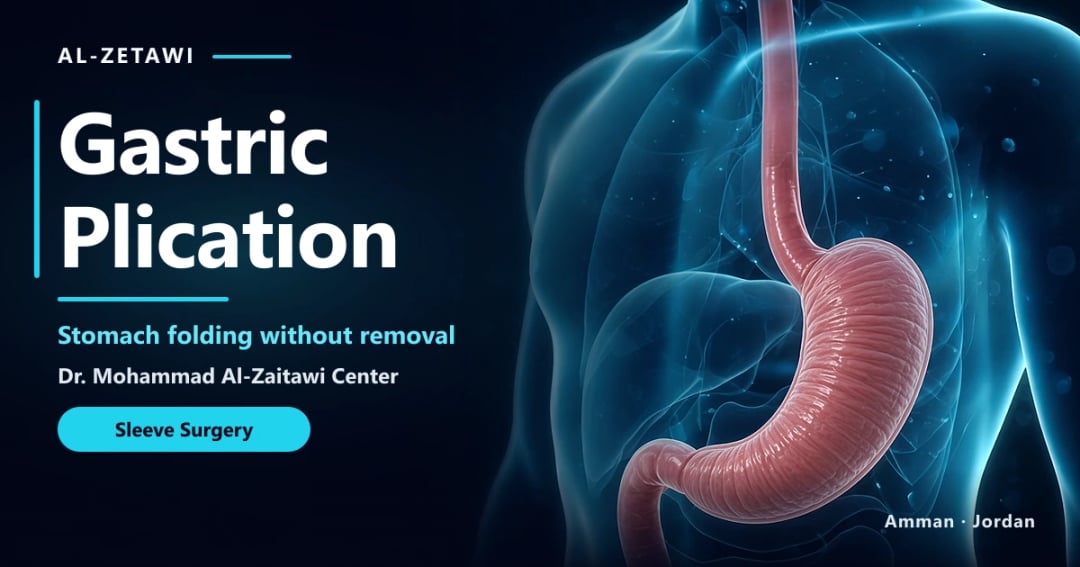
What Gastric Plication Is
Gastric plication is a laparoscopic operation that folds the outer curve of the stomach inward and holds the folds with stitches, so the stomach holds less food. No stomach tissue is removed, and no band or other implant is placed. It is a restriction procedure, and it is not the same operation as sleeve gastrectomy or gastric banding.
A smaller stomach created by folding
The stomach is a muscular bag that stretches to receive a meal and then passes food into the duodenum, the first part of the small intestine. In gastric plication the surgeon turns the long outer edge of that bag inward, a little like tucking extra fabric into a seam, and secures the tuck with stitches. The inner space that is left is narrower, so a usual restaurant portion no longer fits. Fullness arrives earlier. Hunger may also change for some people because the upper part of the stomach, where much of the hunger hormone ghrelin is made, is included in the fold, but that hormone effect is less predictable than it is after the same area is removed in a sleeve.
Food still leaves through the pylorus, the natural valve at the bottom of the stomach, and still meets bile and pancreatic juice in the usual place. Nothing is rerouted. That is why plication is grouped with restrictive operations rather than with bypass operations. Patients sometimes expect a metabolic effect as strong as a gastric bypass. The anatomy does not support that expectation. Any improvement in blood sugar or blood pressure is tied mainly to eating less and losing weight, not to a bypass of the intestine.
What stays in the body
Because the folded wall is not cut away, the stomach tissue remains. In selected cases a later operation can release the folds, although that is another procedure under anaesthesia, not an adjustment done in the clinic, and scar tissue can make the release difficult. Advertising that calls plication simply reversible often leaves this out. The stitches are meant to be permanent. If they loosen or the fold unfolds, the space inside the stomach can enlarge again and weight can return.
There is no silicone ring, no access port under the skin, and no schedule of fluid adjustments. There is also no staple line along a removed portion of stomach, which is the feature that defines sleeve gastrectomy. Understanding those absences matters, because the recovery problems of plication are its own: nausea, a channel that is too tight, stitches that fail, and, uncommonly, injury to the stomach wall. They are not the problems of a band slip, and they are not the problems of a sleeve staple line.
How the operation is framed at this center
At Dr. Mohammad Al-Zaitawi's center in Amman, gastric plication is explained as one option among weight-loss operations, and only after the better-studied choices have been set beside it. Sleeve gastrectomy and gastric bypass have larger and longer bodies of evidence for weight loss and for conditions such as type 2 diabetes. Plication has a smaller evidence base. A patient who wants the fold because it sounds gentler still needs the same anaesthetic assessment, the same honesty about reflux, and the same commitment to follow-up as someone preparing for a sleeve. The name of the operation does not lower the standard of selection.
How Plication Differs from Sleeve and Band
Patients often arrive using sleeve, band and plication as if they were three names for one idea. They are three different constructions. The conversation in clinic starts by separating them, because a preference formed from a video or a relative's story may point at the wrong operation for the person's reflux, diabetes or previous surgery.
Sleeve gastrectomy removes stomach
Sleeve gastrectomy, often called a gastric sleeve, takes away most of the outer portion of the stomach with surgical staplers. About four fifths of the stomach leaves the body. What remains is a narrow tube. The pylorus is kept, so food still enters the duodenum. The removed part includes much of the fundus, and ghrelin levels typically fall. There is a staple line, and leak from that line, though uncommon, is a known serious risk. The sleeve cannot be put back. If weight returns or reflux becomes severe, a later operation may convert the sleeve to a bypass or another reconstruction. Those facts are the reason sleeve surgery is offered only after a full metabolic assessment, and they are also the reason it has become a standard operation in guidelines from societies such as the American Society for Metabolic and Bariatric Surgery and the International Federation for the Surgery of Obesity and Metabolic Disorders.
Plication tries to imitate the shape of a narrower stomach without the removal. The wall is folded instead of stapled off. There is no specimen in a dish at the end of the case. There is no staple line of the sleeve type. In exchange, the restriction depends on stitches holding living tissue in a fold. Those stitches can tear through, the fold can loosen, and the early weeks are often marked by more nausea than many sleeve patients describe. Weight-loss results in published series are more variable and, in general, more modest than the results reported for sleeve gastrectomy. A center that offers both should say this plainly before a date is chosen.
A gastric band is an implant
An adjustable gastric band is a ring placed around the upper stomach, connected to a port that sits under the skin. Fluid can be added or removed later to tighten or loosen the ring. The stomach is not folded and not removed. The band is a foreign body. It can slip, erode into the stomach, or become infected at the port. Many patients who had bands in earlier years now seek removal or conversion because of poor weight control or device problems. Plication is sometimes suggested to people who want to avoid an implant. That wish is understandable. Avoiding an implant does not make plication a substitute with the same adjustability, and it does not give it the evidence base of a sleeve or a bypass.
A band can be tightened in the clinic months later. A plication cannot. The size of the fold is chosen during the operation. If the channel is too narrow, the patient vomits and may need fluids, endoscopy or a further operation. If the fold is too loose, or becomes loose, restriction fades. There is no port to fine-tune the result on a Tuesday afternoon. Anyone comparing the two should weigh that difference, not only the fact that both leave the intestine connected in the normal way.
Questions that sort the three operations
A useful clinic visit answers a short list. Is stomach tissue being removed? Is a device being left inside? Is the intestine being rerouted? Can the result be adjusted without another anaesthetic? What happens to heartburn? What is known at five years, not only at three months? For plication the answers are: tissue stays, no device is implanted, the intestine is not rerouted, adjustment needs another operation, heartburn may continue or worsen, and five-year data are thinner than for sleeve or bypass. Those answers, rather than a preference for the gentlest-sounding word, should drive the choice. Dr. Mohammad Al-Zaitawi reviews them with patients in Amman before any weight-loss operation is booked.
Who May Be Considered
Meeting a weight threshold does not by itself make gastric plication the right operation. International guidance on metabolic surgery describes who may benefit from an established bariatric procedure. Plication then has a second filter: the person must understand that it is a less proven fold, and the surgeon must judge that folding the stomach is technically reasonable.
The broader metabolic-surgery context
The 2022 guidance from the American Society for Metabolic and Bariatric Surgery and the International Federation for the Surgery of Obesity and Metabolic Disorders recommends metabolic surgery for adults with a body mass index of 35 or higher, and considers it for adults with a body mass index of 30 to 34.9 when type 2 diabetes or another metabolic disease is present. Body mass index is weight in kilograms divided by height in metres squared. It is a screening number, not a diagnosis. Fat distribution, diabetes control, sleep apnoea, blood pressure, joint disease and previous attempts at structured weight loss all sit beside it. In the United Kingdom, NICE guideline NG246 uses higher thresholds for National Health Service referral, including a body mass index of 40 or more, or 35 to 39.9 with a condition that weight loss could improve, with lower cut-offs for some ethnic groups. Private and international pathways still require an individual medical decision rather than a calculator result.
Those documents discuss established operations in depth. They do not treat gastric plication as interchangeable with sleeve gastrectomy or Roux-en-Y gastric bypass. At this center the same BMI conversation happens, and then a second sentence follows: if the goal is the most reliable weight loss, or meaningful help with type 2 diabetes, a sleeve or a bypass usually has the stronger record. Plication is discussed when a patient, after hearing that, still wishes to explore a stomach-preserving fold, and when the rest of the assessment supports an operation at all.
Features that make a conversation reasonable
A reasonable candidate is an adult who has already tried a structured approach to eating, activity and medical care, and whose weight or metabolic disease still justifies surgery under the guidance above. The person can describe, in their own words, that the stomach will be folded rather than removed, that there is no band, and that nausea in the first weeks is common. They accept lifelong follow-up even though no intestine is bypassed. They can pause blood-thinning medicines, treat sleep apnoea, and stop nicotine for the period the team requires, because wound and tissue healing depend on oxygen delivery. They have a way to be reached after they go home, including patients who live outside Jordan.
Some people ask for plication because a relative had a complication from a staple line, or because they want the option of a later release. Those reasons can be discussed. They are not, on their own, a medical indication. The surgeon still looks at the hiatus, the liver, previous abdominal operations and the pattern of eating. A person who grazes all day on soft high-calorie foods may feel little restriction from any small stomach, folded or sleeved, and needs that pattern addressed before an operation is offered as the remedy.
Shared decision, not a default
Dr. Mohammad Al-Zaitawi's practice in Amman treats procedure choice as a medical recommendation that the patient can question. If plication is not the recommendation, the visit is still useful. Many people who first ask about folding leave with a plan for a sleeve, a bypass, or more time on non-surgical care. A center that can only offer one operation is a poor place to make this decision. The aim is a match between the person's health, the evidence and an operation the surgeon can stand behind, not a match between a search term and a theatre slot.
When Another Operation Fits Better
Declining plication is often the careful decision. Several patterns come up often enough in clinic that they deserve their own explanation, so patients do not feel a refusal is personal. The aim is to point toward the operation, or the non-surgical plan, that fits the problem in front of the team.
Reflux and a hiatus hernia
Heartburn, acid regurgitation, a known hiatus hernia or oesophagitis on endoscopy are warning lights for any operation that narrows the stomach and leaves the pylorus in place. Sleeve gastrectomy can worsen reflux in a portion of patients. Folding the upper stomach can do the same, because the fold changes how the top of the stomach and the valve into the oesophagus sit. A person whose main suffering is acid in the throat, night cough or a dependence on high-dose acid medicine is often better served by a gastric bypass, which has a stronger record for reflux control, or by repairing the hernia and treating reflux without a restrictive fold. Choosing plication to avoid a bypass, while leaving severe reflux untreated, trades one problem for a likely continuation of another.
Endoscopy and, when needed, a contrast study or oesophageal function tests are how this is sorted. Symptoms alone can mislead. Some people with little heartburn have significant inflammation, and some people with dramatic symptoms have a stomach that looks quiet. The investigation is part of selection, not an extra hurdle added for its own sake.
Diabetes, very high weight and previous gastric surgery
When type 2 diabetes is the leading reason for surgery, especially diabetes that needs insulin or that has been present for many years, bypass operations and, in appropriate cases, sleeve gastrectomy have far more published follow-up than plication. A fold may help through weight loss, but it should not be sold as an equivalent diabetes operation. At the other end, some patients with a very high body mass index need a plan that anticipates staged care or a procedure with more durable weight loss. Plication is a weak choice if the person will be disappointed by a modest change and then face a second anaesthetic anyway.
Previous stomach surgery changes the map. A prior band, a prior fundoplication, a prior perforation repair or dense adhesions may make a safe fold impossible. Previous plication that has loosened is not automatically treated by folding again. Conversion to a sleeve or a bypass may be safer and more logical once the stomach has been unfolded and assessed. That judgement is made from imaging, endoscopy and the old operation note, not from a photograph of a scar.
Situations that postpone any operation
Active nicotine use, an untreated eating disorder, unstable heart or lung disease, a current pregnancy, or an inability to take vitamins and attend follow-up are reasons to wait or to decline surgery altogether. Plication does not bypass these rules because it removes no tissue. Anaesthesia and a stomach that must heal around stitches are still major events. Psychological readiness matters as well. Surgery does not treat binge eating by itself. Where mood, trauma or a disordered relationship with food is active, that care comes first, alongside the medical work-up, and an operation is reconsidered only when the wider team agrees the timing is safer.
Assessment before a Decision in Amman
The assessment is the procedure's real beginning. A date in the operating room is the last step, after the stomach, the metabolic diseases and the person's ability to recover have been understood. Patients who live in Jordan and patients who travel to Amman follow the same medical questions, even if the logistics differ.
History, examination and the story of previous attempts
The visit covers height, weight and the trajectory of both, not a single number from last week. Previous diets, medicines used for weight, and any earlier gastric balloon, band, sleeve or fold are listed with dates. Reflux, night-time choking, diabetes and its medicines, blood pressure, lipids, joint pain, fertility plans and depression or anxiety are part of the same history. Medicines that affect bleeding, such as antiplatelets and anticoagulants, and medicines that irritate the stomach are reviewed so they can be paused or replaced under the guidance of the doctor who prescribed them. A physical examination looks at the abdomen, previous scars, signs of liver disease and the airway, because laparoscopy and anaesthesia both depend on those findings.
Eating pattern is discussed without blame. A person who drinks large volumes of high-calorie liquids will feel less restriction after any small-stomach operation, because liquids slide through. A person who eats until they vomit as a habit needs that pattern recognised before stitches are placed. The team would rather delay an operation than fold a stomach for someone who has not been told this.
Tests that commonly form the work-up
Blood tests usually include a blood count, kidney and liver tests, glucose measures such as HbA1c, lipids, and stores of iron, vitamin B12, folate and vitamin D. Deficiencies are corrected before surgery when possible, because vomiting after plication can worsen them quickly. An endoscopy looks at the lining of the oesophagus, stomach and duodenum, at any hiatus hernia, and at Helicobacter pylori, which is treated if present so the stomach is in better condition. Ultrasound or other imaging may assess the liver and gall bladder. Sleep studies, heart tests or endocrine opinions are added when the history points that way. Not every patient needs every test. The list is built from the person, not from a package.
A short period of structured eating before surgery is often used to reduce the size of a fatty liver, which otherwise crowds the upper stomach and makes laparoscopy harder. This is a safety step. It is not a test of willpower and it is not a promise that the same diet, continued alone, would have replaced surgery. Patients are told what the liver-reduction plan involves in their own case. It is individual, and it is not copied from a generic sheet without review of diabetes medicines, because cutting carbohydrate intake can change the need for insulin or sulfonylureas and can cause low blood sugar if those medicines are left unchanged.
Anaesthesia and consent
The anaesthesia team reviews sleep apnoea, reflux and the airway. Consent for plication covers the intended fold, the possibility that the surgeon will stop or change plan if the stomach or hiatus looks unsafe, the early symptoms that need urgent contact, and the chance that a later operation will be required. Consent also names bleeding, infection, blood clots, injury to the stomach or nearby organs, and the limits of weight loss. Dr. Mohammad Al-Zaitawi expects patients to repeat the plan back in ordinary language. A signature on a form that the patient cannot explain is not an adequate consent. Written material in this guide supports that conversation. It does not replace it.
What the Day of Surgery Is Like
Patients often want a minute-by-minute account of the operating room. The useful version is the sequence they will actually feel and the sequence their family will wait through. Technical settings, stitch brands and device pressures are decisions for the surgical team during the case. They are not instructions a patient should try to specify or compare from the internet.
Arrival, anaesthesia and the keyhole approach
You come to hospital having followed the fasting instructions you were given. Those instructions include a precise time after which you should not eat or drink, and they may differ if you have diabetes or reflux. On the ward the team confirms identity, allergies, consent and the site of surgery. Compression stockings or other clot-prevention measures are started according to the hospital protocol. You walk to the theatre area or are taken by trolley, meet the anaesthesia team again, and then go to sleep. You do not see the operation. Family usually wait in a designated area and are updated when you reach recovery.
The operation is done through small openings on the abdomen, using a camera. The abdomen is lifted with gas so the surgeon can see the stomach. The outer curve is freed so it can be folded inward without being tethered by its attachments. The fold is then held with rows of stitches. A soft tube may be used for a short time to help the surgeon judge that the inner channel is not closed off. The tube is not an implant and does not stay in the stomach as a device you live with. No stomach tissue is removed. No band is placed around the upper stomach. The small skin openings are closed, usually with dissolving stitches or skin glue.
How long you are asleep, and what can change the plan
Many plication operations take on the order of one to two hours of surgical time, but adhesions, a hiatus hernia repair if one has been agreed, or a liver that is still large can make the day longer. You should not treat any published duration as a booking you can hold the team to. What matters is that the channel is safe and the fold is secure, not that the clock matches a brochure. If the findings make folding unsafe, a responsible surgeon stops or converts the plan to an operation that was discussed with you in advance. That possibility is a mark of judgement, not a failure of preparation.
You wake in recovery with a nurse close by. A drip provides fluid until you can sip. Pain is usually soreness at the small openings and a deep ache or shoulder-tip discomfort from the gas used to see inside. Nausea is common and is treated. You are not expected to eat a meal. Walking a few steps, once the team says it is safe, helps breathing and circulation. Most people who are well go to a ward bed rather than to intensive care. A longer stay in a higher-dependency area is reserved for specific medical reasons, which are explained at the time.
What you should see in the operation record
Before you leave hospital you should have a written note that says gastric plication was performed, that tissue was not removed, that no band was placed, and whether anything else was done, such as a hernia repair or treatment of an unexpected finding. International patients need that note in clear English, with the date, the hospital and a way to contact the team. Take photographs of the documents as a backup, and carry them in hand luggage. A future surgeon, in Jordan or at home, should not have to guess what was folded.
The First Weeks of Recovery
Recovery from plication is dominated by how the folded stomach handles fluid. The skin openings are small. The limitation is inside. Planning the first month around sipping, walking and watching for dehydration is more useful than planning around wound cosmetics.
Hospital nights and the journey home
Many patients stay one or two nights. The stay lengthens if vomiting will not settle, if pain is unexpected, if there is fever, or if blood tests or examination worry the team. Discharge requires that you can walk, pass urine, sip enough fluid to stay hydrated, and understand the warning signs. Pain at the small openings is usually managed with the medicines prescribed for you. Do not add anti-inflammatory tablets on your own if the team has asked you to avoid them, because some of those medicines irritate the stomach lining.
At home, arrange a responsible adult for the first night at least. Climbing many flights of stairs, driving and caring for small children alone are poor plans for the first several days. Driving waits until you could perform an emergency stop and you are no longer taking sedating pain medicine. Desk work is often possible within one to two weeks if nausea is controlled. Work that involves lifting, heat or long shifts needs longer, commonly several weeks, and is confirmed at review rather than promised on the day of discharge. Showering is usually allowed once the team has checked the dressings. Baths and swimming wait until the skin has sealed.
Activity, clots and the abdomen
Walking is the main exercise in the first two weeks. Short walks several times a day reduce the chance of clots in the legs and help the bowel recover. Standing still for long periods and sitting on a long-haul flight without moving are the patterns to avoid. If you were prescribed an injection or tablet to reduce clot risk, take it for the exact number of days written on the discharge sheet, and ask before extending or stopping it. Heavy lifting, abdominal straining and intense gym work usually wait about four to six weeks, because the stomach wall and the small openings are still healing. A precise date comes from your own review.
Mild bruising and a feeling of tightness are common. Increasing redness, a swelling that is hot, discharge with a bad smell, or a wound that opens are reasons to send a photograph to the team the same day. Shoulder-tip pain that is fading is usually the leftover gas. Shoulder pain with a fever, a racing pulse or worsening abdominal pain is not something to attribute to gas. That combination needs same-day assessment. The folded stomach can, uncommonly, leak or become ischaemic. Early assessment is how those uncommon events stay survivable.
Emotional pace
The first month can feel smaller than people expect. Friends ask about kilograms. You are still learning to sip. Mood can dip, especially if nausea dominates the day. This is a known phase, not proof that the operation was a mistake, and it is also not something you must endure in silence. Tell the team if you cannot keep fluids down, if you feel hopeless, or if you are frightened by a symptom. International patients should know which local emergency department they would use, and should carry the operation note. Amman follow-up by message or video does not replace emergency care where you are if you are acutely unwell.
Eating, Nausea and Hydration
The diet after plication is a safety protocol for a narrow, swollen stomach, not a brand of eating that continues unchanged for life. Textures advance only as the team allows. The details you are given in Amman override any generic chart you find online, including the general description here.
Why the early diet is liquid
In the first days the fold is swollen and the channel is at its tightest. Clear fluids in small sips are the usual start: water, and other clear drinks the team has approved. Gulping, using a straw, or drinking a large glass because you feel behind on a target can cause pain and vomiting. It is more effective to take a sip, wait, and repeat through the waking day. Protein-containing liquids are introduced when the team says the stomach will tolerate them. Sugar-heavy drinks and carbonated drinks are a poor fit. Carbonation adds gas to a stomach that has little spare room. High-sugar liquids slide through, dump a calorie load, and teach a habit that works against restriction later.
Pureed and soft foods follow liquids, often over the first month, and ordinary textures return gradually after that. The timetable is individual. A person who vomits when they advance should step back to the last texture they tolerated and call the team, rather than forcing the next stage to stay on a calendar. Meat that is dry, bread that swells, rice that clumps, and fibrous vegetables are classic foods that stick at a narrow stomach. They are reintroduced late, in small amounts, chewed thoroughly. Eating and drinking at the same time often overwhelms the pouch of space you have. Many patients do better if they separate fluids from meals by a short interval once they are on soft food. Your dietitian will set that interval for you.
Nausea, vomiting and vitamin B1
Nausea is the symptom patients underestimate. It can last days or a few weeks. Medicines can help, and the team would rather adjust them than have you become dry. Vomiting more than occasional spit-up, dizziness on standing, a very dry mouth, little urine, or a heart rate that stays high are signs of dehydration. Dehydration after stomach surgery is a reason to be seen, sometimes for intravenous fluid, not a reason to try a sports drink and hope. Prolonged vomiting also drains thiamine, vitamin B1. A severe lack of thiamine can injure the brain and the nerves. Warning features include confusion, unsteady walking, double vision or tingling that is new. Those features are urgent. Do not wait for a routine clinic date. The team may give thiamine as part of treatment. This page deliberately does not list a dose, because the dose and the route depend on how unwell you are and belong to the clinician who is treating you that day.
Pain tablets that contain codeine or similar drugs can worsen nausea and constipation. Use the pain plan you were discharged with, and ask before substituting a medicine from a home cabinet. Constipation is common when fluid intake is low and movement is reduced. It is treated with fluids, walking and the laxative approach the team recommends, not with a large high-fibre meal in the first fortnight, which the narrow stomach may not accept.
Protein and the long table
Once textures allow, protein is the food to protect: eggs, fish, dairy if you tolerate it, lentils, poultry, and protein supplements if the dietitian has named them. Hair thinning several months later is usually a response to rapid weight change and lower intake, and it often recovers when protein and iron are adequate. It is not a sign that the fold has failed. Alcohol is a bad match in the early months. It irritates the stomach, dehydrates, and carries calories without fullness. Pregnancy, if it is part of your life plan, should wait until weight is stable and nutrition has been checked, often around twelve to eighteen months after a weight-loss operation. Fertility can rise as weight falls, so contraception needs a real plan, discussed with the clinician who manages it, before surgery rather than after a surprise.
Weight and Health Expectations
No ethical clinic guarantees a kilogram target. Gastric plication reduces the room for a meal and can help a person eat less, if the fold holds and if eating habits change with it. How many kilograms that becomes, and whether diabetes or blood pressure improve, varies widely. The honest summary is that average results in the medical literature are more modest and less consistent than the averages reported for sleeve gastrectomy and gastric bypass, and that some patients later choose a conversion.
What restriction can and cannot do
Restriction helps most with solid food eaten in a sitting. It helps least with liquid calories, with frequent small snacks that never stretch the stomach enough to cause fullness, and with a fold that has loosened. The scale in the first month also reflects water shifts, the liver-reduction diet and low intake because of nausea. That early drop is not the result you judge the operation by. A fairer view is the trend from a few months onward, set against your own starting weight, muscle mass and whether you can eat protein comfortably. Comparing your week-six photo with a stranger's year-two photo is not a clinical measurement.
Health changes follow weight and follow the work you do around medicines. Blood pressure tablets, diabetes tablets and insulin often need reduction as intake falls, sometimes within days, and sometimes that reduction is urgent to avoid low sugar. This is a reason to have a plan with the prescribing doctor before surgery, not a reason to stop medicines in advance on your own. Sleep apnoea may improve, but a CPAP machine is not abandoned until a sleep clinician says so. Joint pain may ease as load decreases. None of these are promised for plication specifically, and none of them have been shown in large comparative trials to match bypass. If a brochure offers a remission rate for diabetes after plication as though it were a settled figure, treat that brochure as marketing.
When the result is smaller than you hoped
A smaller-than-hoped result is investigated, not blamed. The team asks about liquid calories, grazing, medicines that increase appetite, thyroid disease, a fold that may have loosened, and a channel that is so tight that the person has lived on slider foods. Endoscopy or a contrast study can show whether the fold is intact. Nutrition review comes before any talk of another operation. If the fold has failed or the person needs a stronger metabolic effect, conversion to a sleeve or a bypass may be discussed. Conversion is a new operation with its own risks. It is not a free correction included in the original plan, and it is not appropriate as a scheduled second step for everyone. Some people, after review, do better with dietitian support and no further surgery.
Weight regain after any stomach operation is common enough that follow-up exists. After plication, regain should prompt a look at the stitches and the fold as well as at habits. Re-folding is not automatically the answer. The stomach wall that has already been sutured may not tolerate another imbrication as well as a conversion would. Dr. Mohammad Al-Zaitawi's approach in Amman is to read the old note, look inside with endoscopy when indicated, and recommend the next step only after that. A second fold done because the first one was advertised as adjustable is a misunderstanding of the operation.
Loose skin is a separate issue
If weight loss is substantial, skin on the abdomen, arms, thighs or chest may not retract fully. Plication is not a skin operation, and a skin operation is not a weight-loss operation. Body contouring, if it is wanted, waits until weight has been stable for many months, often a year or more, so the surgeon is not chasing a moving target. That conversation belongs to a later assessment. It should not be booked as a package on the day you book a stomach fold.
Risks and Warning Signs
Every abdominal operation under general anaesthesia can cause bleeding, infection, a reaction to medicines, breathing problems, or clots in the legs or lungs. Plication adds risks that come from folding a living stomach and holding it with stitches. Most people recover without a major complication. The ones who do poorly are often those who waited on a serious symptom because they had been told the operation was minor.
Problems of the fold itself
The channel can be too narrow. The person vomits saliva, cannot keep water down, and feels pressure in the upper abdomen. Sometimes swelling is temporary and settles with fluids and time in hospital. Sometimes a stitch has crowded the lumen and needs to be released at a further procedure. Distinguishing those two situations is a medical job, usually with examination and imaging or endoscopy. It is not a job for a home remedy or for forcing solid food in the hope of stretching the stomach. Forcing food can worsen pain and can threaten a stitch line.
Stitches can tear through the wall if they are under tension, if vomiting is forceful, or if tissue is inflamed. A leak of stomach contents into the abdomen is uncommon but dangerous. It may announce itself with a fast heart rate, fever, worsening pain, or a feeling of being suddenly much more ill, sometimes with pain at the shoulder tip. The same picture can come from bleeding. Both need emergency assessment, blood tests and usually a scan. Do not book a routine clinic for the next week if this picture appears. Go to an emergency department and say you have had a stomach-folding operation.
Blood supply, obstruction and reflux
The stomach wall needs blood flow. A fold that is too tight, or a dissection that compromises vessels, can injure that flow. Tissue that loses its blood supply can necrose. This is rare and serious, and it is one reason plication belongs in a hospital that can reoperate and support a very unwell patient, not in a setting that can only do the elective case. Obstruction at the outlet gives persistent vomiting and dehydration. Reflux may appear for the first time or become harder to control. New reflux is not a character flaw in the patient. It is a mechanical consequence that deserves treatment, and sometimes a different operation later.
Bleeding can be inside the abdomen or into the stomach. Black stools, dizziness, a racing pulse and worsening pain are reasons to be seen. Infection at a skin opening is usually a local problem. Infection inside the abdomen is not. Blood clots are more likely when people are dehydrated, immobile, or flying long distances soon after surgery. Swelling of one leg, chest pain, sudden breathlessness or coughing blood are emergency symptoms. Say that you have recently had abdominal surgery when you arrive.
How to call for help
Before discharge, save the team's contact and know which symptoms skip the message queue and go straight to emergency care: inability to keep liquids down for most of a day, little or no urine, fainting, fever, a pulse that stays high, worsening abdominal pain, leg swelling, or breathlessness. For patients who have returned home outside Jordan, local emergency care comes first when the problem is acute. Contact the Amman team as well so the operation details can be shared, but do not delay local treatment in order to wait for a cross-border reply. Bring the written operation note. A clinician who has never seen plication can still start resuscitation, fluids and urgent imaging if you tell them the stomach was folded with stitches and that no tissue was removed.
Follow-up, Nutrition and Later Choices
Plication preserves the route of food, so it does not create the same bypass-related vitamin pattern as a gastric bypass. Follow-up is still mandatory. Vomiting, a narrow diet and rapid weight change can produce iron deficiency, B12 deficiency, folate deficiency, vitamin D deficiency and, as already described, thiamine deficiency. People who assume they need no blood tests because the intestine was not rerouted are the people who present late.
A follow-up shape that makes sense
Reviews in the first weeks focus on hydration, wound healing and whether textures can advance. Reviews over the first year follow weight, diet quality, reflux, mood and blood tests. A typical laboratory set looks at blood count, iron studies, B12, folate, vitamin D, kidney function and, where relevant, HbA1c and lipids. The exact months are set by the team. Missed blood tests are not a paperwork issue. They are how a quiet anaemia or a low B12, which can injure nerves if it is severe and prolonged, gets found while it is still easy to correct. Women with heavy periods need particular attention to iron. People who avoid animal products need a deliberate B12 plan from the dietitian or physician, not an assumption that a folded stomach has solved nutrition.
Supplements are prescribed to the person. This guide does not list doses, because a dose copied from another patient's sleeve protocol can be too much or too little after plication, and because some supplements interact with other medicines. Take what was written for you, and bring the list to every review. If a local doctor changes it, tell the surgical team. Two independent plans that both contain vitamin A, for example, can accidentally stack.
Endoscopy and the possibility of another operation
Not everyone needs a routine endoscopy after an uneventful plication. People with new reflux, difficulty swallowing, vomiting, pain, bleeding or unexpected weight regain often do. Endoscopy looks at whether the fold is intact, whether the channel is narrow, and whether the oesophagus is inflamed. It is a test, not a treatment by itself, although sometimes a narrowing can be managed endoscopically if the endoscopist judges that safe. Decisions about dilatation belong to the clinician who can see the lumen and who knows the stitch pattern. They should not be requested by a patient from a generic article.
Later surgical choices include releasing a fold that is too tight, repairing a problem at the stomach, or converting to a sleeve or a bypass if the goal of treatment has not been met and the anatomy allows it. Each of those is a new consent. A conversion after plication can be more scarred than a first-time sleeve, and the risk conversation changes. Bring the original operation note. A surgeon who can see what was stitched can plan. A surgeon who is guessing may have to back out. If you move cities, ask for a copy of the record before you go.
Pregnancy, medicines and other doctors
Tell obstetric teams about the fold if you become pregnant. Nausea of pregnancy on top of a narrow stomach can dehydrate you quickly, and vitamin needs change. Conception is best delayed until weight and blood tests are stable, and contraception should already have been sorted before the operation. Other specialists, including gastroenterologists and emergency physicians, should be told that you have a folded stomach rather than a sleeve or a band. The words matter. A clinician who hears band may look for a port that you do not have. A clinician who hears sleeve may look for a staple line that was never created. The sentence to memorise is simple: the outer stomach was folded with stitches, nothing was removed, and no band was placed.
Travel, Fees and Questions to Ask
Patients travel to Amman for weight-loss surgery from Jordan's neighbours and from further away. Distance does not change the biology of a folded stomach. It does change how you prepare for clot risk on the flight, how you carry records, and how you will be reviewed when you are no longer in the same city as the operating team.
Before you book flights
Send a summary of your weight history, medicines, endoscopy if you have already had one, and any previous abdominal operations before you buy a non-refundable ticket. The team may tell you that plication is a poor match and that you should be assessed for a sleeve or a bypass instead, or that you need tests at home first. Learning that after you have arrived is more expensive and more distressing. Discuss the plan with your own doctor as well, especially if you have heart disease, sleep apnoea or diabetes. Ask who will check your blood tests after you return, because a surgical team abroad cannot draw your blood from another country. Travel insurance should be asked, in writing, whether a planned operation and its complications are covered. Many ordinary policies exclude planned treatment.
A typical stay allows time for review, the operation, a night or two in hospital if recovery is smooth, and a face-to-face check before flying. Smooth is not guaranteed. Do not book the return flight for the morning after surgery. Flying while dehydrated, in pain, or unable to walk the aisle raises the risk of clots. The team tells you when flying is reasonable for your case. On the aircraft, walk, move your ankles, use the compression you were given, and sip the fluids you are allowed. Carry the operation note, a list of medicines, and enough of those medicines for a delay. Put them in cabin baggage, not in the hold.
How fees are discussed
There is no single fee on this page, and there should not be. Hospital category, length of stay, endoscopy, treatment of Helicobacter, treatment of a hiatus hernia, extra nights for nausea, and a later unplanned procedure all change the bill. A serious quote is written, itemised, and clear about what is not included, such as flights, hotel, insurance and the cost of care in your home country if a complication appears after you land. A headline number that undercuts every other hospital in the region, paired with a promise of a particular weight loss, is a reason to slow down, not a reason to pay a deposit the same day. Dr. Mohammad Al-Zaitawi's center confirms cost only after the medical plan is clear. Currency swings and package extras are explained before you commit, not at the cashier on discharge day.
Ask what happens financially and clinically if the operation is abandoned because the findings are unsafe, and what happens if you need a longer stay. Ask which hospital is used and whether that hospital can reoperate and provide intensive care at night. Ask who answers a message on a weekend. Ask for the diet sheet and the blood-test schedule in a language you read well. Ask how the operation will be named in the discharge letter so a doctor at home does not confuse it with a sleeve or a band. The quality of those answers matters more than a tour of the ward.
A note on this guide
This page is general education for people considering gastric plication with Dr. Mohammad Al-Zaitawi in Amman. It is not a personal recommendation, not a quote, and not a set of operative instructions. Guidelines change, and your endoscopy, medicines and goals may point away from a fold even if a friend with a similar weight had one. The decision belongs to a consultation that can examine you and can say no. If you have fever, uncontrolled vomiting, severe pain, chest pain or breathlessness after an operation, seek emergency care where you are. Do not use this article as a triage service.
Living with the Decision
The operation lasts an hour or two. The eating pattern lasts years. People who do well after plication are usually those who treated the fold as a tool that still needs a dietitian, a walking habit and honest follow-up, not as a device that would police their intake for them. People who do poorly are often those who were promised a reversible, minor alternative to a sleeve and were not prepared for nausea or for a modest result.
Daily habits that match a folded stomach
Meals become smaller and slower. Bites are chewed. Fluids and solids are often separated. Protein is planned first, then vegetables, then a small amount of carbohydrate that does not swell into a paste. Eating standing at a fridge, sharing large platters at speed, and finishing a child's leftovers are the habits that hurt. They are ordinary habits, and changing them is the unglamorous part of care. A dietitian who understands bariatric operations is more useful here than a generic calorie app that still assumes a full-size stomach and pushes large-volume shakes you cannot finish. If you graze, say so at review. Hiding it produces a confusing weight chart and a delayed solution.
Strength work, once the team has cleared you, protects muscle while weight falls. Walking remains the foundation. Sleep, treated sleep apnoea, and alcohol kept rare all affect results as much as the stitch pattern does. Medicines that increase weight, including some drugs used for mood, diabetes or nerve pain, should be reviewed with the prescriber. Stopping them abruptly can be dangerous. The request is a review, not a unilateral decision after reading a forum.
What to tell future clinicians
Keep a one-page summary: date, hospital, surgeon, the words laparoscopic gastric plication, no resection, no band, and any hernia repair. Store it with your phone photos of the discharge letter. If you need an emergency abdominal operation years later, that page saves the next surgeon from assuming you have a sleeve staple line or a band port. If you need an MRI, there is typically no metallic adjustable band to declare, but you should still mention the operation so the request is accurate. Dental procedures, pregnancy care and endoscopy bookings should all carry the same sentence.
Support is part of aftercare. Some people prefer a dietitian they already trust at home, with the surgical team advising on the anatomical limits. Others want reviews from Amman by video for the first year. Either model can work if someone is clearly responsible for blood tests and for acting on vomiting or reflux. What does not work is a handshake and a wish of good luck at the airport. Before you accept a date, name the person who will review you at one month, three months and twelve months. If you cannot name them, the plan is not finished.
If you are still unsure
Uncertainty is a reason to wait. Gastric plication will still exist after you have read your endoscopy report, spoken with a dietitian, and compared it properly with sleeve gastrectomy and gastric bypass. A deposit paid to hold a theatre slot is a poor treatment for doubt. Dr. Mohammad Al-Zaitawi's clinic in Amman would rather see a patient who can explain the fold, the absence of a band, the absence of a resection, and the limits of the evidence, than a patient who is hurrying because a travel companion booked flights. Bring your questions. Expect the answers to include a possible recommendation against this operation. That is what an assessment is for.
Medical note from Dr. Mohammad Al-Zaitawi
A fold is not a gentler sleeve and it is not a band without the port. I recommend plication only when the person can explain those differences, the reflux risk is acceptable, and a better-studied operation is not clearly the safer way to meet their goal. Modest results and the possible need for a later operation have to be accepted before a date is set.
Scientific references and guidance
These sources support the medical information on this page. If you want this guidance applied to your own case, send us your details for an initial review.
Reviewed by Dr. Mohammad Al-Zaitawi
Prefer a quicker route? Try the free case review or see bariatric surgery costs in Jordan.