
Gastric Sleeve vs Gastric Bypass: Which Surgery Fits You?
Neither operation is better for every adult. A gastric sleeve removes about 80 percent of the stomach and does not reroute the intestine. A Roux-en-Y gastric bypass makes a small pouch and two intestinal connections, so food skips most of the stomach and the duodenum. Five-year randomized trials found large weight loss after both. Bypass usually treats reflux more reliably. Bypass also has the longer record when type 2 diabetes is the main disease you are trying to change. The sleeve is the simpler anatomy when reflux is absent and you want to avoid intestinal rerouting.
Search pages treat the choice as a contest of averages. In a clinic the choice is a match between the operation and the stomach you already have. Night-time regurgitation, a known hiatal hernia, esophagitis, or Barrett's esophagus pushes the conversation toward bypass. A quiet esophagus and a clear wish to leave the intestinal path alone pushes it toward a sleeve. Smoking, anti-inflammatory painkillers, and whether you can do lifelong blood tests sit in the same decision. They are not details for after you have picked a brand name.
Harvard Health's patient summary puts typical total body-weight loss near 25 percent after a sleeve and near 33 percent after a bypass. In the SM-BOSS trial, five-year excess BMI loss averaged 61.1 percent after sleeve and 68.3 percent after bypass, a difference that was not statistically significant, with reflux better after bypass. SLEEVEPASS, another five-year randomized trial, also found large weight loss after both. Those sentences describe groups. They do not assign you a winner. Read the sleeve and bypass pages for the operations, then use this guide to see how the choice is actually made.
If you are comparing care in Amman with Dr. Mohammad Al-Zaitawi, send symptoms rather than a preference. The recommendation is written so you can show it to your doctor at home. A popular operation on Google is not a recommendation. A sleeve package is the wrong product if the esophagus says bypass, and this page does not invent a bypass price to make the spreadsheet close.
What Does a Gastric Sleeve Actually Remove?
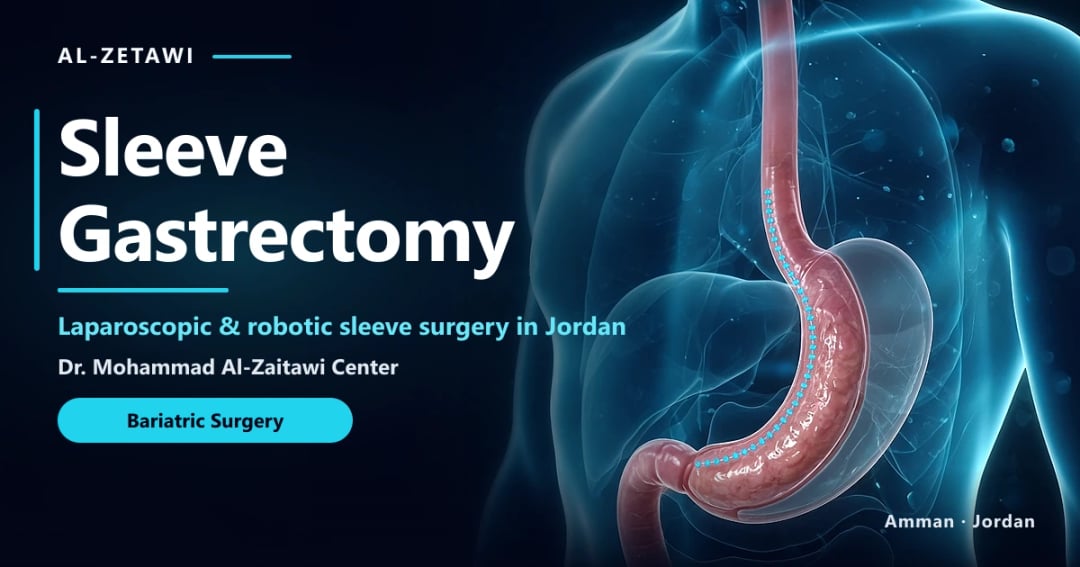
The surgeon staples off the outer curve of the stomach and removes that part. What remains is a narrow tube. Food still enters the duodenum in the normal order. There is no new connection between stomach and intestine, and there is no second connection lower down to bring digestive juices back to the food. That is the entire anatomical idea. People sometimes describe it as a smaller stomach and then add details from bypass videos. Those details do not belong to a sleeve.
Hunger often falls because a large share of the tissue that makes ghrelin, a hunger hormone, is in the portion that was removed. Portions fall because the tube fills quickly. Neither change is a lock. Liquid calories, grazing through the day, and a return to sweetened drinks can all get around a narrow stomach, because liquids do not sit in the tube the way a piece of chicken does. The sleeve asks you to eat slowly and to protect protein. Many programs use at least 60 grams of protein a day unless the written plan differs.
Vitamin needs are real after a sleeve, and they are usually simpler than after a bypass because the duodenum is still in the path of food. Simpler does not mean optional. Iron, B12, vitamin D, and a blood count still get checked. Hair thinning several months later is common and usually temporary. It is not a signal to crash calories further. The removed stomach does not go back. A sleeve is not reversed by a dilation or by stopping a prescription. Anyone who calls it reversible is describing a different operation or a wish.
The incisions are usually small, and the work is done under general anesthesia. A robot, when one is used, is a way of performing that same operation. It does not change the diet, the hormone effect, or the fact that the intestine was left alone. Choosing a sleeve because a device sounds newer is not a medical reason. Choosing it because your esophagus is quiet and you want this anatomy is a medical reason.
What Does a Roux-en-Y Gastric Bypass Change?
A bypass builds a small pouch, often compared with the size of an egg, and connects that pouch to a limb of small intestine. A second connection lets digestive juices meet the food farther downstream. The rest of the stomach stays in the abdomen and still makes fluid, but food no longer enters it. You cannot reach that remnant stomach with an ordinary endoscopy later, which matters if someone talks casually about checking the whole stomach in the future. The map is different on purpose.
Two things change at once. The pouch restricts what you can eat at a sitting, and the rerouting changes gut hormones and how some nutrients are absorbed. Iron, vitamin B12, calcium, and vitamin D need closer blood tests because the duodenum, where much of that absorption is organized, is skipped by the food. This is why a bypass follow-up schedule is stricter than a sleeve schedule even when weight loss looks similar from the outside. Skipping labs because you feel well is a larger gamble after a bypass.
Ibuprofen and similar anti-inflammatory painkillers are avoided. They raise the risk of an ulcer at the new join, especially if you also smoke. That instruction is lifelong, not a six-week incision rule. If you live on those pills for a back or a knee, say so before you ask for a bypass. The operation that helps reflux can be the operation that fights with the only pain medicine that ever worked for you. There may still be a plan. It has to be made with the medicine list visible.
A bypass is also not a casual reversal. Surgeons can revise or reverse in rare, specific situations. That is a new operation with its own reasons, not an undo button you hold in reserve. Go into a bypass only if you can live with the pouch, the two connections, the vitamin schedule, and the ulcer precautions. Go into a sleeve only if you can live with the tube and with the possibility that reflux becomes the long-term problem.
What Did the SM-BOSS Trial Show at Five Years?
SM-BOSS randomly assigned adults to sleeve or bypass and followed them for five years. The paper is in JAMA, PMID 29340679. Excess BMI loss averaged 61.1 percent after the sleeve and 68.3 percent after the bypass. The statistical test did not call that gap significant. In ordinary language, both groups lost a large share of the extra BMI they carried, bypass was somewhat ahead on the average, and the trial was not able to say the difference was clearly more than chance.
Excess BMI loss is not percent of total body weight. If you mix the two, you will think a sleeve takes 61 percent of a person, which is not what the trial said. Excess BMI loss looks at how far BMI sat above a reference, and how much of that distance closed. Total body-weight loss looks at the scale. Both are legitimate. They are not interchangeable. When a forum quotes a percentage, the first question is which measure, and the second is whether the person is describing SM-BOSS or describing a clinic's advertisement.
The clearer difference in SM-BOSS was reflux. Symptoms were better after bypass. That finding matches the anatomy. A sleeve can leave or worsen heartburn. A bypass is built in a way that usually improves it. If your own problem is reflux more than it is the last few percent of weight, SM-BOSS is an argument for bypass even though the weight averages were not statistically separated. If your esophagus is quiet, SM-BOSS is an argument that a sleeve is not a weak operation. It is an argument against treating the two procedures as if one were twice as strong.
The trial does not know your hernia, your insulin dose, or your smoking. It cannot be read backward to produce a personal pound target. Use it to retire two myths: that the sleeve does not work, and that the bypass is guaranteed to win by a wide margin. Then go back to the symptom that made you search this comparison in the first place.
What Does the SLEEVEPASS Trial Add to the Comparison?
SLEEVEPASS is a separate five-year randomized trial of sleeve versus bypass, also published in JAMA, PMID 29340676. It found large weight loss after both operations. This page will not invent the trial's percentages, because they are not needed to understand the direction of the evidence and because a misremembered figure travels farther than a careful sentence. The honest summary is that two independent randomized trials, run for five years, both saw substantial loss after sleeve and after bypass, with bypass modestly ahead on some measures.
Two trials matter more than one enthusiastic program. A single clinic can publish a result that reflects who it operates on and how it measures. A randomized trial assigns the operation rather than letting the easiest cases drift into one arm. SM-BOSS and SLEEVEPASS do not erase individual variation. They do make it unreasonable to claim that one operation fails and the other succeeds as a general rule. People still regain some weight. People still have reflux after a sleeve. People still have vitamin problems after a bypass. The trials describe tendencies. Your endoscopy describes you.
When you read a headline that says one operation won, look for the measure. A win on reflux is not the same as a win on excess BMI loss, and a win on a diabetes lab is not the same as a win on the scale. SLEEVEPASS is allowed, on this page, to stand for the simple claim that both operations produce large five-year loss. Any finer ranking should be read in the paper itself, not in a rewritten percentage that a website filled in from memory.
Bring that posture to advertisements. A center that quotes only the better arm, or only the first year, is telling a shorter story than these trials. Ask what happened at five years, and ask what happened to heartburn. If the answer is a testimonial instead of a measure, you have learned something about the ad. You have not learned a new trial result.
How Much Body Weight Do Sleeve and Bypass Typically Take Off?
Harvard Health's comparison for patients puts average total weight loss near 25 percent after sleeve gastrectomy and near 33 percent after gastric bypass. Those are program-level averages in a patient summary, not a floor and not a ceiling. Early loss is faster than later loss. Some regain after the second year is common and is not, by itself, a failed operation. A person with a sleeve can lose more than a person with a bypass. Averages are not a promise about your clothes.
Do the arithmetic on your own weight if you want a picture, and then remember it is a picture of an average. Twenty-five percent of 280 pounds is 70 pounds. Thirty-three percent of 280 pounds is about 92 pounds. Someone else starts at a different weight and should not borrow yours. Percent of total weight and excess BMI loss will not match numerically even in the same person. SM-BOSS's 61.1 and 68.3 are excess BMI figures. Harvard's 25 and 33 are total-weight figures. Quoting them in one breath without the labels is how families argue past each other.
GLP-1 medicines such as semaglutide are often discussed in the same Harvard summary as about 15 to 20 percent of body weight while they are taken. That comparison is useful so you do not expect a pen and an operation to land in the same place. It is not a reason to pick bypass over sleeve, or the reverse. The medicine leaves your anatomy alone and works while you take it. The operations change anatomy and still require food structure afterward. If the decision in front of you is pen versus operation, that is a different guide. If the decision is sleeve versus bypass, stay with reflux, diabetes duration, and vitamin follow-up.
No honest clinician assigns a pound target from a message. What we can say before a file review is the published averages and the situations that pull a person away from them: liquid calories, constant small snacks, little movement, and an operation chosen against the esophagus. What we will not say is that paying for one operation buys the higher average.
Why Does Heartburn Usually Point Toward a Bypass?
A sleeve can worsen heartburn. That sentence is the practical core of the comparison for a large share of adults who search it. The tube of stomach that remains can sit in a way that favors reflux, especially if a hiatal hernia is already letting the top of the stomach slide. Acid medicine can quiet mild symptoms. It is a weak plan if the esophagus is already inflamed, and it is the wrong plan if Barrett's changes are present and the goal is to stop bathing that tissue in acid.
Bypass is usually better for reflux because food no longer sits in the large stomach and the pouch is constructed so that reflux is less favored. SM-BOSS found that symptom difference more convincing than the weight difference. In clinic, that is how the recommendation is often decided when the scale would have tolerated either operation. Severe heartburn, documented esophagitis, a large hernia, or Barrett's esophagus: discuss bypass first. Little or no reflux: discuss a sleeve first, if you want to avoid rerouting and the rest of the file agrees.
An endoscopy is how those words stop being vague. If you have had one, send the report, including biopsies. If you have not, and the symptoms are strong, expect the review to want that information before a sleeve is treated as settled. Do not stop your acid medicine to prove you need surgery. Do not start a double dose on your own to prove you can live with a sleeve. Both maneuvers hide the thing the choice depends on.
A small amount of heartburn that appears only after a large late meal is not the same as regurgitation into the mouth at night. Describe which one you have. The first may still fit a sleeve, with a plan for how you eat. The second is a bypass conversation until a report says otherwise. Choosing a sleeve to avoid complexity, then living on high-dose acid suppression, is not the simpler life. It is the complexity moved from the operating room into every evening.
Which Operation Helps Type 2 Diabetes More?
STAMPEDE compared surgery with intensive medical treatment. It was not designed as a pure sleeve-versus-bypass contest, and it should not be quoted as one. At five years, an HbA1c of 6 percent or less occurred in 5 percent of the intensive medical group, 29 percent after bypass, and 23 percent after sleeve. The paper is PMID 28199805, in the New England Journal of Medicine. Both operations beat intensive medical care on that target. Bypass was ahead of sleeve. The gap between the operations was smaller than the gap between either operation and the medical group.
Duration and insulin still change the odds for a single person, and this page will not turn the trial into your forecast. Longstanding insulin use is a reason bypass is often favored. It is not a decree. Sleeve still helps many people with diabetes, which is what the 23 percent figure is doing in the sentence. If your diabetes is recent, controlled on one medicine, and your esophagus is quiet, a sleeve remains a coherent discussion. If you have been on insulin for many years and you also have reflux, the file is pointing in one direction more clearly.
Medicines you take now belong in the comparison. Stopping them before travel is not a way to make the trial apply to you. The prescriber who manages your diabetes gives any instruction to hold a drug. Semaglutide and tirzepatide were not the medical arm of STAMPEDE. They are stronger than older pills, and they work while you take them. They do not erase the five-year surgical results, and the surgical results do not erase a medicine that is currently keeping you safe. Tell the reviewer the drug and the dose so the choice includes them.
After either operation, diabetes can improve before you reach your lowest weight. Improvement is not guaranteed, especially after many years of insulin. Plan follow-up with the clinician who can adjust medicines quickly. A bypass or a sleeve that drops glucose is a dangerous success if nobody is watching for lows on the old doses. That handoff is part of choosing an operation, not a courtesy after you land.
How Do Vitamin Needs Differ After Sleeve and Bypass?
Both operations need vitamins and blood tests for life. The bypass needs the closer watch. Food after a bypass skips the duodenum, so iron, vitamin B12, calcium, and vitamin D are the nutrients teams follow most carefully. A sleeve leaves that path intact, which lowers the chance of the same deficiencies and does not eliminate it. Smaller intake alone can leave you short. Labs are how you find out. Symptoms are a late and unreliable guide.
The practical difference shows up on a calendar. After a bypass, missed labs are a bigger problem, and anti-inflammatory pills are off the table because of ulcer risk at the join. After a sleeve, the calendar is still real, and the extra long-term issue to ask about at those visits is heartburn. Neither schedule is inside a flight package in a meaningful way. The clinician at home who orders the labs is the person who makes the schedule true. Name that person before you choose an operation that assumes they exist.
Protein is the food you protect while portions are small. Many programs use at least 60 grams a day unless the written plan differs. The written plan can differ because of kidney disease or because of the operation you had. Do not stack powders until that plan exists. A shake that is mostly sugar is a liquid calorie, and liquid calories are how both operations get outflanked. The bypass has a second sugar issue, dumping, which the next section covers. The sleeve's sugar issue is more often ordinary overeating in liquid form.
Teeth, hair, and energy get blamed on the operation when the missing piece is iron or protein. Sometimes the blame is fair and the lab is abnormal. Sometimes the month-four shed is the temporary hair change people are warned about. The way you tell those apart is a blood test, not a new supplement aisle. Send any recent labs you have so the recommendation can mention what already needs repleting before an operation date.
How Is Daily Life Different After a Sleeve Than After a Bypass?
A sleeve asks you to eat slowly, protect protein, and watch for heartburn. A bypass asks for the same, and it adds a stricter relationship with sugar, with ibuprofen, and with alcohol. Dumping syndrome, with sweating, a racing heart, or urgent diarrhea after sweets, is uncommon after a sleeve and familiar after a bypass. It is not universal after a bypass either. It is common enough that people who live on sweetened drinks should hear about it before they choose the rerouting.
Ulcers at the join are a bypass problem, especially if you smoke or take anti-inflammatory painkillers. A sleeve has a staple line and can leak or bleed, and it does not have that same ulcer at an intestinal join because the join was not made. The bypass has internal hernia as an extra long-term risk because the intestine was rearranged. The sleeve has reflux as its extra long-term risk. This page will not attach percentages to those events. Naming them is the requirement. Inventing a rate would pretend a precision the locked evidence here does not give.
Alcohol deserves a direct sentence. Absorption changes after a bypass, and intoxication can come faster. A sleeve is not a reason to drink freely either. If alcohol has been a problem, that problem is treated before either operation. NSAIDs deserve the matching sentence. If your pain plan is ibuprofen, a bypass means that plan has to be rebuilt with your own physician. A sleeve does not make those pills harmless. Stomach surgery and chronic NSAID use are a poor pair in general. The bypass makes the pair specifically hazardous at the connection.
Neither operation is minor. Both are usually done through small incisions. Both involve a staple line. Both can be followed by dehydration if you cannot sip. The daily-life choice is which rules you can keep when nobody is watching. If you already know you will not give up anti-inflammatory pills or cigarettes, do not ask a bypass to coexist with them. If you already know your nights are ruined by regurgitation, do not ask a sleeve to be the simpler choice.
Do Sleeve and Bypass Have the Same Recovery Time?
Often they do not. A straightforward sleeve is often one or two nights in hospital. A bypass has intestinal joins, and the stay is often a little longer, with the same respect for vomiting and dehydration. Your discharge note is the timeline that counts. This page can only give the pattern. Many international patients stay about a week in Amman so there is time for the operation and a review before a long flight. Fit-to-fly is individual. A bypass does not borrow a sleeve's flight day, and a sleeve does not borrow a promise that day seven is always safe.
Desk work is often reasonable in two to four weeks if you can sip, stand, and concentrate. Heavy lifting usually waits four to six weeks. Those ranges are the ones used for planning leave. A bypass can push you toward the longer end because fatigue and fluid intake take more attention. A job with restraints, patients, or a warehouse floor should be planned at the long end until the note says otherwise. Driving waits until you are off narcotic pain medicine and can brake without hesitation.
Walking starts early after both operations, to lower clot risk. It is not exercise. The shoulder can ache from the gas used at laparoscopy. Fever, a heart rate that stays high, worsening pain, vomiting that will not stop, calf swelling, or sudden breathlessness needs urgent contact. After you are home in the United States, that contact includes local emergency care. The difference between operations matters to the nurse who sees you: a bypass has joins a sleeve does not. Carry the operation name, not the phrase weight-loss surgery.
Pain at the incisions fades on a similar calendar for many people. The eating calendar is the one that diverges. A sleeve patient who feels fine and then stretches the stomach with water at meals will vomit. A bypass patient who feels fine and then tests a milkshake may meet dumping. Recovery is both the incision and the lesson. The flight has to respect both, which is why tickets should stay flexible until someone has seen you.
Which Operation Is Usually Discussed First for Your Main Problem?
Use the row that matches the problem you would mention first in a clinic, not the problem you think sounds more surgical. People sometimes lead with weight because they believe reflux will make them look complicated. Leading with reflux is how you get the right operation. Leading with a wish to avoid vitamins is how a bypass patient ends up unhappy. The table is a discussion order. It is not a booking button, and it does not replace an endoscopy.
| If this is the main problem | The operation usually discussed first |
|---|---|
| Little or no reflux, and you want to avoid intestinal rerouting | Sleeve, if the rest of the file allows it |
| Severe heartburn, esophagitis, a large hiatal hernia, or Barrett's esophagus | Roux-en-Y bypass |
| Type 2 diabetes treated with insulin for many years | Bypass is often favored; a sleeve still helps many people |
| Need for anti-inflammatory painkillers you cannot stop | Say so before a bypass; the ulcer risk has to be planned |
| A previous sleeve with severe reflux or major regain | A revision conversation, often toward a bypass, not a second sleeve advertisement |
BMI still has to make sense. The 2022 ASMBS and IFSO statement recommends surgery above a BMI of 35 and says it should be considered from 30 to 34.9 when metabolic disease is present, with lower thresholds for Asian populations. A comparison of sleeve and bypass does not lower those lines. It chooses the tool once the lines are met and the safety checks are met. Smoking stops either row.
Price is not a row. US self-pay sleeve quotes in 2026 are often about $10,000 to $20,000, with some quotes outside that, and that figure is American, not a bypass quote and not an Amman fee. This center's published reference average for sleeve gastrectomy is about USD 2,500. The written quote after file review is the binding price, and it changes if the operation, the hospital, or the stay changes. A bypass is not given a invented number here. If the table sends you to a bypass, the quote is written for a bypass after the file says that is the operation.
What If You Already Had a Gastric Sleeve?
A previous sleeve changes the comparison. You are no longer choosing a first operation from a blank stomach. You are asking whether the tube you have is the cause of severe reflux, of a major return of weight, or of both. The usual revision, when one is appropriate, is toward a bypass rather than toward another sleeve. A second sleeve is not the default, and it is not something this page will dress up with success rates. Those rates are not in the facts this guide is allowed to use.
Send the original operative note if you have it, the year, and any endoscopy done since. Regain after a sleeve has more than one explanation. Grazing and liquid calories can stretch the result without a dramatic change on camera. A truly enlarged tube, a hernia, or a stubborn reflux problem is a different finding. The review has to be allowed to say that another operation is not the next step. Sometimes the next step is the eating pattern and the labs. Sometimes it is a bypass because the esophagus is paying for the first choice.
Revision is not priced on the sleeve reference average. Do not subtract the original surgery from a new quote or ask a coordinator to match a sleeve advertisement. The hospital stay may be longer than one or two nights. The nutritional watch afterward is the bypass watch, if bypass is what was done. Internal hernia risk and ulcer precautions arrive with that anatomy even if you spent years living as a sleeve patient. Read those rules before you agree. They are the daily life you are choosing the second time.
If your first operation was a band or a bypass, say that plainly. A comparison article about sleeve versus bypass is not a revision manual for every prior surgery. The file still needs the old notes. What this section is here to stop is the idea that dissatisfaction after a sleeve is treated by repeating the sleeve because the first one was almost right.
How Is the Sleeve or Bypass Recommendation Written?
The useful recommendation is a paragraph your own doctor can follow. It names the operation and the reason. It says whether reflux, diabetes duration, medicines, or a prior operation drove the choice. It says what is still unknown, especially if no endoscopy has been done and symptoms are mixed. It does not say you will lose 33 percent because you picked bypass, and it does not say the sleeve is the easy one. Averages can be mentioned as averages. Promises cannot.
You should be able to disagree, slowly. If the paragraph says bypass because of Barrett's and you had hoped for a sleeve, the disagreement is with the finding, not with a sales script. Ask to see the words in the endoscopy report that led there. If the paragraph says sleeve because reflux is absent and you are afraid of vitamin labs, the disagreement is about whether you will do the labs. Both disagreements are respectable. What is not useful is switching operations to match a price you saw first.
The paragraph should also name what you will stop. Cigarettes, if any, are stopped before a date. Anti-inflammatory painkillers are planned, not discovered on the ward. A GLP-1 injection has a last date, given by the prescriber, not improvised around a flight. Alcohol is addressed. Those lines protect the operation you chose. A sleeve with ongoing smoking is not a safer bypass. A bypass with ongoing smoking is a higher ulcer risk. The recommendation that omits smoking is incomplete even if the anatomy paragraph is beautiful.
Keep the paragraph with your passport papers and with the discharge summary later. Emergency clinicians in the United States ask what was done before they ask what you weigh. Sleeve versus bypass is the answer they need in the first minute. A wallet card that says bariatric surgery is almost useless. A line that says laparoscopic sleeve gastrectomy, or Roux-en-Y gastric bypass, with the date and the hospital, is the comparison surviving into real life.
Where Is the Sleeve or Bypass Choice Made in Amman?
It is made after the file is read, and it is confirmed when you are seen, not when a package is selected on a phone. Dr. Mohammad Al-Zaitawi will not use a sleeve just because it is the more common search if reflux is already damaging the esophagus. He also will not convert a quiet esophagus into a bypass because a trial average was higher. The symptoms, the endoscopy, the diabetes history, and the medicine list are the choice. The five-year trials are the background that keeps the choice honest.
The clinic is in Amman, Shmeisani, Hanin Bin Ishaq Street, Al-Husseini Medical Complex 1, opposite Specialty Hospital. The operation, when one is appropriate, is done in a private hospital in Amman. That hospital is named before you book. The clinic is not the operating room. Phone or WhatsApp +962 7 9570 2800. The clinic map is the office. You can request a case review and attach the endoscopy and the medicine list. Published sleeve pricing lives on the cost and packages page as a reference average of about USD 2,500. A bypass is quoted only after the file says a bypass is the operation. Surgery in Amman is private pay, not a US insurance claim.
Send night-time symptoms in plain words, any Barrett's diagnosis, insulin doses, and whether you take ibuprofen. Those four facts sort more people than a long debate about which operation is winning online. If you want the wider field before you choose a name, the weight loss surgery guide is the hub. Come back to this page when you are ready to match a stomach, not a trend.
Leave with the short version. Sleeve: most of the stomach removed, intestine not rerouted, reflux is the long-term question. Bypass: small pouch, two connections, stricter vitamins, usually better reflux control, a serious diabetes record. Both produce large weight loss in five-year trials. The one that fits is the one your esophagus and your follow-up can live with.
Questions patients ask
These answers are general. Your file, your medicines, and your endoscopy can change them.
Is the sleeve reversible?
Which loses more weight?
Which is better for diabetes?
What is a mini bypass?
Medical note from Dr. Mohammad Al-Zaitawi
If reflux is already damaging the esophagus, I do not use a sleeve just because it is the more common search.
Scientific references and guidance
These sources support the medical information on this page. If you want this guidance applied to your own case, send us your details for an initial review.
Reviewed by Dr. Mohammad Al-Zaitawi
Prefer a quicker route? Try the free case review or see bariatric surgery costs in Jordan.