
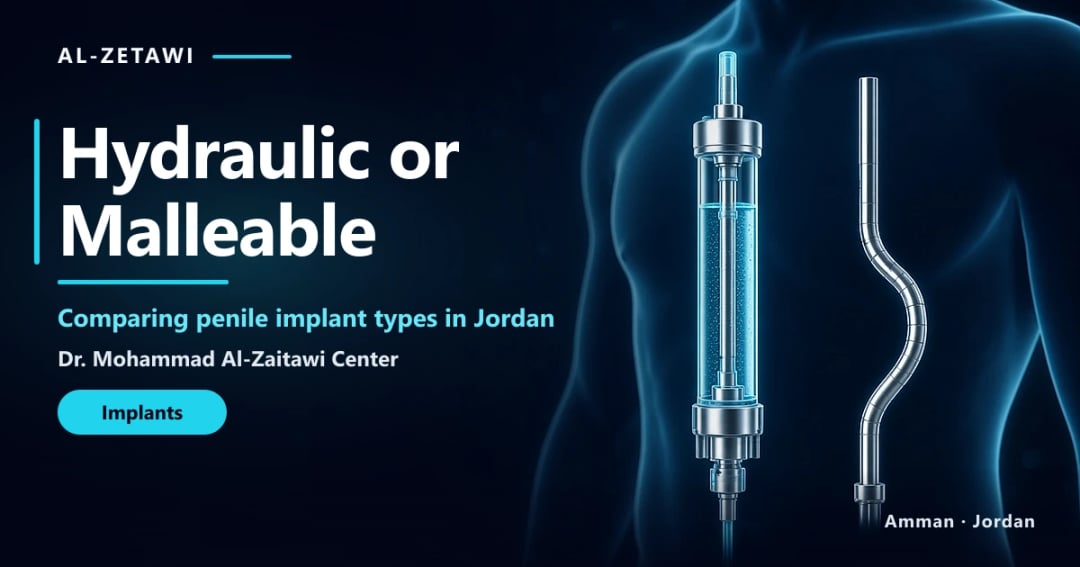
What the Two Implants Are
A hydraulic penile implant uses fluid and a scrotal pump to create rigidity and then return to a softer state. A malleable implant is a bendable rod that stays firm and is positioned by hand. Both are options when tablets, a vacuum device, and injections have not given a usable erection. Neither recreates a natural erection.
Erection, in health, is a vascular event. Signals relax smooth muscle in two cylindrical bodies, the corpora cavernosa, blood fills them, and veins are compressed so the penis becomes rigid enough for penetration. The glans, the head, engorges through a separate spongy body that surrounds the urethra. Erectile dysfunction means this sequence fails often enough to matter to the man and, usually, to a partner. Tablets that support the chemical signal, a vacuum cylinder with a constriction ring, and injections into the side of the shaft are the treatments most men meet first. An implant does not repair that chemistry. It replaces the filling mechanism with a device placed inside the corpora. Desire, touch, and climax stay dependent on nerves and on the relationship, not on the brand of cylinder.
Two mechanical ideas
The hydraulic idea stores sterile fluid in a reservoir and moves it into cylinders when you want rigidity. When you are finished, the fluid goes back and the penis lies softer. The malleable idea accepts permanent firmness. A metal core inside a soft coat can be bent up for intercourse and down toward the scrotum for daily life. There is no pump to learn and no reservoir to place beside the bladder. There is also no truly flaccid state. Understanding that single trade, softness versus simplicity, is the heart of the consultation. Everything else is detail around it.
Neither device is a lengthening procedure, a filler, or a treatment for low desire. Men sometimes arrive having mixed those markets together. A prosthesis will not enlarge a penis beyond the envelope the tissues already allow, and it will not create interest that depression, hormones, or a relationship problem have removed. Hormone deficiency, where it exists, is tested and treated on its own merits before anyone calls the erection "mechanical failure". Cardiovascular safety of sexual activity is considered too. The Princeton consensus exists because the exertion of intercourse, not the incision, is what some hearts cannot tolerate. An implant in a man who has been told to avoid sexual exertion is not a kindness.
How this guide is meant to be read
The language here stays anatomical because the decision is anatomical. You will read about the scrotum, the glans, penetration, and orgasm. You will not find a prescription, a cylinder diameter, or a story presented as a review. Dr. Mohammad Al-Zaitawi's clinic in Amman uses this comparison in counselling. Placement of a prosthesis is planned with a surgeon who does that operation, after the history shows that simpler care has already had a fair trial or a clear reason to be skipped. If you still have not tried a vacuum device or discussed injections, that conversation comes before a device is ordered.
Bring a partner if you have one and if you both want that. Concealment and hand strength are easier to judge when the person who will notice the result is in the room. If you prefer to come alone, that is equally legitimate. The models of the devices should still be handled. A decision made from a photograph is how men choose a pump their fingers cannot work.
Where an Implant Sits in Care
Guidelines from the American Urological Association and the European Association of Urology place the prosthesis after, or instead of, less invasive treatment, not before it. Oral medicines are first for many men because they are reversible. They fail when the nerves are gone, when the blood supply is severely diseased, when side effects are intolerable, or when a nitrate medicine for the heart makes that drug family unsafe. A vacuum device is unglamorous and effective for some couples. Injections work well for others and cause pain, scarring, or a prolonged erection in a minority. A prolonged erection is an emergency. It is also a reason some men reasonably refuse to continue injections. An implant is appropriate when these options are ineffective, unwanted after a real explanation, or medically unwise. It is not appropriate as a shortcut past a conversation you found embarrassing.
Causes that change the counselling
Diabetes, smoking, high blood pressure, and raised lipids damage the small vessels of the penis over years. Pelvic surgery, especially radical prostatectomy or rectal surgery, can injure the nerves that start an erection even when the vessels are intact. Radiotherapy in the pelvis does similar slow harm. Spinal cord injury changes both erection and sensation, and it changes the risk profile of a permanent rod against skin the man may not feel. Peyronie's disease adds scar and curvature. Low testosterone may reduce desire more than rigidity, and replacing it is a medical decision with its own monitoring, not an automatic prelude. Psychogenic erectile dysfunction, where morning erections persist and the difficulty is situational, is often a poor indication for a permanent device. That distinction requires a history, not a hunch. Men are sometimes angry to be asked about morning erections. The question is trying to save them from an operation they do not need.
Medicines that contribute to erectile difficulty, including some antidepressants and some blood-pressure tablets, should be reviewed by the prescriber before surgery is treated as inevitable. Stopping a psychiatric medicine without a plan is not sexual health. It is a new illness. Say what you take. A careful clinic will not raid another specialty's regimen in order to sell an implant.
Shared expectations before any model is chosen
You should be able to say, in your own words, that the erection will be mechanical, that the glans may stay softer than the shaft, that length is not increased, and that infection can mean taking the device out. If those four sentences feel unacceptable, you are not ready, and that unreadiness is useful information. Partners should hear that orgasm and ejaculation are not guaranteed by the hardware. After prostatectomy many men already have a dry orgasm. The implant does not bring semen back. Counselling that promises a "natural feel" without these limits is advertising. Dr. Al-Zaitawi's standard is that the limits are said early enough for you to walk away without embarrassment.
Fitness for anaesthesia is separate from fitness for sex. A man who can safely have a hernia repair can usually be assessed for this operation, which is not a prolonged procedure in straightforward cases. A man with unstable angina is not cleared by enthusiasm. The sexual activity he hopes to resume is part of the cardiac question. Coordinate with the physician who knows your heart rather than hoping the implant day will sort it out.
How a Hydraulic Device Works
The usual hydraulic prosthesis has three pieces. Two cylinders lie inside the corpora cavernosa, one on each side of the penis. A small pump sits in the scrotum, where it can be felt and worked between the fingers. A reservoir of fluid sits in the lower abdomen or in the space beside the bladder, connected by tubing you cannot see. When you squeeze the pump several times, fluid moves into the cylinders and they become rigid. A release mechanism, usually a part of the same pump that you squeeze differently or press, lets the fluid return. The penis softens. You remain able to pass urine through the urethra, which is not where the cylinders sit, provided the urethra was respected at surgery.
What everyday use actually involves
Learning takes practice and should happen with the clinician, not from a video alone, once tenderness has faded. Men with good pinch strength usually master it. The scrotum needs to be supported gently while the pump is found. Early on, swelling disguises the shape. That is why the formal lesson is delayed until you can feel the pump as a distinct object. Inflating before the tissues have settled, to "test it", is a cause of pain and a poor test. Deflation should become a habit before you dress, so you do not spend the day partly inflated and uncomfortable. A well deflated device lies discreetly. A half-deflated one is what people notice.
Two-piece hydraulic designs exist. They combine reservoir and pump function in a way that avoids a separate abdominal reservoir. They are chosen occasionally when placing a reservoir would be unwise and a fully malleable rod is not what the man wants. They are a compromise on fullness and on softness, not a secret upgrade. If one is offered, ask what problem with a three-piece device it is solving in your abdomen. The answer should mention prior mesh, prior pelvic surgery, or a specific anatomical limit, not a preference you never stated.
What the fluid system can and cannot survive
The fluid is sterile salt solution inside a closed device. You do not top it up. You do not inject anything into the pump. A leak in tubing or a crack in a cylinder is a mechanical failure. The erection becomes uneven or incomplete. This can happen years later in a device that was perfect. It is disappointing and usually correctable with a revision, not a personal failure. Pumps can also stick. Revision is a second operation with a second infection risk, which is why the first operation's infection prevention matters so much. Hydraulic devices ask more of the body in exchange for a softer resting state. That exchange is worth it for many men and wrong for others. There is no leaderboard.
Concealment under clothing is the advantage you are buying. In a changing room, in light trousers, and in a close embrace when you are not intending sex, a deflated cylinder behaves more like ordinary tissue than a rod does. Partners often prefer that. The cost is the learning and the later possibility of a mechanical revision. Name that cost in the consultation so it does not arrive as a surprise in the fifth year.
How a Malleable Device Works
A malleable prosthesis is a pair of rods placed in the same erectile bodies. Each rod has a core that holds the position you bend it into, coated so the surface is not bare metal against tissue. There is no pump, no tubing, and no reservoir. To have intercourse you lift the penis into a useful position. Afterward you bend it down, often against the scrotum or toward the thigh, so clothing fits more easily. It remains firmer than a natural flaccid penis. That sentence should be said aloud and accepted before this device is ordered. Men who need a completely soft resting state will be unhappy with it even if the operation is technically perfect.
Who finds the simplicity worth the firmness
Limited dexterity is the clearest reason. Arthritis, tremor, a previous stroke, poor vision, or neuropathy from diabetes can make a small scrotal pump frustrating or impossible. A rod that you position with the whole hand asks less fine movement. Some men simply do not want a mechanical sequence in an intimate moment. They would rather have a device that is always ready and accept the concealment cost. Cognitive difficulty matters too. If remembering the inflation steps will not be reliable, a malleable rod can be the safer, kinder tool, sometimes with a partner who helps with positioning. That plan should be agreed, not assumed. A partner who did not consent to that role should not discover it after surgery.
There is a second, surgical reason. When the pelvis has already been operated on, when a kidney transplant sits in the iliac fossa, or when hernia mesh fills the lower abdomen, the space for a reservoir may be awkward or unsafe. A malleable device sidesteps that space entirely. Previous implant infection is another setting in which some surgeons prefer the simpler device for a later attempt, once tissues have recovered, because there is less hardware. These are judgements made on your scans and your scars. They are not a hierarchy of prestige. A malleable implant in a complex pelvis is often the more sophisticated decision.
Daily life with permanent firmness
Clothing choices may change. Closer trousers show more. Swimming costumes show more. This is not equally important to every man, and it should not be minimised for the man to whom it is important. Some occupations and some social settings make a permanent outline genuinely distressing. Say so. The alternative is a hydraulic device if your hands and your pelvis allow it. Pain from pressure is uncommon but real, especially if sensation is reduced and the rod presses in one position all night. Men with spinal cord injury need particular teaching about pressure, skin checks, and not leaving the penis bent in a way that they cannot feel. Erosion is uncommon. It is more worrying when the skin cannot report pain. That is a counselling topic, not a reason to refuse all treatment, and not a reason to pretend the risks match those of a man with normal sensation.
Urination is usually unchanged in direction once swelling settles, because the urethra is a separate channel. If the stream becomes spraying or difficult, that is a reportable problem, not something to watch for weeks. The rods should not be visible through the skin. A pale or thinning area at the tip is a warning of erosion and needs an examination promptly, before the device is through the skin.
Concealment, Rigidity, and Everyday Life
Compare the devices by the hours you are not having sex, because those hours are most of your life. A hydraulic implant, properly deflated, is the one that tries to disappear. You will feel the pump in the scrotum if you search for it. A partner may feel it. Under ordinary clothing it should not announce itself. A malleable implant does not disappear. It can be decently positioned, and many men are content, but it is a permanent firmness. If your priority is a spontaneous-looking body in a shared bathroom, lean hydraulic, provided you can work the pump. If your priority is reliability without a sequence of squeezes, lean malleable, provided you can accept the feel.
Rigidity is the point of both
Both devices are capable of penetration when they are the right size for the corpora and the operation has gone well. Rigidity from a hydraulic cylinder is often described as more natural in the sense that it comes and goes. Rigidity from a rod is immediate and does not depend on a pump that might stick. Neither matches the slight give and the glans fullness of a youthful erection. The shaft is supported from inside. The glans may remain relatively soft, which some couples notice and most accommodate. A very soft glans that slips during penetration is a known complaint. There are surgical manoeuvres for selected cases. They are not a promise, and they are discussed if the problem actually occurs, not as a bundle sold in advance.
Travel, sport, and physical work are usually possible once healing is complete. Cycling and certain saddle sports may be uncomfortable and are restarted cautiously. A reservoir in the pelvis is not a reason to avoid a normal life, but it is a reason to tell a surgeon before a later hernia repair or prostate operation. Security screening at airports does not single these devices out in any special theatrical way. The device card is still worth carrying for medical scans and for any future operation. You do not owe strangers an explanation in a gym. You do owe your future anaesthetist one.
Relationships and privacy
A regular partner usually does better when they understand the device before the operation. Surprise during intimacy is harder than a slightly awkward conversation a month earlier. Men who are not in a relationship still have a valid reason to choose an implant. Concealment then matters for future partners and for the man's own comfort. There is no medical requirement to be married, and there is no medical requirement to demonstrate the device to anyone except the clinician teaching you. What is unwise is choosing a hydraulic pump you cannot deflate and then avoiding all follow-up because you are embarrassed. The follow-up exists to catch a half-inflated device, a forming infection, or a man who never learned the release.
Mood and desire still govern whether the device is used. An implant does not repair grief, a hostile relationship, or a depression that removed interest in sex. Those deserve their own care. Some men feel more confident simply knowing rigidity is available, and use it less often than they predicted. That is a successful outcome if it matches their hope. A clinic should ask what success means to you before measuring it with a number of monthly uses you never agreed to.
Hands, Sight, and Who Manages Which Device
A hydraulic pump is small, and the scrotum is a sensitive place to practice. You need enough pinch to compress the bulb repeatedly, enough sensation to know you have the pump and not the testis, and enough sight or spatial sense to do it without watching if that is how you live. Practice models in clinic are more honest than reassurance. If you cannot work the model on a calm afternoon, you will not work it more easily when you are nervous and tender. Say so. Switching the plan to a malleable device before the operation is a success of counselling. Discovering the problem afterward is a revision conversation nobody wanted.
Partners, tremor, and memory
A willing partner can be taught to inflate and deflate a hydraulic device. That is a reasonable plan for some couples and an unfair assumption for others. The partner should be in the room when the plan is made, should be able to see or feel the pump reliably, and should not be someone whose presence in your life is uncertain. Tremor may still allow a malleable bend when it does not allow a fine squeeze. Memory impairment cuts both ways: the steps of a pump are hard, and a rod left in a pressure position without recall has its own risk. The clinician's job is to match hardware to the hands and the household you actually have, not to the household in a brochure.
Vision matters less than people expect if sensation in the fingers is good, because the pump is found by touch. Severe neuropathy removes that backup. Diabetes can take dexterity and sensation together, which is exactly the population that often needs an implant. This is not a contradiction. It is a reason to test the model rather than to guess from the diagnosis. A man with diabetes and skilled hands may be an excellent hydraulic candidate. A man with diabetes and numb fingertips may not. The disease name does not choose the device. The examination does.
Teaching after surgery is part of the operation
The best cylinder placement can still fail the patient if nobody teaches deflation properly. The lesson should be unhurried, repeated if needed, and accompanied by a way to contact the team when the pump cannot be found in the first fortnight of swelling. Written steps help. A single demonstration as you are leaving the ward does not. Malleable devices need teaching too: how far to bend, which direction avoids pressure on the urethra, and when to come back if the tip looks thin or pale. Men are sometimes shy of returning. Shyness is how a small skin problem becomes an erosion. Dr. Al-Zaitawi's counselling includes this follow-up expectation before the date is set, so the operation is not imagined as a single day.
If you travel to Amman for the procedure, the teaching plan has to survive the flight home. A video review, a clear number to message, and a local clinician who knows you have an implant are part of safety. Do not leave on the morning you were supposed to demonstrate deflation for the first time. The itinerary follows the swelling, not the other way around.
Infection, Erosion, and Mechanical Failure
Infection is the complication that dominates consent. Skin bacteria can seed the device despite careful preparation. Diabetes, revision surgery, spinal injury, prolonged operation, and a break in the sterile field raise the risk. Prevention is a bundle: treating urine infection first, skin preparation, a limited number of people in the room, antibiotics given for prophylaxis rather than as an afterthought, and a device handled in a way that keeps it from touching skin. You will not be given a dose to copy. You will be asked to follow washing instructions and to say if you have a boil, a dental infection, or a fever in the days before. Operating through an active skin infection is how devices are lost.
What infection looks like and what it costs
Early infection may show fever, spreading redness, wound fluid, or pain that is worsening rather than fading. Late infection can be quieter. The usual end of a clearly infected prosthesis is removal. Leaving an infected foreign body in place and hoping antibiotics will sterilise it is often a way to prolong illness. Some carefully selected cases are treated with salvage replacement. That is a specialist judgement, not a promise. After removal, a later attempt at a new device is sometimes possible once the tissues have settled, and sometimes the tissues are then better suited to a malleable rod. Men should hear this sequence before the first operation so that infection is understood as a real branch of the story, not as a rare footnote in small print.
Erosion means part of the device is wearing through tissue, toward skin or toward the urethra. Pain, a spraying stream, blood at the tip, or a visible edge under thin skin are warnings. Erosion requires prompt assessment. Continued use can turn a threatened erosion into an infected one. Reduced sensation, a poorly sized rod, and long-term pressure are classic contributors. This is uncommon in well selected men and important enough to name. It is not a reason to describe the operation as unsafe in general. It is a reason to keep follow-up and to look at the tip of the penis if something feels wrong.
Mechanical failure is mostly a hydraulic conversation
Rods seldom snap. Hydraulic tubing, pumps, and cylinders can fail after years of use. The result is a device that will not inflate fully, inflates on one side, or will not deflate. Revision replaces the failed part or the whole device. Each revision carries infection risk again, which accumulates over a lifetime if a young man needs several. This is one honest reason some younger men still choose hydraulic devices: the concealment is worth a possible future revision. It is one honest reason some men choose malleable: they prefer to avoid that future. No clinic can promise a decade without reoperation. Anyone who does is selling a number they do not control. Ask instead how revisions are handled and whether the device card will identify the model. Future surgeons need that card more than they need your memory of a trade name.
Bleeding and haematoma in the scrotum look dramatic and are often self-limited. A haematoma that expands, or a wound that opens, is not. Urethral injury recognised at surgery may mean stopping and placing no device that day. That disappointment is safer than implanting through a hole you will erode later. Anaesthetic risk follows your general health. The operation is not a trivial injection, and it is not open heart surgery. Proportion belongs in the consent.
Length, Sensation, and Partner Experience
Length is the expectation most likely to injure satisfaction if it is left fuzzy. The cylinders occupy the corpora. They do not extend the penis beyond what those cylinders can hold. Years of absent erections allow elastic tissue to contract. Pelvic surgery and Peyronie's scar do the same. After the implant, the visible length may be less than the man's memory of himself at twenty. Surgeons can use techniques to recover some lost length in selected, scarred cases. They cannot invent tissue. Measuring in clinic, with a calm explanation of glans support, is kinder than discovering the difference during a first attempt at intercourse. If length is your primary goal and rigidity is acceptable already, you are in the wrong consultation.
Sensation and climax
Touch on the skin and glans is carried by nerves that the cylinders do not replace. Most men with normal sensation before surgery keep it. Men whose nerves were damaged by prostatectomy, diabetes, or spinal injury keep the sensation they already had, whether that is reduced or not. Orgasm remains possible for most and is not delivered by inflation. It still depends on arousal, pelvic floor sensation, and the brain. Ejaculation of semen stops being the measure after some prostate operations, where climax can be dry. Explain that to a partner so they do not interpret a dry climax as a broken implant. Pain with orgasm is uncommon and reportable. It is not something you are expected to tolerate in silence because you "chose surgery".
Partners sometimes worry they will feel a mechanical edge or be injured. A properly placed device, used when you are ready and with ordinary lubrication if tissues are dry, should not injure anyone. Dryness after menopause or after hormonal treatment is a partner's medical issue as well, and it deserves its own care rather than being blamed on the implant. A malleable rod feels firmer at rest. A hydraulic cylinder feels firmer when inflated and softer when it is not. Couples adapt better when they have handled the teaching model together and when the first attempts are allowed to be short, awkward, and free of an audience of expectations. Pain is a reason to stop and to be examined if it persists. Bravery is a poor wound-care strategy.
What satisfaction usually tracks
Satisfaction in published series is generally high when men were counselled honestly and the indication was true drug-refractory erectile dysfunction. Dissatisfaction clusters around length, a soft glans, difficulty with a pump, infection, or a partner who was not included in the original hope. These clusters are predictable. They are the curriculum of the preoperative visit. A clinic that measures success only by "the operation was done" will miss them. A clinic that asks, at a later visit, whether you can inflate, whether you can deflate, whether intercourse is comfortable, and whether the resting appearance is acceptable, will catch them early. That is the standard this guide is arguing for.
Pornography and social media are unreliable tutors here. They present erections that are not a clinical outcome and devices that are not labelled. Judging your result against that material will make even a technically perfect implant feel like a failure. Judge it against the goal you wrote down: reliable rigidity, acceptable concealment, preserved sensation. Those are adult goals. They are enough.
Diabetes, Curvature, and Previous Surgery
Diabetes belongs in the consultation as a healing factor and as a cause of erectile failure, not as a moral category. Glucose that has been running high is improved before an elective implant because infection risk is otherwise needlessly higher. The target and the medicines are the prescribing physician's. This page will not set a number for you to chase the night before theatre. Neuropathy, retinal disease, and heart disease travel with long-standing diabetes and may change both the device choice and the anaesthetic. A man who cannot feel a small ulcer on his foot needs a frank talk about whether he will feel a problem at the tip of the penis. That talk can still end in an operation. It should not be skipped.
Peyronie's disease
Peyronie's disease is scar in the wall of the erection bodies that bends the erect penis and sometimes shortens it. In the stable phase, when pain has settled and the curve has stopped changing, an implant can provide rigidity and straighten a useful share of curvature because the cylinders act as an internal splint. Residual curve, narrowing, or a hinge may need an additional straightening manoeuvre at the same operation. Those manoeuvres raise complexity slightly and should be consented, not improvised as a surprise. An implant is not the first treatment for a mild curve with a still-usable erection. Tablets, traction discussions, and other options exist and belong to a proper Peyronie's assessment. Operating in the painful, changing phase is how results disappoint. Date the onset. If the shape is still evolving month to month, wait.
Previous implant surgery changes the tissues. A removed infected device leaves scarring that can shorten the corpora and make a later cylinder harder to place. A mechanical revision of a hydraulic device is a different, usually cleaner, operation if infection is absent. Bring the old device card. Knowing the model tells the surgeon what connectors and reservoirs to expect. "I had an implant abroad" is not a model number. If the first device eroded, the reason matters before a second one is offered. Repeating the same pressure problem in numb skin is not courage. It is a pattern.
Pelvic surgery, mesh, and transplants
Radical prostatectomy is a common path to this clinic. Nerve-sparing technique improves the chance of natural recovery but does not guarantee it, and recovery can take many months. An implant too early can pre-empt a return that was still possible. An implant delayed for years of avoidable distress is the opposite error. The interval is individual and should respect any ongoing cancer follow-up. A reservoir can usually be placed after prostatectomy, with attention to the altered pelvis. Hernia mesh, especially large laparoscopic mesh, can occupy the same neighbourhood. Kidney transplants sit in the iliac fossa and are not a place for a careless reservoir. In those abdomens a malleable device, or a hydraulic plan that avoids the transplant, may be wiser. The surgeon who places the implant needs to know the transplant team exists. You are the messenger if the records are in different hospitals.
Anticoagulation for a heart stent or a valve is coordinated, never casually stopped. A cancelled case because nobody spoke to cardiology is annoying. A stroke because somebody stopped a medicine for a penile implant is a catastrophe. The order of priorities must be visible in the plan you take home.
The Day of the Operation
Preparation is deliberately dull. You shower as instructed, avoid improvising a shave that cuts the skin, and say if you have a cold, a skin sore, or burning urine. A urine infection on the morning is a reason to postpone, not a reason to push on because travel was expensive. Blood-thinning medicines follow the plan agreed with the physician who started them. You meet the anaesthetist. Many men have a general anaesthetic. Some pathways use a regional technique. The choice is about your health and the team's practice, not about toughness. A brief safety check confirms the device type you agreed. If you decided on malleable and the consent says hydraulic, stop the line until the words match.
What you are asleep for
The skin is prepared more carefully than for many other operations because the device is an implant. Hair is managed in theatre rather than by an aggressive home shave that leaves cuts. An incision is made in a place the surgeon can use safely, often on the scrotum or at the junction of penis and scrotum. Through that opening the erectile bodies are entered and sized. Sizing is the surgeon's task. You are not awake to negotiate millimetres, and a webpage should not pretend to teach it. Cylinders that are too long threaten erosion. Cylinders that are too short sit poorly and worsen the complaint of a soft tip. The malleable rods or the hydraulic cylinders are placed. If a hydraulic device was planned, the pump is seated in the scrotum and the reservoir is placed in the lower abdomen or pelvis through the same plan, sometimes with a separate small incision. The team checks flow, symmetry, and the urethra. Then the device is left deflated or in the agreed resting position, and the skin is closed.
A catheter may drain the bladder overnight or may not be used. It is a comfort and safety choice, not a sign of urethral disaster, unless you are told otherwise. A dressing and a scrotal support limit swelling. You wake with bruising that can look worse than it is, including colour tracking down the shaft. That colour is not, by itself, an infection. Fever and feeling systemically unwell are different. Most men go home the same day or after one night if they are comfortable and have passed urine. A hotel far from help is a poor discharge address in the first day. Stay where you were told to stay.
What the day does not include
You will not inflate the device for intercourse on the day. You will not see the final cosmetic resting state through fresh swelling. You will not be given a milligram chart of antibiotics to continue according to a forum. If tablets are continued after discharge, the name and the duration are on your paper because of your operation, not because of this article. Ice, support, and walking as advised are the ordinary home measures. Ignore advice to "cycle the pump hard" in the first nights. Early cycling, when it is used, follows a specific instruction to keep a capsule supple, and it is not the same as sexual use. If you were not given that instruction, do not invent it.
Before you leave, you should have the device card, a contact number, and a written statement of which implant is inside you. Photograph the card. Future MRI requests and future abdominal operations depend on it. A man who knows he has "the inflatable one" has not given the next clinician enough.
Healing and When Intimacy Resumes
The first fortnight is bruising, swelling, and support. The penis may point in an odd way until swelling drops. The scrotum can feel firm around a pump. Pain should trend down. Pain that climbs, a temperature, or fluid from the wound is a call, not a character test. You may shower when told the incision is ready. Soaking in a bath too early softens a healing edge. Clothing that supports is more comfortable than clothing that aims to look normal. Sexual thoughts do not injure the device. Sexual use before clearance can.
The lesson and the first attempts
When tenderness allows, a hydraulic device is inflated and deflated in clinic until you can do it. You then practice at home, not as a performance, but as a skill. Some surgeons ask you to cycle the device regularly for a period so a scar capsule forms around a correctly shaped cylinder. Follow the instruction you were given rather than a generic schedule from the internet. Malleable devices are positioned gently. The first attempts at intercourse are often several weeks after surgery, commonly around a month or later if swelling or pain argues for patience. There is no prize for being early. Lubrication, a position that does not put all the weight on a tender scrotum, and permission to stop are the whole technique. If penetration is painful for you or your partner, stop and be examined if it happens again. A soft glans, a rod that is too prominent, or a cylinder that is not seated right can all be assessed. They cannot be assessed if you disappear.
Orgasm may take longer to return than rigidity. That lag frightens men who equate the device with their entire sexual function. Rigidity was the only part the operation promised. Arousal still belongs to you. If climax was present before surgery and is absent months later, say so. If it was already absent after prostatectomy, the implant has not failed. Mood, blood pressure medicines, and fatigue are allowed into that conversation. A surgeon who will only discuss hardware at the review has done half the follow-up.
Months later
By a few months the swelling is a memory and the device is either part of life or a problem with a name. Hydraulic users should be able to deflate fully every time. Malleable users should have a position that does not hurt and does not tent clothing more than they accepted. Skin at the tip should look like skin, not like a thinning window. Any later operation on the abdomen should be preceded by a sentence about the reservoir if you have one. Any MRI booking should start with the device card. Dental work and other procedures do not automatically require special antibiotics because you have a penile implant. Ask if a specific procedure raises that question, and do not start leftover tablets "to be safe".
If the device fails mechanically years later, revision is a discussion, not an emergency in the middle of the night, unless infection or inability to urinate is part of the picture. A pump that will not deflate and is painful needs earlier contact than a pump that has gradually become weak. Know which situation you are in. The follow-up door in Amman, and the clinician you name at home, should both understand the difference.
Making the Choice
Write down what you are optimising. If it is concealment and your hands work, a hydraulic device is usually the better match. If it is simplicity, weak hands, or a pelvis that should not hold a reservoir, a malleable device is usually the better match. If you cannot accept either permanent firmness or a scrotal pump, you may not want an implant at all, and that is a respectable outcome of counselling. The worst choice is a hydraulic device you cannot deflate, or a malleable device you will resent in every changing room, made because one of them was in stock.
Questions for the visit
Ask which treatments you still have not tried and whether skipping them is medically justified. Ask which device the counsellor thinks fits your hands, and why. Ask where the reservoir would sit if you have had hernia mesh, a transplant, or prostate surgery. Ask what happens, step by step, if infection occurs. Ask when you would be taught, when intercourse would be considered, and who answers a message after you go home. Ask how length will be discussed so you do not discover the limit as a shock. Ask for the device card at discharge. Ask whether the surgeon placing the device does this operation as part of regular practice. A careful answer is specific. A sales answer is fluent and vague.
Bring a list of medicines, a note of previous pelvic operations, and any old implant documents. If you use a vacuum device or injections, say how they failed. "They did not work" is less useful than "the tablets gave headache and no rigidity" or "the injection worked but the erection would not go down". Those are different pathways. If a partner will share the teaching, bring them. If you do not want them involved, say that too. Privacy is part of the plan, not an obstacle to it.
A decision without theatre
Cost follows the device and the hospital and is quoted for a named plan. This guide will not print a price, because a hydraulic revision and a first malleable implant are not the same episode of care. Beware of a quotation that does not say which device, whether the reservoir is included, and what a return for infection would cost. Beware equally of a clinic that will not discuss malleable devices because the hydraulic model is more impressive in a photograph. You are choosing a tool for the next decade of ordinary days.
This page is general education from the clinic of Dr. Mohammad Al-Zaitawi in Amman, Jordan. It does not prescribe tablets, does not size a cylinder, and does not replace an examination. Erectile dysfunction is common, mechanical treatment is legitimate, and the choice between hydraulic and malleable should feel almost plain once the trade-offs are said in everyday words. If it still feels like a sales pitch, wait. A device inside the body can wait for a clearer yes.
Medical note from Dr. Mohammad Al-Zaitawi
I ask men to separate rigidity from desire, sensation, and climax. An implant can provide stiffness when tablets, a vacuum device, and injections have not. It does not create a natural erection. The choice between hydraulic and malleable is about hands, concealment, future operations, and what still feels acceptable under clothing.
Scientific references and guidance
These sources support the medical information on this page. If you want this guidance applied to your own case, send us your details for an initial review.
Reviewed by Dr. Mohammad Al-Zaitawi
Prefer a quicker route? Try the free case review or see bariatric surgery costs in Jordan.