
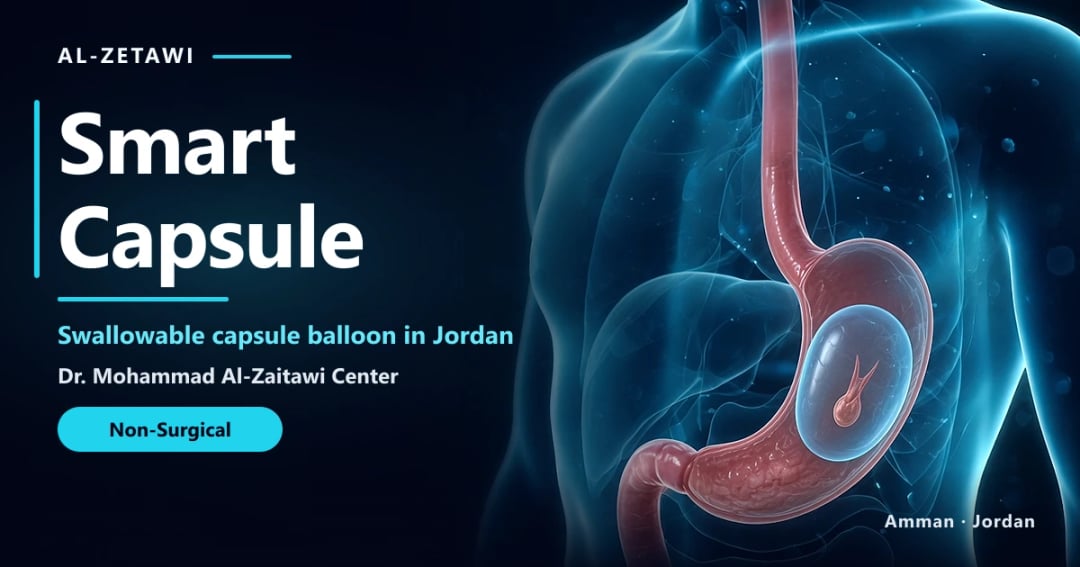
What a Smart Capsule Is
A smart capsule for weight loss is a swallowable balloon filled in the stomach and left for a limited time to help you eat less. It is a device class, not one brand. The capsule must be confirmed in the stomach before it is filled. It is not an operation, and the result depends on the eating programme around it.
Patients use the words smart capsule for a balloon you swallow, rather than a balloon that a doctor places with a camera. Inside the class, products differ. Some are attached to a very thin filling tube that is withdrawn once an X-ray shows the capsule is in the stomach. Some are designed to empty themselves after a set number of months and to pass through the bowel. Others may still need an endoscopic procedure if they do not behave as designed, or if they cannot be tolerated. The clinic does not treat those designs as interchangeable. Dr. Mohammad Al-Zaitawi offers a swallowable balloon only when assessment says a balloon is appropriate and a suitable device is actually available in Amman.
The balloon works by taking up space and by changing how quickly you feel full. It does not remove part of the stomach, it does not reroute the intestine, and it does not cause the malabsorption of a bypass. Liquid calories, melted ice cream, and sweet drinks can still pass around it. That is why people who drink their calories can defeat the device while it is sitting correctly. The capsule is a temporary constraint. The change in how you eat, sleep, and move is the part that can outlast it.
It is not a camera and it is not a thinking machine
A different capsule is used in gastroenterology to photograph the small bowel. That diagnostic pill contains a camera and a light. It does not treat weight. Sharing the word capsule causes real confusion. If you have been told you need a camera capsule because of bleeding or suspected Crohn's disease, this page is not that test, and a weight-loss balloon is not a substitute for it. Ask which meaning is intended whenever the phrase is used in a message or an advertisement.
Smart, in the name patients hear, usually refers to a built-in release that lets the balloon deflate after its planned life, or to a design that avoids routine endoscopy. It does not mean the device measures your meals, adjusts itself during the day, or decides your treatment. It cannot tell a craving from thirst. It will not message your phone if you are eating past fullness, unless a separate programme happens to use an app. Any app is education. The balloon is silicone and fluid, or whatever materials that particular product uses. Treat marketing adjectives as adjectives.
Because products change and approvals differ by country, this page describes the class. It does not copy a manufacturer brochure, it does not promise a fill volume, and it does not promise a residence time. Those numbers are read from the instructions of the device in front of you, at the consultation, after someone has decided you are a candidate. If a clinic cannot name the device, the imaging step, the expected duration, and the rescue plan if the balloon obstructs the bowel, it is not ready to place one.
How a Swallowable Capsule Differs from an Endoscopic Balloon
An endoscopic gastric balloon is placed with a camera, under sedation, and is removed with a camera at a planned later date. A swallowable capsule is designed to be swallowed without that placement endoscopy. That single difference drives most of the rest. You usually do not need a companion because of sedation, because you usually are not sedated. You do need an X-ray or an equivalent check that the capsule has reached the stomach before anyone fills it. Filling a capsule that is still in the oesophagus, or that has slipped onward, would be dangerous. The picture is not a formality.
Removal is the second large difference. A standard endoscopic balloon stays until a clinician takes it out. Leaving it in beyond its rated life raises the chance of deflation and blockage. A swallowable balloon in the passable subgroup is built to open and travel down the intestine. You may never see it. You might see it in the toilet. Both can be normal for that design. The danger is a balloon that deflates early, or a deflated shell that sticks at a narrow point in the bowel. That is an emergency pattern: pain, vomiting, a swelling abdomen, and failure to pass gas. Endoscopic balloons can also deflate and migrate. The difference is that their primary plan is a booked removal, not transit through the intestine.
What you gain and what you give up
What you gain with a swallowable device is a lighter placement day and, for many products, no planned second procedure. What you give up is the look inside. An endoscopy sees ulcers, large hernias, leftover food, inflammation, and previous surgical changes before a balloon is filled. A swallowable pathway may include an endoscopy anyway if your history is not straightforward, or if swallowing fails and you still want a balloon. No endoscopy as a slogan is not the same as no endoscopy in your case. Assessment decides whether the stomach needs to be seen.
Weight-loss expectations should not be copied from the other device. Both are temporary balloons. Published series for fluid-filled balloons, swallowable and endoscopic, generally show modest average loss compared with metabolic surgery, often in the region of about a tenth of starting body weight by the end of treatment in people who complete the programme, with wide scatter around that average. Some people lose more. Some lose little. Some regain quickly after the balloon is gone. Anyone quoting a personal transformation as if it were the device specification is selling. The consultation should quote a range and a condition: the range appears when eating changes, and it shrinks when liquid calories continue.
You also give up adjustability with many swallowable designs. Some endoscopic balloons can have fluid added or removed at a later camera test. A capsule that has no port cannot be topped up because you feel it is not tight enough. If it is intolerable, the solution is support, and sometimes endoscopic retrieval, not a casual extra fill. Hear that before you swallow. A device you cannot easily empty in the clinic is a device you must be willing to have rescued if it makes you ill.
The pages are separate because the aftercare is separate. People who need the stomach inspected, who cannot swallow a large capsule, who need a balloon that will be retrieved on a known date, or who may need volume adjustment, are endoscopic-balloon candidates if they are balloon candidates at all. People who want to avoid sedation and who fit a swallowable product's rules may be capsule candidates. Some people should have neither. They should have a structured medical programme, an anti-obesity medicine prescribed properly, or an operation.
Who a Swallowable Balloon May Suit
A swallowable balloon is considered for adults with overweight or obesity who have already tried a structured effort at eating and activity, who understand that the device is temporary, and who can attend follow-up for the whole time it is inside them. The body-mass range is not a slogan on this page. It is the range written in the approval of the specific device plus the judgement of the clinician. Many balloon programmes have historically focused on people below the range where surgery is clearly indicated, and on people who are not ready for surgery or whose risk of surgery is high for reasons that a balloon does not share. Surgery remains the more effective and more durable treatment when the indication for surgery is strong, especially with serious metabolic disease.
A good candidate can swallow a large capsule with water, can come for imaging on the day, can tolerate a period of nausea without living alone and unsupported, and can change the pattern of meals. A good candidate also has a plan for the month after the balloon has gone. That month is when old portions try to return and the stomach is empty again. People who only want the weeks of nausea to be over, with no plan beyond that, are borrowing a device.
What assessment looks at
Assessment includes weight history, previous diets and medicines, pattern of eating, bingeing or purging, alcohol, smoking, sleep, reflux, abdominal surgery, hernias, inflammatory bowel disease, and medicines that raise bleeding risk. It includes pregnancy plans. It includes whether you can reach urgent care. A balloon that can obstruct the bowel is not a device to place in a person who cannot get to a hospital. For international patients that question is practical: where will you be in week six, and which hospital will see you if you start vomiting and cannot keep water down.
Metabolic disease does not automatically disqualify you and does not automatically mean a balloon is enough. Type 2 diabetes, high blood pressure, fatty liver, and sleep apnoea improve when weight falls, including when the fall is modest. They improve more, and more durably, with the larger weight loss of surgery in people who meet surgical criteria. A balloon can be a step, a trial of how you respond to forced portion control, or a choice when surgery is declined. It should not be described as the same treatment. Dr. Mohammad Al-Zaitawi will say which of those sentences applies to you. The device does not get to say it.
Age, by itself, is not the criterion. The ability to swallow, the safety of an X-ray, the support at home during the nauseated days, and the wisdom of a temporary tool versus a definitive operation are the criteria. Adolescents are not managed on an adult consumer pathway. Pregnancy is a contraindication. If you could be pregnant, the team needs to know before imaging and before placement.
People who have succeeded briefly many times and then regained often hope a capsule will be the missing discipline. Sometimes the limit really was portion size, and a balloon plus coaching helps. Sometimes the pattern is night eating, liquid calories, untreated depression, or a medicine that drives appetite. A balloon does not treat those. Part of candidacy is willingness to have those named. If the assessment finds them and you do not want them discussed, the capsule is the wrong first move.
Who Should Not Have a Swallowable Balloon
Do not have this device if you are pregnant, trying to become pregnant during the months it would be inside you, or unwilling to use reliable contraception if pregnancy is possible. Do not have it if you cannot swallow safely because of a stricture, a neurological swallowing problem, or an oesophageal disease that traps food. Do not have it if previous surgery has changed the stomach, including most bariatric operations, because the shape the balloon expects is no longer there and the risk of injury or blockage rises. A large hiatal hernia, a severe motility disorder, inflammatory disease of the stomach or bowel, and an active ulcer are usual reasons to refuse a balloon or to look inside before any decision.
An eating disorder that involves purging, or a severe restrictive disorder, is a reason to stop and involve the right mental health care. A balloon can worsen vomiting, hide an illness, and focus a person on a number rather than on recovery. Binge eating does not automatically forbid a balloon, but placing one without addressing the binges is how the device fails in public and the person is blamed. Screening is part of competent practice. It is not a courtesy.
Medical conditions that change the risk
Uncontrolled heart or lung disease matters because vomiting and dehydration stress the circulation. Severe liver disease matters because clotting and fluid balance are already abnormal. Chronic kidney disease matters because dehydration and some anti-sickness medicines are more dangerous. Blood thinners are a planning problem if an ulcer or a rescue endoscopy might bleed. None of these is a rule you apply from a list without a clinician. All of them are reasons to say the history out loud. Hiding a medicine because you want the capsule approved is how rescue procedures become unsafe.
You should not have a passable balloon if you have a known narrowing of the bowel, Crohn's strictures, or adhesions that have obstructed you before. The design assumption is that a deflated shell can travel to the toilet. A bowel that already catches apricot pieces cannot be asked to pass a balloon shell on faith. This is a class warning. It is one of the most important differences between a device that is retrieved by a doctor and a device that is retrieved by peristalsis.
You should not choose a capsule because an advertisement showed a dress size. You should not choose it if you cannot afford, in time or money, the follow-up and a possible endoscopic rescue. A cheap placement with no rescue plan is expensive later. You should not choose it if you need the weight loss of surgery for heart failure, severe diabetes, or a BMI in the range where guidelines discuss operations and you are simply hoping a capsule is a painless equivalent. It is not equivalent.
Allergy to balloon materials is uncommon and is asked about. So is latex in some settings, depending on the product. The consultation reads the device sheet. This page cannot, because the sheet belongs to the product selected on the day. If the clinic cannot show you that sheet or a clear summary of contraindications in your language, do not swallow the capsule.
How Doctors Decide, Including Which Device Exists Locally
The decision has three layers, and they are easy to collapse into one sales sentence. The first layer is whether you should have a weight-loss procedure at all, or a medicine, or a return to a supervised programme. The second is whether a balloon, rather than an operation, is the right intensity. The third is whether a swallowable product that the clinic can actually obtain is safe for your anatomy and your travel plans. Failing any layer is a no. Passing all three is a conditional yes, with a programme attached.
Guidelines from surgical societies set indications for operations. They do not say that everyone outside those indications needs a balloon, and they do not say that everyone inside them should be denied a balloon if they decline surgery after a real discussion. They do say, in spirit and in detail, that temporary endoscopic therapies are not the same as metabolic surgery. Dr. Mohammad Al-Zaitawi uses that distinction in Amman. A person who meets criteria for a sleeve or a bypass hears that those operations exist, what they add, and what they cost in permanence and risk. A capsule is not offered as a way to avoid hearing it.
Availability is a medical fact
Device choice depends on assessment and on local availability. A product that is licensed in one country may be unavailable or differently indicated in Jordan. A product the clinic used last year may not be the product in use now. The honest sentence at consultation is the name of the device being considered, whether it is designed to pass on its own, how the position is confirmed, how long it is intended to remain, and what the rescue is. If availability is the reason a device is offered, that should be said beside the medical reason, not instead of it. If the medically preferable option is an endoscopic balloon or no balloon, availability of a capsule does not overturn that.
Imaging and blood tests are chosen to the history. They are not a ritual panel. A person with reflux and a possible large hernia may need a look inside before a swallowable balloon is even discussed. A person with anaemia needs a cause. A person with abdominal pain needs a diagnosis before a balloon is used to explain the pain away. Placement is not a diagnostic test. It can hide symptoms and delay the right test if it is used casually.
Informed consent for this class includes the early nausea, the chance of little weight loss, the chance of endoscopic removal if you cannot tolerate it, the chance of bowel obstruction when a deflated balloon travels, the need to avoid pregnancy, and the fact that the balloon will not police liquid calories. It includes cost ranges as a quote, not as a guarantee, because the device, the imaging, the follow-up, and any rescue endoscopy are different lines. Consent is a conversation you can restate in your own words before you swallow. If you cannot restate it, you are not ready.
A decision to wait is a result. So is a decision to treat reflux first, to stop a medicine that is inflaming the stomach, or to refer you for an eating-disorder assessment. The capsule will still exist later if it was a good idea. It is much harder to retrieve a bad idea from the intestine than to postpone a good one.
What the Placement Day Feels Like
You arrive having followed fasting instructions. You are not sedated as the default. You swallow the capsule with water, in the way the device's own instructions describe, with a clinician present. People who cannot get it down are not forced. Gagging is a reason to stop and reassess, not a reason for heroics. If swallowing fails, the options are to abandon the plan or to discuss an endoscopic balloon another day. Those options should have been mentioned before you took time off work.
After the capsule is swallowed, you have imaging to confirm it is in the stomach. Only then is it filled, typically with fluid, to the volume specified for that product. You may feel a coolness or a growing fullness. The filling tube, if the design uses one, is then removed. You stay until the team is satisfied you are safe to leave: not vomiting uncontrollably, not in severe pain, and clear about warning signs. Many people go home the same day. A minority stay longer because nausea starts immediately.
The first seventy-two hours
The first three days are the hardest for most people. The stomach recognises a large object and may respond with nausea, cramps, burping, reflux, and vomiting. This is common. It is not proof that the balloon is working well, and it is not something to endure until you are dehydrated. Small sips, the anti-sickness treatment you were prescribed, and a low threshold to call are the plan. Doses are not on this page because they are prescribed to you, with your other medicines in mind. If you cannot keep sips down for hours, you need fluids, possibly in a clinic or hospital. Waiting to see if you faint is not stoicism.
Pain that is severe, pain in the shoulder or chest that worries you, vomiting blood, black stool, or a swelling abdomen are not the ordinary adjustment. They need urgent assessment. So does fainting. Ordinary adjustment is queasiness and a feeling of having eaten too much, easing gradually over several days. By the end of the first week many people are drinking more normally and moving toward soft food. Some are not, and those people need a review, not a slogan about pushing through.
You will be told how to eat in stages. The stages usually move from liquids toward soft foods and then small ordinary meals. The point of the stages is the healing of your tolerance, not a brand ritual. Chew. Stop at comfortable fullness. Do not drink large fizzy drinks that add gas to a stomach that is already sharing its space. Do not test the balloon with a feast to see if it works. It will object, and you will learn nothing except misery.
If you are an international patient, do not fly in the nauseated window. A vomit in a cabin, with dehydration on the far side, is a predictable failure of planning. Stay in Amman until you are keeping fluids down and the team has seen you. The number of nights is clinical, not a package length. Budget a margin.
Life While the Balloon Is in the Stomach
After the first week, the balloon should fade into a feeling of getting full sooner. Meals become smaller. Protein matters because total intake has fallen and muscle is easy to lose if meals are only crackers and juice. A dietitian's plan, or a clear written plan from the clinic, is part of the device. Walking most days is part of the device. Sleep and alcohol matter because both change hunger and reflux. None of this requires a perfect personality. It requires a few rules you can keep on a bad day.
Reflux, burping, and a sour taste bother some people for the whole residence of the balloon. Raising the head of the bed, not eating late, and the acid medicine you were prescribed if it was appropriate, are the usual responses. New difficulty swallowing, pain on swallowing, or food sticking is not routine reflux. Report it. An ulcer can form where a balloon presses. Smoking and frequent anti-inflammatory painkillers raise that concern. Tell the team before you start those painkillers for a sore knee. There may be a safer pain plan.
Follow-up is the safety system
Follow-up exists to catch intolerance, poor intake, dehydration, and stalled weight that means the plan is wrong. It also exists to notice vomiting that has become a habit. Some people discover they can vomit and feel empty, and they start to use it. That is a medical problem, not a technique. Say it before it is a pattern. The team would rather adjust food texture or retrieve a device than meet an eating disorder that a balloon trained.
Weight loss that is very fast, with dizziness and hair shedding and no protein, is not a better result. It is under-nutrition. Weight loss that is absent after the early weeks is a prompt to look at liquid calories, grazing, a balloon that has deflated, or a mismatch between the tool and the problem. A deflated balloon may announce itself as a sudden return of old portions. Some products use a dye that colours the urine if fluid leaks. Many do not. Do not wait for a colour change you were never told to expect. If restriction vanishes, call. The team may need an X-ray.
Exercise can include walking immediately and more vigorous work when you feel able. Contact sports and heavy abdominal strain are worth a specific question for the device you have. Pregnancy must be avoided. If a period is late, test, and tell the clinic. The plan for a pregnant person with a balloon inside is individual and prompt. It is not something to disclose after the first trimester.
Travel while the balloon is in place is allowed when you are well, you know the warning signs, and you know which hospital you would use at the destination. Carry a short English or local-language card that says you have an intragastric balloon, the device name, the date it was placed, whether it is designed to pass, and the clinic contact. Emergency doctors cannot see silicone on every X-ray equally. The card saves hours. It is part of your packing, like a passport.
How the Balloon Leaves, and When Passage Is Dangerous
If your device is designed to deflate and pass, a valve or a material change opens after the planned period. The fluid empties. The shell becomes a soft object that the stomach pushes onward. It travels the small bowel and the colon and leaves in a bowel movement. Many people never see it. Some see a limp sac. Both can be normal. You should have been told roughly when this is expected. An opening that happens much earlier is not the plan. Report it, especially if it is accompanied by pain or by a sudden change in how much you can eat.
Passage hurts only if the shell cannot get through. The bowel is a tube of changing width. It narrows at points and at scars. A shell that jams causes cramping, vomiting, bloating, and constipation that may progress to a stop of gas. That picture is bowel obstruction until proven otherwise. It is a same-day emergency. Do not take a laxative marathon and wait. Do not book a commercial flight. Go to a hospital, say that you have a gastric balloon that may be passing, and show the card. Treatment may be watchful if the shell is moving, or endoscopic, or surgical if it is not. Delay is how a recoverable obstruction becomes a bowel injury.
Devices that do not pass, and rescues
Not every product in the swallowable class is meant to pass. If the one offered to you is meant to be removed by a clinician, you need a removal date before you accept placement, exactly as with an endoscopic balloon. Do not leave Amman without that date and without knowing who removes it if you will not return. A balloon without a removal owner is a stray medical device.
Rescue endoscopy is the back-up for intolerance, suspected ulcer, early deflation that needs retrieval, and some obstructions. This is why a clinic that places swallowable balloons must be able to reach an endoscopist. Placement without endoscopy is not a system without endoscopy. Ask who comes in at night if you are the person who cannot stop vomiting. If the answer is vague, the programme is vague.
After the balloon has left, hunger and portion size rebound within days to weeks. This is physiology, not weakness. The stomach is no longer sharing its space. People who have practised a plate size, a protein target, and a walking habit have something to stand on. People who endured the balloon as a punishment and then celebrated with the old pattern regain. Published experience with balloons of every type shows regain is common. The ethical description of the device includes that sentence. A programme that ends on the day the balloon deflates has not finished the treatment.
You do not need a second capsule as a routine. A second placement is a new decision, made only if the first was tolerated, the pattern of eating justifies it, and the alternative of medicine or surgery has been reconsidered. Serial balloons are not maintenance therapy for severe obesity. They are repeated temporary tools, each with nausea, ulcer risk, and, for passable designs, obstruction risk. Hear that before the first one, not as a surprise at month five.
Risks and Warning Signs
Common effects are nausea, vomiting, cramps, reflux, burping, and constipation or loose stool while your diet is changing. These can be miserable and still be within the expected adjustment. They become complications when you dehydrate, when vomiting does not ease, when you vomit blood, or when pain is severe. Ulceration and bleeding are less common and are important. Perforation of the stomach is rare and is an emergency. Pancreatitis and spontaneous overfilling of a fluid-filled balloon are rare events that regulators have highlighted for liquid-filled gastric balloons. The symptom pattern is severe abdominal or back pain, distension, and vomiting that is not the mild first-week nausea. You will not diagnose pancreatitis yourself. You will go to hospital.
Bowel obstruction from a migrating shell is the risk that belongs especially to devices that pass. It can occur around the time of planned deflation or after an early leak. People with prior abdominal surgery or known strictures are at higher risk and often should not have this design. The warning signs are progressive cramping, green or brown vomit, a tense abdomen, and no flatus. Fever and a rigid abdomen are late and dangerous signs. Earlier is better.
What to do with the ordinary and the extraordinary
Make a written line between expected and urgent before you leave on placement day. Expected: queasiness, small vomits that are decreasing, fullness, burping. Urgent: inability to keep any fluid for most of a day, vomiting blood, black stool, severe pain, fainting, chest pain, a swollen abdomen, or no gas and stool with vomiting. The urgent list is an emergency department list. The clinic phone is for the expected list and for advice on the way to emergency care. It is not a substitute for emergency care at two in the morning.
Nutritional risk is quieter. If the balloon suppresses intake so far that you are not eating protein and you are dizzy on standing, that is harm. Hair loss and profound fatigue a month later tell the same story late. The fix is intake, sometimes texture changes, sometimes removal. Leaving a device in to satisfy a weight target while you cannot eat is not a success. Women who could become pregnant, and people with existing anaemia or bone disease, need particular care about intake. Blood tests are used when the history suggests deficiency, not as a gadget.
Psychological risk is real and under-discussed. A device that makes you vomit can reconnect old disorder. A number on the scale that stalls can worsen mood. Say so. Removal for mental health is a legitimate medical removal. It is not quitting. The aim of treatment is a healthier person, not a completed residence time.
Death related to balloons is rare and has occurred, internationally, from perforation, unrecognised obstruction, and aspiration. Citing rarity is not the same as citing zero. This is why the card in your wallet, the companion in the first days if you are frail, and the refusal to fly while vomiting are part of safety. A temporary device still deserves the respect of an implant.
Risk also includes spending money and discomfort for little change. That is not a surgical complication. It is the main statistical risk for people who keep liquid calories or who needed a different treatment. Consent that mentions only perforation and not disappointment is incomplete. You should hear both.
Alternatives to a Swallowable Capsule
The first alternative is a structured programme without a device: food pattern, activity, sleep, treatment of medicines that promote weight gain where substitutes exist, and support. Many people have tried something they called a diet that was neither structured nor long enough. A balloon on top of an unexamined fortnight of salad is not a fair test of non-device care. It is reasonable for a clinic to ask for a period of organised effort when the medical risk of waiting is low. It is not reasonable to demand endless delays from a person with severe disease who needs surgery.
Anti-obesity medicines, including newer hormone-based injections and older oral agents, are a major alternative. They are prescribed by a clinician who knows your pancreas, your thyroid, your mental health, and your other drugs. This page will not name a dose or a starter schedule. Medicines can be used instead of a balloon, and sometimes the sequence is medicine first to see what an appetite change does. They are not sweets. They have side effects, they stop working when stopped unless habits have changed, and they are the wrong choice in some medical histories. A balloon is not morally superior to a medicine. It is different.
Endoscopy, surgery, and doing nothing yet
An endoscopic balloon is the closest device alternative. Choose it if you need the stomach inspected, if you cannot swallow a capsule, if you want a booked removal, or if adjustment of volume is part of the plan. Do not choose it merely because a friend had one. The friend may have had a different BMI, a different hernia, and a different ability to attend a second procedure.
Sleeve gastrectomy, gastric bypass, and other metabolic operations produce larger and more durable weight loss and stronger effects on diabetes for people who meet indications. They also change anatomy permanently and carry operative risk, nutritional follow-up, and a different recovery. A capsule does not prepare your stomach for those operations in some magical way, and previous gastric surgery is usually a reason not to swallow a balloon later. If you already know you want and need surgery, inserting a temporary balloon to delay the decision can be a detour. If you are unsure, a balloon is sometimes a way to live with smaller portions before you decide. The surgeon should help you tell those two situations apart.
Other endoscopic procedures exist in some countries, such as stitches that reduce gastric volume or treatments that alter the duodenal lining. Availability in Amman should be stated honestly. A procedure that the clinic does not offer should not be invented, and a procedure that is available should not be hidden because a capsule is simpler to schedule. You can ask what is not being offered and why.
Doing nothing new, while continuing a decent programme, is legitimate when your health risk is moderate and the device risks do not look like a good trade this year. Obesity is a chronic disease. Treating it this quarter with a swallowable balloon is optional for many people and urgent for few. Urgency is greater when diabetes is worsening, when fatty liver is advancing, or when a person meets criteria for surgery and is choosing a delay with eyes open. The tone of the consultation should match the urgency. A sales tone is the wrong tone for all of them.
Life After the Capsule Has Gone
The weeks after deflation are the treatment. Weigh yourself on a schedule you can keep without obsession, or use measurements and how clothes fit if the scale damages your thinking. Keep the plate pattern you used when the balloon was helping. Keep protein. Keep walking. Expect hunger to be louder. Plan for it the way you plan for jet lag, as a known disturbance, not as a personal collapse. If bingeing returns, ask for help early. Do not wait for the entire regain.
Reflux often eases once the balloon is gone. If it does not, it needs its own assessment. It may have pre-dated the balloon. Ulcer symptoms that continue are not ignored because the device has left. A follow-up visit belongs on the calendar before placement, so it is not optional in the glow of feeling normal again.
What success means
Success is not a single kilogram. It is a lower weight that you can partly hold, a change in a health marker if one was abnormal, and no injury from the device. A person who loses a modest amount, keeps half of it, and starts treated walking and better sleep has used the tool well. A person who loses a dramatic amount, vomits for months, and regains it all with a new fear of food has been harmed. Clinics should be willing to record both.
A later operation remains possible for most people who had a balloon that did not involve gastric surgery. Tell the future surgeon the device name and the dates. Endoscopy before bariatric surgery may be advised for other reasons. The balloon does not replace that workup. It also does not disqualify you. What disqualifies a future swallowable balloon is the surgery itself. Sequence matters. Balloon first, surgery later, can be coherent. Surgery first, swallowable balloon later, usually is not.
Skin, fitness, and mood do not track the balloon's calendar. Loose skin is a function of how much you lose, your age, and your skin, and it is not treated with another capsule. Muscle comes from protein and use. Mood may improve with weight and may not, if mood was never about weight. Keep those expectations in different boxes so that a normal amount of loose skin is not called a failed balloon.
If the shell has not appeared and you were told you might see it, you still may have passed it unnoticed. If you have pain, that reassurance does not apply. Pain plus a missing exit is a clinical question, sometimes an X-ray question. Do not decide you are fine because a forum said most people never see the balloon. Forums do not have your abdomen.
Long-term medical care of obesity continues. The capsule was an episode. Blood pressure, glucose, liver tests, and sleep symptoms still belong to your ordinary doctors. Send them a short note of what was placed and when it was expected to leave. Continuity is a safety feature, especially if you present months later with a bowel obstruction and nobody locally knows a balloon was ever inside you.
Travelling to Amman for a Swallowable Balloon
A swallowable balloon can be a short-stay visit if assessment is completed properly and you remain in Amman through the nauseated days. It should not be a same-morning fly-in and same-evening fly-out. Dr. Mohammad Al-Zaitawi's team needs a real history, a decision about whether any balloon is appropriate, confirmation that the specific capsule is available, imaging on the day, and a margin for vomiting. People who must be back at work in another country in twenty-four hours are not showing the slack this device requires.
Before you travel, send your weight history, medicines, previous operations, reflux symptoms, pregnancy plans, and any endoscopy or scan reports. Say where you will sleep for the first three nights and who will notice if you are getting dehydrated. A hotel room alone, with a flight at dawn, is a weak plan. A companion is not always medically required in the way sedation requires one. It is still wise.
The card, the cost, and the flight home
You leave with the device name, the date, whether the balloon is designed to pass, the expected window, warning signs, and a contact. Keep that card with your passport. Translate the warning signs if the country you fly home to will not read the original. Emergency departments work faster from a clear card than from a brand nickname.
Cost is quoted after assessment. The quote should show the device, the placement visit, imaging, the early follow-up, and what a rescue endoscopy would add if it happens while you are still in Jordan. It should not be presented as a guaranteed all-inclusive result. A person who needs an endoscopic retrieval because of intolerance is buying necessary care, not a luxury upgrade. Ask the question while you are well.
Fly home only when you are keeping fluids down, pain is ordinary fullness rather than severe pain, and you have been seen. Walk on a long flight. Drink small amounts often. If vomiting restarts at the airport, you do not board. Cabin crew cannot manage a bowel obstruction, and a divert to a third country is not a clever itinerary.
After you are home, local emergency care is the right care for urgent symptoms. Message the Amman team for context. Do not wait for an international reply while your abdomen swells. Non-urgent follow-up can be remote if that was the agreement, with weights and symptoms recorded honestly. Remote care cannot retrieve a balloon. Know the local endoscopy service before you need it.
Insurance rarely treats a self-funded weight-loss device as it treats an emergency admission for obstruction. Ask your insurer before travel what, if anything, is covered, and what an overseas complication would require. The clinic can describe the medical pathway. It cannot sign your policy. Build the financial plan for a complication into the decision to come, or do not come.
Questions to Ask Before You Swallow a Capsule
Ask which product is being proposed, in a sentence you can write down. Ask whether it is designed to pass by itself or to be removed. Ask how they confirm it is in the stomach before filling. Ask how long it should remain. Ask what you should do if you think it has deflated early. Ask whether your device uses a urine dye. If it does not, ask how deflation is recognised instead. These questions separate a clinic that has a device from a clinic that has a nickname.
Ask whether you personally need an endoscopy before placement. Ask what happens if you cannot swallow the capsule. Ask who performs a rescue endoscopy and where, including outside office hours. Ask what the first three days usually feel like and which symptoms cancel your flight. Ask how nutrition is supervised so that protein is not an afterthought.
Results, alternatives, and money
Ask what range of weight change the team actually sees, and over what period, without a promise. Ask what proportion of people need early retrieval. If they say none, you are not hearing a careful programme. Ask what happens at month five when hunger returns. Ask whether a medicine or an operation would be more appropriate for your BMI and your diabetes, even if you think you do not want them. You are listening for a clinician who can tolerate a no to the capsule.
Ask about pregnancy, blood thinners, prior abdominal surgery, and reflux until you get an answer that mentions your chart, not a generic brochure. Ask whether a large hernia has been excluded well enough for a swallowable device. Ask what the obstruction warning looks like in everyday words. Then repeat it back. The repetition is the consent.
Ask what the quoted fee includes and what a complication in the first week adds. Ask what is not included after you fly home. Ask for the card you will carry. Ask for the follow-up dates. If those answers are cheerful and empty, delay. A swallowable balloon is easy to start and occasionally hard to finish. The quality of the programme is the quality of the finishing plan.
You can also ask yourself a question the clinic cannot answer. If this device did nothing except make you nauseated for a week and change nothing about your nights and your drinks, would you still have a way to treat your weight this year. If the answer is no, the capsule is being asked to be a personality. It is only a balloon. Dr. Mohammad Al-Zaitawi can place a suitable one in Amman when the layers of the decision line up. He can also tell you to leave it unswallowed. Both are medical care.
Medical note from Dr. Mohammad Al-Zaitawi
I treat a swallowable balloon as a temporary tool with a named device and a rescue plan, not as a smart shortcut around assessment. If the stomach needs to be seen, or the bowel cannot safely pass a shell, I would rather say no than stretch a slogan. The result, such as it is, comes from the months of eating change after the nausea settles.
Scientific references and guidance
These sources support the medical information on this page. If you want this guidance applied to your own case, send us your details for an initial review.
Reviewed by Dr. Mohammad Al-Zaitawi
Prefer a quicker route? Try the free case review or see bariatric surgery costs in Jordan.