
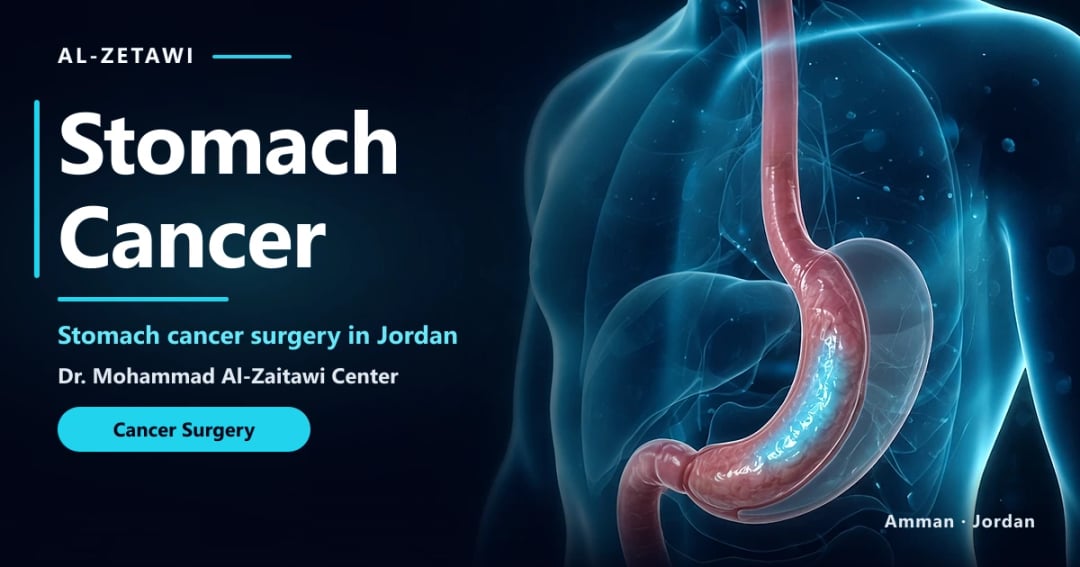
What Stomach Cancer Is
Stomach cancer is a malignant tumour starting in the stomach lining, most often an adenocarcinoma. It may cause little trouble early and is confirmed by endoscopy with biopsy. Care depends on stage. Removing part or all of the stomach is considered when disease looks removable, alongside oncology treatment rather than as an isolated step.
The stomach is a muscular reservoir between the oesophagus and the duodenum. Its lining is renewed constantly in an acid environment. Cancer begins when cells of that lining escape the controls on growth. Adenocarcinoma is the type this guide means unless it says otherwise. Less common tumours, such as lymphoma, neuroendocrine tumours, and gastrointestinal stromal tumours, can occupy the same organ and follow different rules. A scan that says "mass" has not chosen among them. Tissue does. Treating a lymphoma with a gastrectomy, or a stromal tumour like a typical adenocarcinoma, is how names cause harm. The first courtesy of a surgical opinion is to ask what the pathologist actually called it.
Where in the stomach it sits
Cancers of the distal stomach, toward the outlet, have long been linked with Helicobacter pylori and with diets high in salt-preserved foods. Cancers near the cardia, where the oesophagus enters, share some features with oesophageal adenocarcinoma and with reflux. A tumour straddling the junction may be planned with both upper-gastrointestinal traditions, because the operation and the node fields are not identical to a distal gastric cancer. Linitis plastica, a diffuse thickening that makes the stomach stiff and small, is a pattern more than a single lump. It is easy to under-read on a casual endoscopy and hard to cure if it has already crept widely. Location is not trivia for the booking clerk. It decides whether a partial gastrectomy is even anatomically honest.
Pathologists also separate a more gland-forming intestinal pattern from a diffuse pattern in which cells infiltrate singly, sometimes as signet-ring cells. Diffuse disease can spread under mucosa that still looks almost normal, which is why margins and hereditary questions matter. You may see these words on a report and feel they were written for someone else. They were written to stop your team choosing an operation that is too small. Ask for a translation into decisions: partial or total, endoscopic or surgical, curative or symptom-based. Dr. Mohammad Al-Zaitawi uses that translation in clinic in Amman, after the slides exist, not before.
What this operation is not
Gastrectomy for cancer is not a sleeve for weight loss, not a treatment for ordinary gastritis, and not a punishment for a positive Helicobacter test. A weight-loss sleeve removes the outer stomach for metabolic reasons and leaves a tube. A cancer operation removes the tumour with a margin and the lymph nodes that belong to that tumour. The scars, the eating pattern, and the purpose differ. People who already had a sleeve or a bypass can still develop stomach cancer in remaining tissue, though this is uncommon. Their anatomy needs the old operation note before anyone promises what can be removed. Bring it.
Outlook depends on stage more than on adjectives such as aggressive or mild used in a message thread. Early disease that is fully removed can be cured. Disease that has seeded the abdominal lining or reached distant organs is seldom cured by taking the stomach out. Between those poles, drug treatment and surgery share the work. This page keeps those poles visible so hope stays attached to a stage.
Why It Develops
No single habit explains most stomach cancers, and no clean life guarantees avoidance. The strongest worldwide clue is long-standing Helicobacter pylori infection. The bacterium inflames the lining for decades, encourages atrophy and intestinal metaplasia, and raises the chance of distal adenocarcinoma. Treating the infection lowers later risk in populations and is good medicine when it is found. It is not an emergency tablet you start instead of endoscopy when you are already vomiting blood or losing weight. The course, the test of cure, and the interactions belong to the clinician who prescribes. This guide will not print a dose. Other infections and a minority of cancers linked with Epstein-Barr virus show that the stomach's environment is not one story.
Food, tobacco, and previous surgery
The World Cancer Research Fund has judged that salt-preserved foods, and a pattern low in fruit and vegetables, are relevant to risk, while smoking is a convincing cause. Alcohol is a clearer cause of some other cancers than of typical gastric adenocarcinoma, but smoking cessation still belongs in every preoperative conversation because it also affects healing. Obesity and reflux are more tightly tied to cancers of the gastro-oesophageal junction than to distal gastric cancer. A previous partial gastrectomy, done years ago for ulcer disease, leaves a remnant that deserves attention if new symptoms appear. Pernicious anaemia, with loss of acid and intrinsic factor, is another long-term change in the lining. None of these is a reason to accuse a patient. They are reasons to choose endoscopy thresholds wisely and to explain why a bland diet after the fact cannot undo a tumour that is already there.
Family history needs a calm question, not a genetic panic. Most people with stomach cancer have no hereditary syndrome. A few families do. Hereditary diffuse gastric cancer, often linked with a CDH1 variant, can justify a genetics referral and, in confirmed carriers who are properly counselled, a discussion of removing the stomach before a visible cancer appears. That operation is prophylactic, life-altering, and never a casual suggestion from a webpage. Lynch syndrome and other inherited patterns also change surveillance of the colon and, sometimes, the stomach. Breast cancer in young relatives alongside diffuse gastric cancer is a combination worth mentioning out loud. If none of this is in your family, you have not failed a test. You have probably spared yourself an irrelevant gene panel.
What prevention can and cannot claim
Not smoking, treating Helicobacter when it is diagnosed, and a diet that is not built on heavily salted preserved foods are reasonable population advice. They are not a treatment for an established tumour, and they are not a reason to delay biopsy. Screening of symptom-free adults is practised in some high-incidence countries and is not a universal programme everywhere, including many Middle Eastern and European settings. A one-off "cancer blood test" advertised without a pathway is not staging. If you have alarm symptoms, the test that changes the week is endoscopy. Dr. Al-Zaitawi will still ask about infection, tobacco, and family, because those answers change counselling for you and sometimes for your relatives. They do not replace the scope.
Inflammation from anti-inflammatory pain tablets can ulcerate the stomach and confuse the picture. Stopping them suddenly is not always safe if they were masking another disease or if you need them for a specific cardiac reason. Tell the endoscopist what you take. A medicine list is part of cancer diagnosis even though the medicine is rarely the cause of a true adenocarcinoma.
Symptoms That Need Endoscopy
Early gastric cancer is often silent or disguised as ordinary indigestion. That is the cruel feature of the disease, and it is why persistent change matters more than a single greasy meal that disagreed with you. Symptoms that should not be managed with repeating antacids alone include trouble swallowing, vomiting that is new or blood-stained, black stool, unexplained iron-deficiency anaemia, unintentional weight loss, early fullness after a few bites, a persistent upper abdominal pain, or a lump felt by a clinician. Heartburn that is new in midlife, especially with difficulty swallowing, also belongs on an endoscopy list. These features are called alarm symptoms because they are allowed to interrupt the usual habit of watching dyspepsia. They are not a diagnosis. They are a key that opens the correct test.
What benign disease can mimic
Gastritis, ulcer disease, gallstones, pancreatic problems, and even heart disease can occupy the same pain. A normal examination does not retire the scope if the history is ringing alarms. Conversely, a young person with brief indigestion and no anaemia does not automatically have cancer, and local guidance on when to scope is allowed to be sensible. The error this page worries about is the months of acid medicine given to someone who is losing weight. If you have already had that delay, do not spend the consultation punishing yourself. Bring the timeline. Delay changes stage sometimes. It does not change the next correct step, which is still tissue and staging, not shame.
Bleeding may be obvious or hidden. Black, tarry stool and dizziness are emergency patterns. A slowly falling haemoglobin discovered on a routine test is quieter and just as important. Transfusion may be needed before any cancer plan. Finding an ulcer that is bleeding does not finish the job if biopsies were not taken or were inadequate. Cancer can sit in the edge of an ulcer. A repeat endoscopy is sometimes the correct "complication" of a first endoscopy that did not explain anaemia. Ask whether biopsies were done. It is a fair question.
Symptoms that suggest spread
A swollen abdomen from fluid, a node felt above the collarbone, jaundice from nodes at the liver hilum, or bone pain are late clues. They do not mean you should skip biopsy. They mean the staging must catch up quickly so that a large operation is not the first reflex. Difficulty swallowing from a junction tumour can dehydrate you before the word cancer is even confirmed. Nutrition and water sometimes need support in parallel with tests. That support is not a sign that surgery has been cancelled. It is a sign that you cannot be staged while you are collapsing.
Keep a simple record: when appetite changed, kilograms lost, medicines tried, and any family cancers. Photographs of reports beat recollection. In Amman, arriving with the endoscopy video or at least the biopsy paragraph saves a repeat test. If you have not had a scope at all, that is the referral. A CT scan without a biopsy is a map without a city name.
Confirming the Diagnosis
Endoscopy is the test that sees the lining and takes biopsies. A camera on a flexible tube is passed, usually with sedation, and the oesophagus, stomach, and duodenum are inspected. Suspicious areas are sampled. One tiny fragment can miss a cancer sitting a centimetre away, so several biopsies from an obvious tumour are standard practice, not fussiness. The pathologist looks at cell type, grade, and sometimes markers that later guide drugs, such as HER2 status in selected advanced cases. Those markers are not fashion. They are reasons to wait for the full report before locking a story you heard on the day of the scope.
What the report should contain
You should be able to point to three sentences: the site of the biopsies, the diagnosis in words, and whether anything else was seen, such as a second lesion or a narrow outlet. "Gastritis" on one line and "suspicious for malignancy, pending stains" on another means you do not yet have a final answer. Waiting for stains is infuriating and correct. Operating on a preliminary phrase is how benign ulcers are resected and how lymphomas are mistreated. If Helicobacter was tested, that result should be visible too. If it was not tested, ask. Infection does not explain away a mass, but it belongs in the chart.
Cross-sectional imaging comes next, typically a CT scan of the chest, abdomen, and pelvis. It looks for enlarged nodes, liver deposits, lung deposits, and fluid. It is poor at seeing a thin dusting of cancer on the peritoneal lining, which is why a clear CT is not the same as a clear abdomen. PET scans are useful in selected junction tumours and when a finding on CT needs another look. They are not a compulsory souvenir for every distal gastric cancer. Tumour markers in the blood are unreliable as a screening net and are not a substitute for biopsy. A normal marker does not mean a seen mass is harmless.
A second look is sometimes safer than a rush
Slides can be reviewed by another pathologist when the result is rare, unexpected, or the hinge of a permanent operation such as total gastrectomy. That review is not an insult to the first laboratory. It is proportionate caution. Similarly, an endoscopy that found "gastritis" in a person who is still losing weight may need to be repeated with more biopsies or with a different level of suspicion for diffuse cancer, which can hide. You are allowed to ask for that repeat. Dr. Mohammad Al-Zaitawi would rather delay a week for the right tissue than remove a stomach for the wrong disease.
Bring a companion to the visit where the word cancer is first used. People forget half of what is said. A written list of the next three tests is more useful than a metaphor. The next three are usually: complete the pathology, complete the imaging, and decide whether a staging laparoscopy is required before treatment starts. Everything else is detail inside those three.
Staging in Plain Language
Stage describes how deep the tumour has grown and how far it has travelled. Clinicians use the TNM language of the American Joint Committee on Cancer: T for the depth in the stomach wall, N for regional lymph nodes, M for distant spread. You do not need to memorise every number. You need the translation. Early disease sits in the inner layers. Locally advanced disease has gone deeper or into nodes and may still be curable with combined treatment. Metastatic disease has reached organs or surfaces that a gastrectomy will not clear. Treatment guidelines from ESMO, NCCN, and the Japanese Gastric Cancer Association all start from this map. They do not start from a calendar date.
Why a clear scan is not always the last look
Cancer on the peritoneal lining can be too fine for CT. Staging laparoscopy is a short operation under anaesthesia in which the surgeon looks inside, often samples fluid, and sometimes biopsies a nodule. It is not the cancer resection. It is a truth-telling step. Finding spread at that look can spare you a large incision and point treatment toward medicines that match metastatic disease. Finding nothing does not make the later operation trivial, but it makes the aim of cure more honest. Not every tiny early tumour needs this look. Many tumours that are being considered for preoperative drug treatment do. If it is recommended, it is not a delay tactic. If it is omitted, ask why your particular scans were thought sufficient.
Endoscopic ultrasound has a different job. From inside the stomach it estimates how deep a tumour goes and may sample a node. It helps decide whether a very early cancer is suitable for endoscopic removal or whether the wall invasion already demands surgery. It is operator-dependent. A reassuring ultrasound does not override biopsies that show a deep, poorly differentiated tumour. Tests are weighed together. The multidisciplinary meeting is the scale.
Stage can change after surgery
The clinical stage before the operation is an educated estimate. The pathological stage, after the specimen is examined, is sharper. More nodes may be involved than scans suggested. The tumour may have reached the cut edge. That is not a scandal if the operation was properly chosen. It is a reason the pathology visit matters as much as the discharge day. Further drug treatment may be advised because of what the microscope showed. People sometimes feel betrayed by that sequence, as if the surgery failed. Often it did exactly the job of showing the truth. Ask to have the final stage written in a letter you can keep. Future oncologists should not have to reconstruct it from memory.
Repeat staging is also how the team notices a response to drug treatment given before surgery. The tumour may shrink, symptoms may ease, and the operation may become safer. Shrinkage on a scan is encouraging. It is not a reason to skip the resection that was the point of the plan, unless a new finding of spread has changed the aim. Feelings of "it has gone, so I can cancel" need a conversation, not a silent no-show. Residual microscopic disease is the reason the operation was still on the calendar.
Endoscopic Removal or Surgery
A small group of very early cancers can be removed through the endoscope, lifting the lesion off the deep muscle of the wall. The criteria are strict: favourable depth, favourable cell type, no suggestion of node disease, and a specimen that can be examined completely at its edges. When those conditions are met, a person may keep their stomach. When the specimen shows a deeper or more aggressive tumour than expected, surgery is then recommended even after a "successful" endoscopic day. Endoscopic removal is not a casual polyp snare. It belongs in units that do it often and that can complete a proper pathological examination. If you are offered it, ask which criteria you meet and what the backup plan is if the laboratory disagrees with the optimism of the day.
Partial gastrectomy
If the tumour sits in the lower stomach and a healthy margin can be obtained, the lower portion may be removed and the upper stomach kept. Lymph nodes along the relevant vessels are removed with it. Reconstruction joins the remaining stomach either back toward the duodenum or to a limb of jejunum, depending on the tumour, the acid risk, and the surgeon's reasoned preference. You still have a small reservoir. Meals are reduced, but the change is usually less extreme than after total removal. A partial operation that leaves tumour at the margin is not a kindness. It is an incomplete cancer operation. This is why diffuse tumours and those too close to the top are often better served by taking the whole stomach. Dr. Al-Zaitawi's recommendation of partial versus total should be explainable with a diagram you can follow. If it cannot be drawn, the decision is not ready.
Total gastrectomy removes the entire stomach. The oesophagus is joined to a prepared limb of small bowel. There is no reservoir unless a pouch is fashioned in selected cases, and a pouch is not a miniature stomach with normal hunger signals. Lymph node removal is part of the cancer operation, not an optional extra, when the aim is cure. Japanese and European guidance has shaped how thoroughly those nodes are taken. The phrase you may hear is a D2 dissection. In plain language it means the surgeon removes not only the nodes immediately beside the stomach but also the next, defined tier along the main arteries, because that tier is where curable disease often hides. It is not a licence to remove organs casually. Spleen and pancreas are preserved unless the tumour forces a different choice. Ask that question directly. Knowing what will stay matters to diabetes risk and to infection risk later.
When the aim is not cure
If cancer has blocked the outlet, a bypass from stomach to jejunum, a stent placed by endoscopy, or a limited resection may restore eating even though deposits remain. If bleeding cannot be controlled, a resection is sometimes the most humane haemostat. These operations should be named as palliative so expectations do not pretend otherwise. A stent is not a failure of courage. A large operation in a person who will spend their remaining weeks recovering from it can be the failure. The multidisciplinary conversation is where that line is drawn, with you able to say what you want the remaining time to be for.
Open, laparoscopic, and robotic routes are access methods. The cancer result is judged by margins, nodes, leaks, and recovery, not by the advertisement for a device. Previous surgery, a large tumour, and a need for a difficult reconstruction are classic reasons an open incision is wiser. A small incision that compromises the node dissection is not advanced. It is small.
Drug Treatment Around Surgery
For many locally advanced gastric cancers, surgery alone is no longer the whole curative plan. Chemotherapy given before and after the operation, or after the pathology is known, improves outcomes in trials that underpin ESMO and NCCN guidance. The drugs, the number of cycles, and the adjustments for kidney function and hearing are oncology decisions. They are not printed here because a copied regimen is dangerous and because your fitness may exclude a combination that a younger stranger tolerated. What you should understand is the purpose. Preoperative treatment may shrink the tumour, treat microscopic spread early, and show how the cancer behaves. Postoperative treatment tries to mop up what the knife cannot see. If you are told you do not need chemotherapy, the reason should be stage or frailty, not forgetfulness.
Markers, radiotherapy, and immunotherapy
Some advanced tumours overexpress HER2 or carry other markers that allow targeted drugs or immunotherapy to be added. Those markers are tested on biopsy tissue. A negative result is still useful. It stops you chasing a treatment that does not fit the biology. Radiotherapy is used more selectively in gastric cancer than in some rectal or oesophageal plans. It may have a role at the junction, for a close margin, or for symptom control such as bleeding. It is not a default companion of every gastrectomy. If it is offered, ask what problem it is solving. If it is not offered, that is often guideline-concordant rather than a missing piece.
Side effects you can prepare for, without doses, include fatigue, nausea, a drop in blood counts, mouth soreness, diarrhoea, and numbness in the fingers from certain drug families. Fever during drug treatment can be an emergency because the white count may be low. That warning comes from the oncology unit with a number to call. Nutrition often dips during chemotherapy. A plan that says "eat well" without helping you do it when you are nauseated is incomplete. Feeding through a vein or a tube is sometimes a bridge to an operation, not a defeat. Arriving in theatre malnourished raises leak risk. Building you up can be the most surgical thing done in the fortnight before a scalpel is lifted.
How the teams stay aligned
The failure mode is a surgeon and an oncologist each assuming the other has timed the operation. You should know the intended order: scope and stage, laparoscopy if needed, drugs or not, then resection, then pathology, then further drugs or not. Write the order down. In Amman, Dr. Mohammad Al-Zaitawi's role is the surgical line in that sequence. He should not be the only name on the page if drug treatment is part of standard care for your stage. If you live far from the oncology unit, travel and blood tests between cycles need a named local doctor. Distance is a logistics problem. It is not a reason to skip half the curative plan because only the operation was available in one city.
Clinical trials exist in many countries for gastric cancer. Joining one is voluntary and does not mean you are being experimented on instead of treated. Not joining is also legitimate. Ask what the standard treatment would be if you decline. A good answer describes that standard clearly. A vague answer is a reason to pause.
Eating After Part or All of the Stomach Is Removed
The stomach's jobs are storage, acid, a grinding mix, intrinsic factor for vitamin B12, and a paced release into the intestine. Remove part of it and those jobs shrink. Remove all of it and they are reassigned to a join that was never designed as a reservoir. People feel full after a few spoonfuls, lose weight in the early months, and learn by trial which foods rush through. This is expected. It is not evidence that the join has failed. The learning curve is real, and a dietitian who knows gastrectomy is more useful than a generic cancer leaflet that only says "high calorie".
Dumping and the pace of a meal
Dumping means food, especially sugar, entering the small bowel too fast. Early dumping, soon after a meal, can bring flushing, a fast pulse, cramps, and a need to lie down. Late dumping, a couple of hours later, can feel like a hypo as insulin overshoots. The usual remedies are practical: smaller meals, fewer sugary drinks, protein and fat as anchors, and sometimes separating liquids from solids so the meal is not washed through. Medicine is occasionally added by a clinician if behaviour is not enough. No dose belongs on this page. Not every dizzy spell is dumping. Anaemia, dehydration, and a narrow join can look similar. If you are vomiting everything, that is a mechanical problem until proved otherwise, not a cue to try a smaller pudding.
After total gastrectomy, vitamin B12 replacement is not optional. The cells that made intrinsic factor are gone, and stores eventually run out. The route and schedule are prescribed from your bloods and your clinician's practice. Iron, folate, vitamin D, and calcium also deserve scheduled tests, because a person who eats less will not reliably replace them with food. Bone health and energy depend on this unglamorous follow-up. A multivitamin chosen at random is not the same as a plan. Bring the plan to every visit so it is not restarted from zero.
Weight, appetite, and ordinary tables
Some weight loss is the price of the anatomy. Relentless loss, month after month, is a prompt to look for recurrence, a stricture, depression, or simply an intake that cannot meet the new demand. Supplemental drinks have a role when food cannot keep up. So does treating pain and nausea properly so eating is not a punishment. Appetite may never feel like the old hunger. People grieve that. The grief is legitimate, and it is compatible with a good oncological result. Meals with family often work better as small plates you can leave without comment. Explain the anatomy once to the people who will otherwise urge you to finish. You should not have to re-litigate your stomach at every dinner.
Alcohol hits harder when there is less stomach to delay it. Smoking continues to injure healing and health. Dental care matters because acid and altered eating change the mouth. These are life details, not footnotes. A return to work is often possible, with fatigue as the limiting factor rather than a wound. Driving waits on concentration and on whether you still need sedating pain relief. The measure of success is an honest one: the cancer plan is on track, and you can eat enough to live the life you came to save.
Risks and the Signals That Matter
Gastrectomy is major surgery. Leaks at the join, bleeding, infection in the abdomen or chest, clots, and heart or lung complications are the early worries. Pancreatitis or a pancreatic fluid collection can follow a difficult node dissection near the pancreas. A leak may show as fever, a fast heart rate, new pain, or fluid from a drain that looks like bowel content. Sometimes the only early sign is a pulse that will not settle. These signs are time-sensitive. A covered dressing and optimism are the wrong response. The hospital that offers this operation should be able to image a leak, drain a collection, and support nutrition while a join rests. Ask that question before you are the person in the bed. It is the right question, and a serious unit is not offended by it.
The days in hospital
You will have a drip, a plan for pain that lets you breathe deeply, and encouragement to walk. Tubes and drains vary. A tube through the nose is not a punishment. It is sometimes used to protect a join and sometimes avoided in a modern pathway. Ask what each tube is for so the night is less frightening. Sips begin when the team believes the join can tolerate them. Forcing food to prove you are strong is how aspirations and vomiting start. Breathing exercises matter because upper abdominal incisions make you guard, and guarded breathing is how chest infections begin. Clot prevention includes movement and prescribed medicine matched to your bleeding risk. The dose stays on the chart.
Going home is allowed when pain is controlled by mouth, you are mobilising, and intake is on the agreed path. It is not allowed merely because a package said day five. Nausea that prevents all fluids, a climbing temperature, calf swelling, sudden breathlessness, black stool, or pain that is worse each hour are reasons to return. A wound that is a little pink can be reviewed routinely. A wound that is opening, or a gush of fluid, cannot. International patients should not fly through these symptoms. The aeroplane is a poor ward.
Later risks you should hear before you consent
Narrowing of the join can develop as a scar and may need dilatation. Internal hernia is a particular concern after some reconstructions and causes intermittent, severe pain that can become a bowel-threatening emergency. Bile reflux, bone thinning, and anaemia are slower. Recurrence of cancer is the risk that sits under all the others. It is watched for with a schedule of visits, not with daily self-palpation. No page can quote your personal risk honestly without your stage. Be wary of any counselling that offers a survival percentage before the pathology is back. Population numbers are a climate. You are a weather system inside it. Dr. Al-Zaitawi's consent conversation in Amman should include leak, clot, eating change, B12, and the possibility that the aim of the operation changes if spread is found on the day. Consent that mentions only the happy path is incomplete.
Death from elective gastric surgery is uncommon and not imaginary, especially when malnutrition, advanced age, or emergency bleeding is part of the picture. Writing that down is respect. It is also why frailty is assessed before a date is set, and why a stent or no operation can be the braver recommendation.
Families, Follow-up, and the Years After
Follow-up has two agendas that should not be blurred. One is cancer surveillance: symptoms, examination, and selected scans or endoscopies timed to your stage and to the guidelines your team is using. The other is survivorship: weight, B12, iron, bone health, dumping, and mood. A visit that only asks "any pain?" and skips the blood count is half a visit. A visit that only refills vitamins and never thinks about recurrence is the other half missing. You can ask for both to be named on the clinic letter. Keep copies. Recurrence is easier to interpret when the baseline is findable.
What recurrence can look like
A return of early fullness, a new node, a rise in pain, unexplained vomiting, or weight loss after a stable period deserves contact rather than a wait until the annual slot. Some recurrences are in the remaining stomach or at the join and can be seen with a camera. Some are in the lining of the abdomen or the liver and are seen on scans. Finding recurrence is devastating and still useful, because palliative medicines, radiotherapy for a local symptom, or a procedure for blockage can restore weeks or months of better function. A promise that nothing can ever be done is as inaccurate as a promise of cure. The action simply changes. Ask what the goal of the next treatment is: cure, length of life, or relief of a named symptom. Those words help families stop arguing about "giving up" when the goal was never the same thing.
Hereditary questions, if they were relevant, should be finished rather than left as a comment in a margin. A living relative who is a confirmed CDH1 carrier needs specialist genetics, not a photocopy of your operative note. Children and siblings in ordinary sporadic cases usually need no urgent test. They need a clear family history written down in case future symptoms appear. Fear that you caused the cancer by a meal you cooked is common and unsupported. Say the fear if it is running the household. It can be answered.
Living forward
Work, faith, travel, and intimacy resume on a slower clock than pride would like. Fatigue after combined drug treatment and surgery can last many months and is not laziness. Psychological support is part of cancer care, not an extra for people who are coping badly. A stomach cancer diagnosis rearranges a family's meals, which is to say it rearranges a family's culture. That is allowed to be mourned. It is also allowed to become ordinary. People do travel after total gastrectomy. They pack snacks, they decline large plates without apology, and they carry a short medical summary in case a stranger in an emergency department has never seen the reconstruction.
If you had a weight-loss operation in the past, follow-up must respect both anatomies. Vitamin plans for a bypass and vitamin plans for a later total gastrectomy are not identical. Tell every new clinician both stories. The chart should not make them guess which stomach you still have.
A Consultation in Amman
Bring the endoscopy report, the biopsy, the CT images if you have them, a medicine list, and any letter about chemotherapy already started. If a previous surgeon offered an operation, bring that opinion too. Disagreement between surgeons is sometimes about access route and sometimes about whether cure is possible. Those are different disagreements. Dr. Mohammad Al-Zaitawi, a consultant gastrointestinal and oncology surgeon, will start with the tissue and the stage. A clinical examination looks for nodes, a large liver, fluid, and your overall reserve. Nutrition is assessed with more than a glance. A person who has lost a tenth of their weight and cannot walk a corridor is not ready for a heroic date until that frailty is faced.
Decisions you should hear in plain speech
You should leave knowing whether the aim is cure or symptom control. You should know whether more staging, including laparoscopy, is required first. You should know whether oncology should see you before any resection. You should know the likely sacrifice: part of the stomach or all of it, and what that means for B12 and meals. You should know the main risks named for your body, not a generic list only. You should know who to call if you are already in the middle of drug treatment and a new pain appears. If any of those sentences is missing, ask for them before you accept a date. A date without an aim is how people wake up from an operation they did not understand.
Cost is individual. Staging tests, drug treatment, a keyhole staging look, and a gastrectomy are not one product. A webpage price would be false. Ask, once the plan exists, what is included and what another specialty will bill separately. International patients should plan a stay that matches the real recovery of a gastrectomy, which is not the same as the stay after a minor elective procedure. Flying is a medical decision. Companions matter because you will not carry luggage or cook a careful meal alone in the first period. Records should travel home with you in a language your next oncologist can read.
Urgency without panic
Cancer feels like an emergency, and some presentations are: bleeding that will not stop, complete obstruction, perforation. Most newly diagnosed stomach cancers are urgent without being a same-night resection. The days spent on a proper biopsy, a proper scan, and a proper peritoneal look save people from the wrong operation. Use those days. Do not fill them with cleanses, unnamed herbal products that change clotting, or a second and third scan that repeats the first without a question. Do tell the team about every product you are taking. Interactions are not theoretical when the liver is processing chemotherapy.
This guide is education from Dr. Mohammad Al-Zaitawi's clinic in Amman, Jordan. It cannot stage you, choose a drug, or promise a survival figure. It can steady the questions you ask. Stomach cancer is a disease where the order of steps is the treatment. Get the order right, with a team, and the operation takes its proper place: central when cure is real, restrained when it is not.
Medical note from Dr. Mohammad Al-Zaitawi
A mass on a scan is not a plan. I want the biopsy, a clear stage, and an oncology discussion before I talk about removing part or all of the stomach. Surgery is powerful when the disease is still removable. It is the wrong first boast when spread has already put cure out of reach.
Scientific references and guidance
These sources support the medical information on this page. If you want this guidance applied to your own case, send us your details for an initial review.
Reviewed by Dr. Mohammad Al-Zaitawi
Prefer a quicker route? Try the free case review or see bariatric surgery costs in Jordan.