
How Much Weight Do You Lose After a Gastric Sleeve?
A Harvard Health summary puts average weight loss after a gastric sleeve at about 25 percent of total body weight. For comparison, the same summary places gastric bypass at about 33 percent and GLP-1 medicines such as semaglutide or tirzepatide often at about 15 to 20 percent while they are being taken.
Those are averages across many people, not a forecast for one person. If you weigh 300 pounds, a quarter of your body weight is a useful way to picture the scale of change a sleeve tends to produce, but it is not a number anyone can promise you before surgery. Some people lose more, some lose less, and the path to the lowest weight is rarely a straight line. What a responsible surgeon can do is explain the range, explain what tends to move a person toward the better end of it, and explain why a little regain later is part of the normal story rather than proof that the operation did not work.
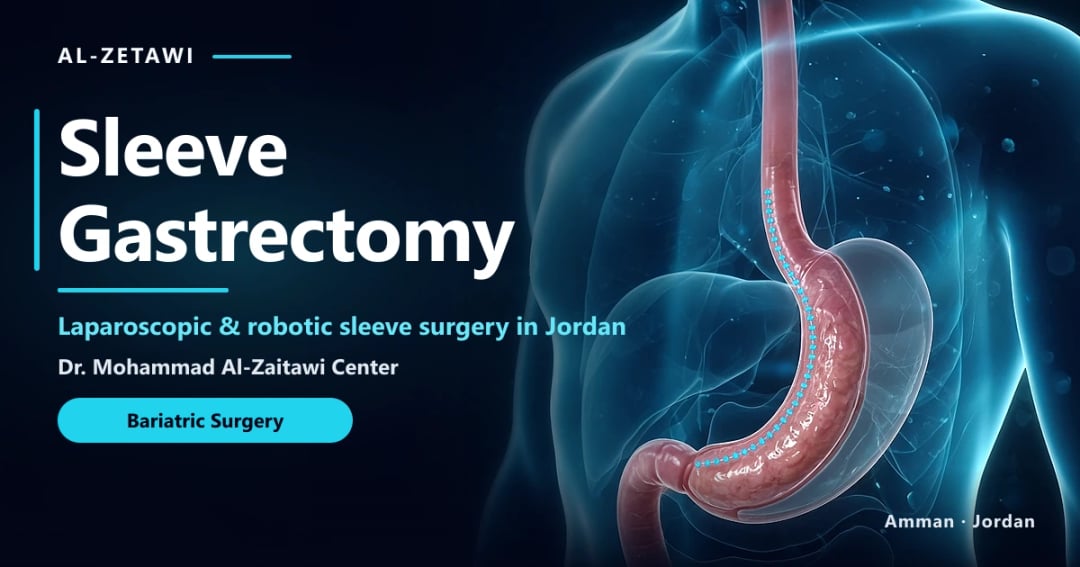
A sleeve gastrectomy removes about 80 percent of the stomach and leaves a narrow tube. The intestine is not rerouted. Food still travels the usual path, only through a much smaller stomach that fills quickly and sends different hunger signals than before. That design is the reason the weight loss is large but generally a little smaller than after a bypass, where a small egg-sized pouch is created and the intestine is joined in two places.
This guide is written for adults in the United States who are weighing surgery in Amman, Jordan with Dr. Mohammad Al-Zaitawi. It explains how weight loss is measured, what the large studies actually found, how the months after surgery usually unfold, and how to get an estimate built from your own records rather than from an advertisement.
What Is the Difference Between Total Body Weight Loss and Excess BMI Loss?
Bariatric results are reported in two common ways, and mixing them up is the most frequent reason people think one study contradicts another. Percent of total body weight lost is the plain version: the pounds you lost divided by the pounds you weighed before surgery. Excess BMI loss is a surgical research measure: it looks only at the part of your body mass index above 25, which is treated as the upper edge of the normal range, and asks how much of that excess is gone.
Because excess BMI loss uses a smaller denominator, its percentages always look larger than total-weight percentages for the same person. A result described as more than half of excess BMI lost and a result described as roughly a quarter of body weight lost can describe the same human being on the same scale. Neither is exaggerated. They answer different questions.
A worked arithmetic example
Imagine, purely for arithmetic, a person whose BMI is 45 before surgery. The excess BMI is everything above 25, which is 20 points. If that person later reaches a BMI of 33, they have lost 12 BMI points. Twelve out of the 20 excess points is 60 percent excess BMI loss. Twelve out of the original 45 points is about 27 percent of starting BMI, which tracks closely with percent of total body weight. Same person, same result, two very different-looking percentages.
| Measure | What it divides by | Where you see it |
|---|---|---|
| Percent total body weight loss | Your entire starting weight | Patient summaries such as Harvard Health, medication trials |
| Percent excess BMI loss | Only the BMI points above 25 | Many surgical studies, including SM-BOSS |
When you read a clinic website, a forum post, or a journal abstract, find out which measure it uses before you compare it with anything else. A medicine trial reported in total body weight and a surgical study reported in excess BMI cannot be lined up side by side without converting one of them.
What Do Five-Year Studies Show About Sleeve Weight Loss?
Short-term results after any weight-loss treatment can be flattering, so the more useful evidence follows people for years. Two randomized trials from Europe, both published in JAMA in 2018, compared the sleeve with gastric bypass over five years. Randomized means patients were assigned to one operation or the other rather than choosing, which reduces the chance that healthier or more motivated people clustered in one group.
The Swiss SM-BOSS trial (PMID 29340679) reported excess BMI loss at five years of 61.1 percent after sleeve and 68.3 percent after bypass. The difference between those two figures was not statistically significant, which means the trial could not show that one operation reliably produced more weight loss than the other in that population. Reflux, the burning and regurgitation many people know as heartburn, did better after bypass.
The Finnish SLEEVEPASS trial (PMID 29340676) also randomized patients to sleeve or bypass and followed them for five years. It found large weight loss after both operations. This page does not quote its exact figures, because summarizing them loosely would risk misstating them. If you want them, the abstract is public and your surgeon can walk through it with you.
What these trials do and do not tell you
Together these studies say that a sleeve is a durable operation, not a one-year effect, and that the choice between sleeve and bypass often turns on more than weight alone. They do not tell you exactly what you will weigh. Trial participants were selected, monitored, and followed in a structured way. Your result depends on your starting point, your health conditions, and the habits you are able to keep. Use the trials as evidence that the operation works over time, and use your own file review for the personal estimate.
Do You Lose More Weight With a Gastric Bypass Than a Sleeve?
On average, a little more. Harvard's summary of about 25 percent for sleeve and about 33 percent for bypass reflects a real tendency, and the SM-BOSS numbers point the same direction, even though that trial's difference did not reach statistical significance. For many people, the honest answer is that both operations produce large weight loss and the decision is driven by other factors.
The anatomy explains the difference. A sleeve narrows the stomach and changes appetite hormones, but food still passes through the full length of intestine. A gastric bypass creates a small egg-sized pouch and makes two intestinal joins, so food skips part of the stomach and the first section of small intestine. That rerouting adds metabolic effects and changes how some nutrients are absorbed.
| Point of comparison | Gastric sleeve | Gastric bypass |
|---|---|---|
| What is changed | About 80 percent of stomach removed, intestine untouched | Egg-sized pouch plus two intestinal joins |
| Harvard average total weight loss | About 25 percent | About 33 percent |
| SM-BOSS 5-year excess BMI loss | 61.1 percent | 68.3 percent (difference not significant) |
| Reflux in SM-BOSS | Less improvement | Better |
Reflux is often the deciding issue. If you already take heartburn medicine every day, have a hiatal hernia, or have been told about changes in the lining of your esophagus, a bypass may be the better operation even if you came in asking about a sleeve. Type 2 diabetes, the medicines you take, and how you feel about lifelong vitamin monitoring are other parts of the conversation. The sleeve versus bypass comparison goes through those trade-offs in more depth.
Choosing bypass only to chase a few extra percentage points rarely makes sense. Choosing the operation that fits your stomach, your esophagus, and your health history does.
Is a Gastric Sleeve More Effective Than Ozempic or Wegovy?
In the summary figures used throughout this guide, yes, on average. GLP-1 medicines often produce about 15 to 20 percent body-weight loss while they are taken, compared with about 25 percent after a sleeve. The more important difference is in the phrase while they are taken. A medicine works as long as you keep using it. A sleeve is a permanent change to the stomach.
That difference is not a verdict against medicines. Many Americans start with an injection because it requires no operation, no anesthesia, and no travel. For some people, the medicine alone reaches a weight that resolves their health problems, and surgery is never needed. For others, the injection works but the cost, insurance changes, supply gaps, or side effects make long-term use uncertain. Still others lose a meaningful amount but stop well short of what their doctor hoped for.
Using both
Medicine and surgery are not always either-or. Some people use a GLP-1 medicine before surgery and some use one after a sleeve if weight returns later. Those decisions belong to your prescriber and your surgical team together, with clear agreement on dosing and timing around anesthesia. Do not stop or restart a diabetes medicine on your own because a surgery date is approaching.
If you are currently on an injection, tell the surgical team the drug, the dose, the date you started, your weight when you started, and your weight today. Those two weights tell a reviewer how much the medicine has already accomplished. Hiding the earlier number makes surgery look easier to forecast than it is. Hiding today's number makes safe anesthesia planning harder. Both facts help the estimate become personal rather than generic.
How Fast Do You Lose Weight After a Gastric Sleeve?
The fastest loss usually happens early, when portions are tiny and the diet moves through liquid and puree stages. It then slows gradually over the following months. This page will not publish a month-by-month pound chart, because those charts are often invented averages that create false alarm in people who are perfectly on track.
The first weeks
In the first weeks, you are healing and eating very little. The scale often drops noticeably, partly from fat loss and partly from changes in fluid and in the food sitting in your gut. Energy can be low. The priority is protein, fluids, and walking, not the number on the scale.
The first several months
As you move from purees to soft foods and then to regular textures, the rate of loss tends to settle. Many people notice their clothing size changing faster than their weight seems to justify, because body shape responds as muscle is protected and fat is lost. Short stalls of a week or two are common in this period and are not evidence of failure.
Toward the end of the first year and beyond
Loss continues more slowly. Many people approach their lowest weight somewhere around 12 to 18 months after surgery. After that, weight usually stabilizes, sometimes with a modest rise.
Comparing yourself with someone else's timeline on social media is rarely helpful. A person who started at a higher weight usually loses more pounds early simply because there is more to lose. A person with diabetes on insulin may see a different pattern as medicines are reduced. A person recovering from a slower start may catch up later. What matters is the overall direction across months and the habits that support it, not whether a particular week matched a stranger's video.
When Do You Reach Your Lowest Weight After a Sleeve?
For many people, the lowest weight after a sleeve arrives around 12 to 18 months after surgery. That window is a pattern, not a deadline. Some people level off a little sooner and some keep drifting down a little longer. The point of knowing the window is planning: the first year and a half is when the operation does the most work on its own, and it is the best time to build habits that will carry you after the strongest effect fades.
Why does loss slow? Your body adapts. As weight falls, you need less energy to move and to maintain a smaller body. The stomach tube also relaxes slightly over time, so comfortable portion sizes grow from the very small amounts of the first months. Appetite hormones, which change sharply after surgery, partly settle. None of that means the sleeve has stopped working. It means the dramatic early phase has turned into a maintenance phase.
Using the window well
- Learn to build each meal around protein first, while small portions make that easy
- Establish a walking or exercise routine that fits your actual week, not an ideal one
- Get labs on schedule so vitamin problems are caught early rather than at year three
- Keep a simple weight record, weekly or monthly, so trends are visible without daily anxiety
- Notice which foods slide down easily and tend to bring back old patterns, such as crackers, chips, and sweet drinks
The lowest weight is not the target to defend at all costs for the rest of your life. A healthier way to think about it is as the bottom of a range. Your realistic long-term weight will likely sit somewhere above that low point, and that is expected. Planning for that range, rather than for a single number, protects you from feeling defeated by normal changes.
Is It Normal to Regain Some Weight After a Gastric Sleeve?
Some regain after the first one to two years is common, and it is not automatically a failure. After reaching the lowest point, many people see their weight rise by a modest amount and then settle. That is part of how bodies respond to large weight loss, and it happens after bypass as well as sleeve.
The real question is the size and speed of the change. A small rise that levels off and leaves you far below your starting weight with your health conditions still improved is a good long-term result. A steady climb month after month, especially with returning blood sugar, blood pressure, or joint problems, deserves attention sooner rather than later.
Common contributors
Regain usually has several causes at once. Grazing on soft, calorie-dense snacks that pass easily through the sleeve is a frequent one. Liquid calories, including sweetened coffee drinks and alcohol, are another. Life events such as a new job, caregiving, an injury that stops exercise, or a new medicine that increases appetite can all shift weight. Sometimes reflux leads people to eat in a pattern that soothes symptoms but adds calories.
What to do if weight is climbing
Start with a factual record: your weight trend, what you eat on an ordinary day, your activity, your medicines, and any symptoms such as heartburn. Then contact a bariatric team or your primary care doctor. Options range from a structured return to nutrition basics, to working with a dietitian, to medicines, to, in selected cases, a revision operation. A revision is a separate decision with its own evaluation and, often, a longer hospital stay than the first sleeve. The guide on weight regain after a gastric sleeve covers those paths in more detail.
What Affects How Much Weight You Lose After a Sleeve?
Several factors push a result toward one end of the range or the other. None of them can be turned into a precise prediction, and this page will not attach invented percentages to them. They are useful because they tell you which parts of the outcome are in your hands and which are not.
Starting point
People who begin at a higher BMI often lose more total pounds, though not always a larger percentage. A person starting at a lower BMI may reach a near-normal weight with fewer pounds lost. That is one reason two people who both lost a quarter of their body weight can look very different afterward.
Health conditions and medicines
Type 2 diabetes, especially when treated with insulin, can shape the pace of loss. Certain antidepressants, steroids, and other medicines influence appetite and weight. Thyroid problems, sleep apnea, and joint disease that limits walking all matter. Bring a full medicine list to the evaluation so the team can tell you which ones may affect your result.
Habits you can build
Protein at every meal, fluids sipped through the day, regular movement, and avoiding grazing all help. Attending follow-up, whether with the surgical team remotely or with a local doctor, is linked in everyday practice to people catching problems early. Sleep and stress affect appetite, too, even if they rarely appear in surgical brochures.
The operation itself
A sleeve performed for the right reasons, in a patient for whom it is the right operation, sets up the best chance of a good result. When reflux or other findings point toward a bypass, choosing the sleeve anyway can trade a cheaper or simpler procedure for a less comfortable life afterward. Getting the operation choice right is part of getting the weight loss right.
What Should You Eat After a Sleeve to Keep Losing Weight?
The eating plan after a sleeve moves through stages over several weeks: clear and full liquids first, then purees, then soft foods, and finally regular textures. Each stage gives the staple line time to heal and teaches you how much your new stomach can hold. Your written plan from the surgical team is the version to follow if it differs from general descriptions online.
Protein is the backbone of every stage. Many programs aim for at least 60 grams of protein a day unless your written plan sets a different number. Protein protects muscle while you are losing weight quickly, supports healing, and keeps you satisfied longer than the same amount of starch. In the liquid stages, that often means protein shakes. Later it means eggs, fish, poultry, Greek yogurt, cottage cheese, beans, and lean meat, eaten first at each meal.
Separating fluids from meals
Many programs ask you to stop drinking before a meal and wait to drink again afterward, often with about 30 minutes on each side. Drinking with food can push it through the sleeve faster, reducing fullness, and can make you uncomfortable. Sipping steadily between meals is how most people reach their fluid goal without feeling sick.
- Eat slowly and stop at the first sense of fullness, not when the plate is empty
- Choose foods that need chewing over foods that slide down, such as chips and crackers
- Avoid sugary drinks and be cautious with alcohol, which can affect you more strongly after surgery
- Keep vitamins and minerals on the schedule your team gives you
The guide to eating after a gastric sleeve describes each stage in detail, and the page on vitamins after weight-loss surgery explains why supplements remain part of life afterward.
Does Type 2 Diabetes Improve After a Gastric Sleeve?
For many people with type 2 diabetes, blood sugar improves substantially after bariatric surgery, and the improvement can begin before major weight loss has occurred. The strongest long-term evidence comes from the STAMPEDE trial, published in the New England Journal of Medicine (PMID 28199805), which randomized adults with type 2 diabetes and obesity to intensive medical therapy alone or to surgery plus medical therapy.
At five years, the share of patients with an HbA1c of 6 percent or less was 5 percent in the intensive medical therapy group, 29 percent in the gastric bypass group, and 23 percent in the sleeve group. HbA1c is the blood test that reflects average blood sugar over roughly the prior few months. Reaching 6 percent or lower is a demanding target, and the trial shows that surgery made it reachable for a meaningful minority, far more often than medicines alone.
Reading those numbers fairly
The STAMPEDE figures also show that most patients in every group did not reach that specific target. Surgery improved control broadly, but it did not erase diabetes for everyone. People who have had diabetes for many years or who already use insulin may still need medicines after surgery, though often fewer or at lower doses.
Diabetes changes the safety plan, too. Blood sugar can drop quickly once you are eating very little, so insulin and some oral medicines usually need adjustment immediately after surgery. That adjustment has to be agreed between the surgical team and whoever manages your diabetes in the United States. Bring your latest HbA1c, your full medicine list, and the year you were diagnosed to the evaluation. Those facts influence whether a sleeve or a bypass is recommended and how closely you will be monitored in the first weeks.
What BMI Do You Need to Qualify for a Gastric Sleeve?
The 2022 guidelines from the American Society for Metabolic and Bariatric Surgery and the International Federation for the Surgery of Obesity (PMID 36336720) recommend metabolic and bariatric surgery for adults with a BMI above 35, whether or not they have obesity-related disease. They say surgery should be considered for adults with a BMI of 30 to 34.9 who have metabolic disease, such as type 2 diabetes.
Those guidelines describe medical appropriateness. They are not an insurance rule. Many US insurers and Medicare still use older thresholds and extra documentation requirements, which is why someone can meet the 2022 guideline and still be denied coverage at home. When you are paying privately, the guideline frame is what the surgical team uses to decide whether surgery makes sense for you at all.
Why BMI is only the first question
BMI is a screening number. It does not show where weight is carried, how much of it is muscle, or how badly diabetes, blood pressure, sleep apnea, or joint pain are affecting your life. The surgeon will also look at your reflux history, prior abdominal operations, smoking, medicines, and mental health. A person at BMI 36 with severe reflux may need a different operation from a person at BMI 36 with none.
You can check your number with the BMI calculator using today's weight, measured on a scale rather than remembered. If you have lost weight on a GLP-1 medicine, note your BMI before the medicine as well. The weight-loss surgery overview explains how BMI, health conditions, and history combine in deciding whether surgery is reasonable and which operation fits.
What Should You Do When Weight Loss Stalls After a Sleeve?
A stall, sometimes called a plateau, is a stretch of days or weeks when the scale stops moving even though you are following the plan. Stalls are common after a sleeve, especially in the first several months, and most of them resolve on their own. They feel discouraging because the early weeks often brought steady drops, but they are part of the normal pattern rather than a sign that something has gone wrong.
Short stalls often reflect shifts in body water, especially as you increase activity or change food textures. Muscle can also be holding steady while fat continues to fall, which is why measurements around the waist or the fit of clothing sometimes keep improving while the scale is flat.
A practical checklist
- Confirm you are reaching your protein goal rather than estimating it
- Check that fluids are not crowding out food, or food crowding out fluids
- Look for small calorie sources that have crept in, such as creamers, juices, nuts eaten by the handful, or snacking while cooking
- Review whether activity has dropped because of weather, work, or an injury
- Make sure a new medicine has not been started without anyone mentioning weight
If a stall lasts much longer than a few weeks, or if weight begins to rise steadily, contact the surgical team or your primary care doctor with a short record of what you have been eating and doing. Do not respond to a stall by cutting protein or skipping meals. Undereating can slow you down, cost you muscle, and leave you lightheaded. Steady habits usually restart progress more reliably than drastic changes.
How Do You Track Your Results at Home After Surgery Abroad?
Once you fly back to the United States, the weight loss continues for months, and so does the need for follow-up. Tracking well means three things: knowing your numbers, getting labs on schedule, and having a local doctor who knows what operation you had.
Start by asking your primary care doctor, before you travel, whether they are willing to order post-bariatric labs and see you for routine visits. Many will, especially if you bring a written summary of the operation and the follow-up schedule the surgical team recommends. If your doctor is uncomfortable, a local bariatric program or a registered dietitian experienced with bariatric patients may be able to help.
What to keep a record of
- Your weight, measured on the same scale at the same time of day, weekly or monthly
- Waist measurement and how clothes fit, which often change when the scale does not
- Daily protein and fluid intake for at least a few days each month
- Lab results, especially those your team asks for, such as vitamin and iron levels
- Symptoms such as heartburn, difficulty swallowing, hair thinning, or fatigue
- Changes to diabetes or blood pressure medicines made by your US doctor
Share that record with the surgical team at the intervals they set. Remote follow-up works well when the information is organized; it works poorly when months pass without contact and the first message arrives during a problem. Keep the operative summary and hospital discharge papers in one folder, on paper and on your phone. If you ever need care at a US hospital, those pages tell the staff exactly what was done and save precious time.
How Can You Get a Realistic Weight Loss Estimate for Your Case?
An honest estimate starts with your records, not with a headline. Send your current height and measured weight, your highest adult weight, any weight lost on medicines, your medical conditions, your full medicine list, prior abdominal surgeries, and any endoscopy report you have. Describe reflux in plain words: how often, what you take for it, and whether it wakes you at night. Dr. Mohammad Al-Zaitawi reviews that file and tells you whether a sleeve is reasonable, whether a bypass may fit better, and what range of result is realistic for someone with your history.
The clinic is in Amman, Shmeisani, Hanin Bin Ishaq Street, Al-Husseini Medical Complex 1, opposite Specialty Hospital. The clinic is where consultations and reviews take place; it is not the operating room. Surgery, when appropriate, is performed in a private hospital in Amman that is named before you book. You can reach the team on WhatsApp at +962 7 9570 2800, and the clinic map shows the office location.
On cost, US self-pay sleeve quotes in 2026 are often about $10,000 to $20,000. That is a US figure, not this center's fee. This center's published reference average for a sleeve is about USD 2,500. The binding price is the written quote issued after your file is reviewed, and the operation recommended, the hospital, and the length of stay can change it. The cost and packages page explains what the reference covers, and the international patients page explains travel planning, including the roughly one-week stay many patients from abroad plan in Amman.
When you are ready, request a consultation. Ask for the estimate in total body weight terms so you can compare it directly with the Harvard averages and with your medicine results.
Questions patients ask
These answers are general. Your file, your medicines, and your endoscopy can change them.
How many pounds is 25 percent?
When does weight loss slow?
Why do some people lose less?
Can the weight come back?
Medical note from Dr. Mohammad Al-Zaitawi
I will not give you a pound promise from a message. I can tell you the published averages and what usually pulls a result below them.
Scientific references and guidance
These sources support the medical information on this page. If you want this guidance applied to your own case, send us your details for an initial review.
Reviewed by Dr. Mohammad Al-Zaitawi
Prefer a quicker route? Try the free case review or see bariatric surgery costs in Jordan.